477 posters, 14 topics, 2,065 authors, 1,055 institutions
ePostersLive by SciGen Technologies S.A. All rights reserved.
The Joint EBJIS-MSIS 2026 Conference
17 - 19 September, 2026 | Porto, Portugal

EP363
Inherited susceptibility to periprosthetic joint infections: a nationwide case-control studybof first-degree relatives
Poster Presenter
Authors
Anders Joelson, Emma Thuresson, Freyr Gauti Sigmundsson, Peter Wildeman
Affiliations
Orthopaedics, Department of Surgical Sciences, Uppsala University, Uppsala, Sweden, Department of Orthopaedics, Skane University Hospital, Lund, Sweden, Department of Orthopaedics, Orebro University Hospital, ?rebro, Sweden; School of Medical Sciences, Faculty of Medicine and Health, Orebro University, ?rebro, Sweden, ?rebro University
Part of Topic
Prosthetic Joint Infections
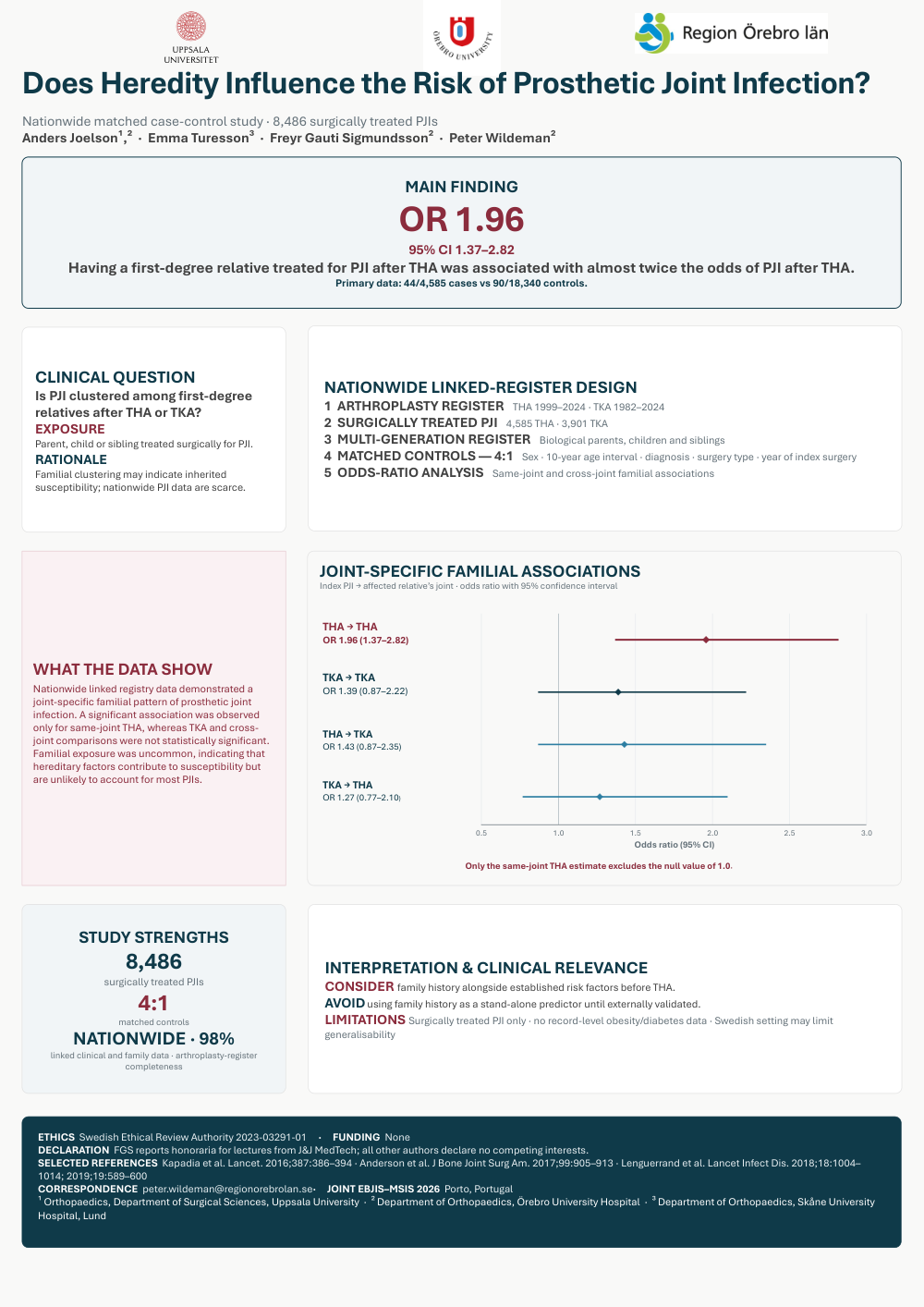
Does Heredity Influence the Risk of Prosthetic Joint Infection?
Evidence before this study
We conducted a search in PubMed and Web of Science for articles published from database inception to March 30, 2025, using combinations of the search terms periprosthetic joint infection, prosthetic joint infection, genetic, hereditary, and familial. We found that (1) there is solid scientific evidence that hereditary variations contributes to susceptibility to infectious disease in general; (2) candidate genes associated with susceptibility to PJI have been identified but additional studies are needed to verify the clinical importance of these specific genes in relation to genetic predisposition to PJIs; (3) one study reported data on familial clustering of surgical site infections and one study reported regional data on familial clustering of PJIs; (4) nationwide population data on familial risk factors for PJI were non-existent.
Added value by this study
To our knowledge, this is the first case-control study to use nationwide population data to investigate familial risk factors for PJI following THA or TKA. We found that the risk of having a PJI after THA was elevated in patients having a first-degree relative treated for a PJI compared with patients not having a first-degree relative treated for a PJI. In contrast, the corresponding risk of having a PJI after TKA was not elevated. Our findings suggest that there might be a hereditary susceptibility for PJI in specific joints and not for PJI in general.
Implications of all the available evidence
The available evidence suggests that hereditary variations may contribute to susceptibility to PJI after THA. It is important to take the family history of postoperative PJI in consideration when evaluating risk factors before scheduling patients for THA. Information about familial risk factors for PJIs is also important when counselling patients in the shared decision-making process prior to THA. Close PJI monitoring might be of value for patients undergoing THA if they have relatives treated for PJI after THA.