477 posters, 14 topics, 2,065 authors, 1,055 institutions
ePostersLive by SciGen Technologies S.A. All rights reserved.
The Joint EBJIS-MSIS 2026 Conference
17 - 19 September, 2026 | Porto, Portugal

EP361
AUDIT AND FEEDBACK STRATEGIES AND CHANGES IN DEFINITION OF SURVEILLANCE IN POST-ARTHROPLASTY SURGICAL SITE INFECTIONS: 15-YEAR INTERRUPTED TIME SERIES ANALYSIS
Poster Presenter
Authors
Leonardo Antunes Vilaça De Souza, Juliana Arruda de Matos, Júlia Herkenhoff Carijó, Rosilene Claudio Vellasco Lobão, Claudio Coletti Junior, Carolina Arana Stanis Schmaltz, Marilena Aguiar Lopes, Amanda da Silva Gomes, Lislane Santana Alves Pinheiro, Diva Maria Nunes Rodrigues dos Santos
Affiliations
Instituto Nacional de Traumatologia e Ortopedia, Rio de Janeiro, Brazil, Instituto Nacional de Traumatologia e Ortopedia, Rio de Janeiro, Brazil; Fiocruz, National Institute of Infectology Evandro Chagas, Rio de Janeiro, Brazil, Instituto nacional de traumatologia e ortopedia
Part of Topic
Prosthetic Joint Infections
Introduction/Objectives
Surveillance of surgical site infections (SSIs) is essential; analysis of SSI time series can provide insights into the effects of ecological intervention measures and changes in SSI definitions. In 2017, the Centers for Disease Control and Prevention (CDC) reduced post-implant SSI surveillance from 1 year to 3 months. This study evaluated long-term SSI trends after arthroplasty and the impact of individual feedback.
Methods
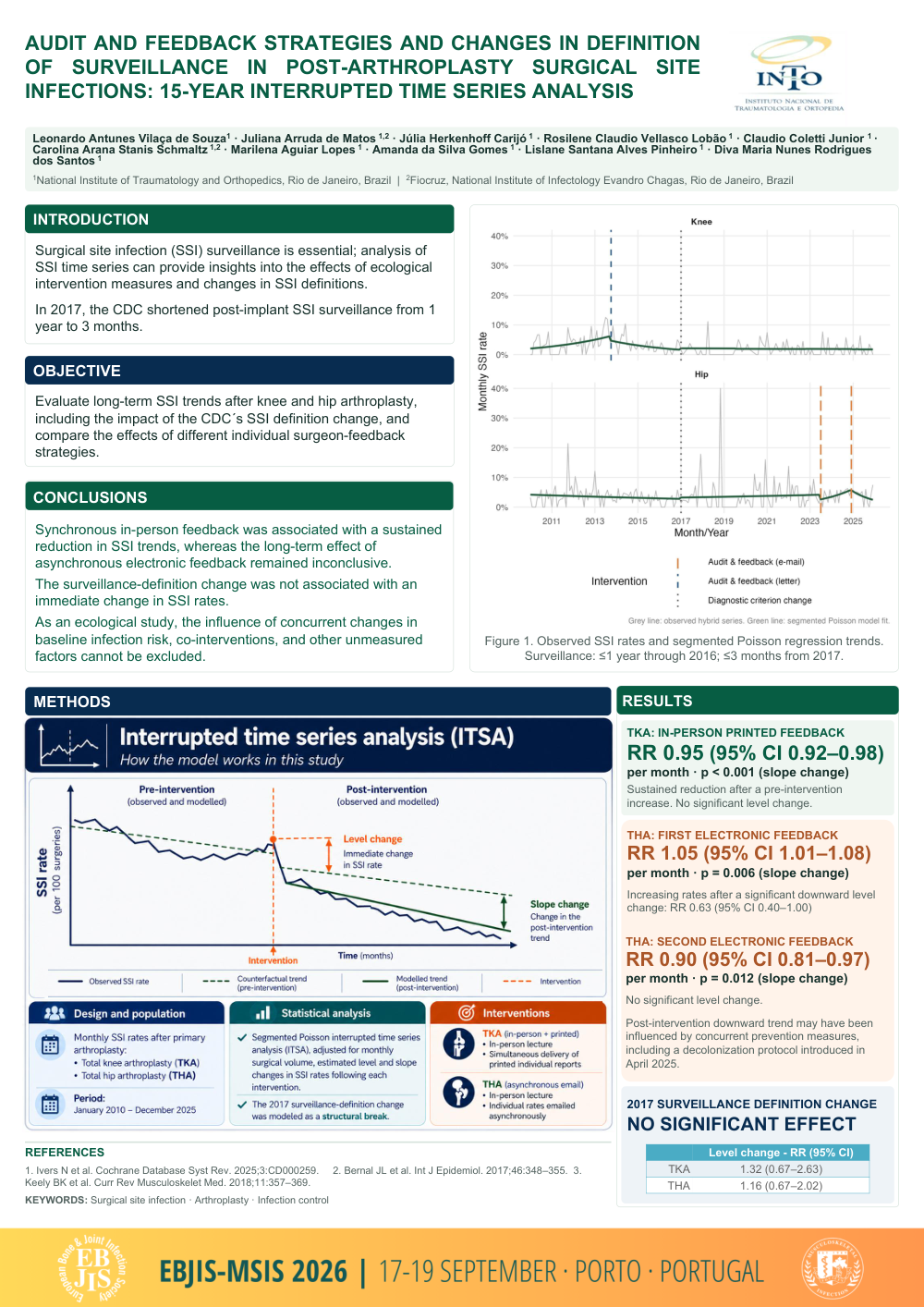
Monthly SSI rates (Jan/2010–Dec/2025) following primary total hip arthroplasty (THA) and total knee arthroplasty (TKA) were analyzed. Definitions followed CDC criteria during each period (1-year surveillance through 2016; 3-month surveillance from 2017 onward), forming a hybrid time series. Interrupted time series analysis (ITSA) using segmented Poisson regression, was used to estimate immediate changes in SSI rates (level changes) and changes in temporal trends (slope changes) following each intervention. Interventions: (1) in-person feedback for knee surgeons (lecture and simultaneous printed individual reports); (2) electronic feedback for hip surgeons (lecture and emailed individual rates at different times). The definition change in 2017 was treated as a structural break point.
Results
The SSI definition change did not produce level changes on rates (TKA: RR 1.32; 95% CI 0.67–2.63; THA: RR 1.16; 95% CI 0.67–2.02). In-person feedback led to sustained SSI reduction after TKA (RR 0.95/month; 95% CI 0.92–0.98; p<0.001 – slope chage), but no level change. The first electronic feedback reduced SSIs after THA initially (RR 0.63; 95% CI 0.40–1.00; p=0.049 – level change), but effects attenuated over time (RR 1.05; 95% CI 1.01–1.08; p=0.006 – slope change). The second eletronic feedback did not produce immediate effect, but was associated with downward trend (RR 0.90; 95% CI 0.81–0.97 – slope change), which may have been influenced by concurrent prevention measures, including a decolonization protocol introduced in April 2025.
Conclusions
Synchronous in-person feedback was associated with a sustained reduction in SSI trends, whereas the long-term effect of asynchronous electronic feedback remained inconclusive. The surveillance-definition change was not associated with an immediate change in SSI rates.
As an ecological analysis, the study does not account for concurrent baseline risk changes or unmeasured factors. Feedback format and its social context may influence SSI prevention effectiveness.
Keywords:
Surgical site infection
Arthroplasty
Infection control
References
1) Ivers N et al. Cochrane Database Syst Rev. 2025 Mar 25;3(3):CD000259.
2) Bernal JL et al.Int J Epidemiol. 2017;46(1):348–355.
3) Keely BK et al. Curr Rev Musculoskelet Med. 2018;11(3):357–369.