477 posters, 14 topics, 2,065 authors, 1,055 institutions
ePostersLive by SciGen Technologies S.A. All rights reserved.
The Joint EBJIS-MSIS 2026 Conference
17 - 19 September, 2026 | Porto, Portugal

EP353
Epidemiology and microbiological profile of orthopedic implant-related infections: a 3-year retrospective study
Poster Presenter
Authors
Mohamed ben jemaa, Jawhar Ben Dhief, Achref lajmi, khaled keskes, Mohamed ali Rekik, hedi Chaabouni, Moez Trigui, zoubaier Ellouz, hassib Keskes
Affiliations
The Orthopedics and Traumatology Department, Habib Bourguiba University Hospital, Sfax, The Orthopedics and Traumatology Department, Habib Bourguiba University Hospital, Tunisia
Part of Topic
Prosthetic Joint Infections
BACKGROUND: Orthopedic implant-related infections represent one of the most serious complications in musculoskeletal surgery, associated with significant morbidity, functional impairment, and economic burden. With the increasing number of arthroplasties and osteosynthesis procedures worldwide, the incidence of these infections continues to rise. Moreover, the emergence of multidrug-resistant organisms further complicates their management and negatively impacts prognosis.
OBJECTIVES: The aim of this study was to analyze the current epidemiological, clinical, and microbiological characteristics of orthopedic implant-related infections. We also sought to evaluate antibiotic resistance patterns, identify prognostic factors, and contribute to optimizing therapeutic strategies.
METHODS: We conducted a retrospective descriptive study including patients treated for orthopedic implant-related infections at the Department of Orthopedic Surgery and Traumatology, CHU Habib Bourguiba of Sfax, over a three-year period from January 2021 to January 2024. All patients with confirmed infection on orthopedic implants were included, while incomplete records and patients lost to follow-up were excluded. Data collected included demographic characteristics, comorbidities, clinical presentation, biological and imaging findings, microbiological results, as well as therapeutic management and outcomes. Statistical analysis was performed using SPSS software.
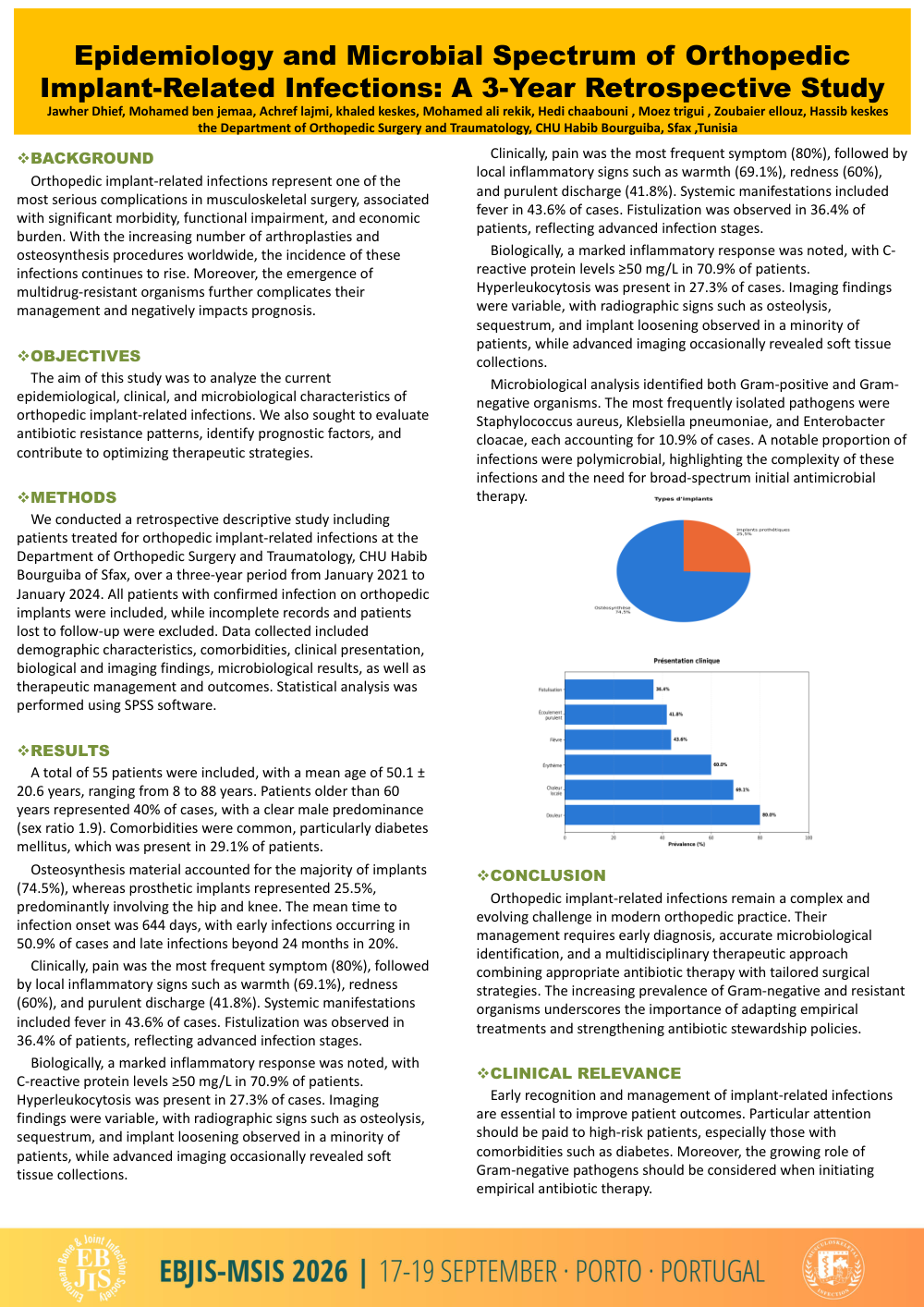
RESULTS: A total of 55 patients were included, with a mean age of 50.1 ± 20.6 years, ranging from 8 to 88 years. Patients older than 60 years represented 40% of cases, with a clear male predominance (sex ratio 1.9). Comorbidities were common, particularly diabetes mellitus, which was present in 29.1% of patients. Osteosynthesis material accounted for the majority of implants (74.5%), whereas prosthetic implants represented 25.5%, predominantly involving the hip and knee. The mean time to infection onset was 644 days, with early infections occurring in 50.9% of cases and late infections beyond 24 months in 20%. Clinically, pain was the most frequent symptom (80%), followed by local inflammatory signs such as warmth (69.1%), redness (60%), and purulent discharge (41.8%). Systemic manifestations included fever in 43.6% of cases. Fistulization was observed in 36.4% of patients, reflecting advanced infection stages. Biologically, a marked inflammatory response was noted, with C-reactive protein levels ≥50 mg/L in 70.9% of patients. Hyperleukocytosis was present in 27.3% of cases. Imaging findings were variable, with radiographic signs such as osteolysis, sequestrum, and implant loosening observed in a minority of patients, while advanced imaging occasionally revealed soft tissue collections. Clinically, pain was the most frequent symptom (80%), followed by local inflammatory signs such as warmth (69.1%), redness (60%), and purulent discharge (41.8%). Systemic manifestations included fever in 43.6% of cases. Fistulization was observed in 36.4% of patients, reflecting advanced infection stages. Biologically, a marked inflammatory response was noted, with Creactive protein levels ≥50 mg/L in 70.9% of patients. Hyperleukocytosis was present in 27.3% of cases. Imaging findings were variable, with radiographic signs such as osteolysis, sequestrum, and implant loosening observed in a minority of patients, while advanced imaging occasionally revealed soft tissue collections. Microbiological analysis identified both Gram-positive and Gramnegative organisms. The most frequently isolated pathogens were Staphylococcus aureus, Klebsiella pneumoniae, and Enterobacter cloacae, each accounting for 10.9% of cases. A notable proportion of infections were polymicrobial, highlighting the complexity of these infections and the need for broad-spectrum initial antimicrobial therapy.
CONCLUSION: Orthopedic implant-related infections remain a complex and evolving challenge in modern orthopedic practice. Their management requires early diagnosis, accurate microbiological identification, and a multidisciplinary therapeutic approach combining appropriate antibiotic therapy with tailored surgical strategies. The increasing prevalence of Gram-negative and resistant organisms underscores the importance of adapting empirical treatments and strengthening antibiotic stewardship policies.
CLINICAL RELEVANCE: Early recognition and management of implant-related infections are essential to improve patient outcomes. Particular attention should be paid to high-risk patients, especially those with comorbidities such as diabetes. Moreover, the growing role of Gram-negative pathogens should be considered when initiating empirical antibiotic therapy.