477 posters, 14 topics, 2,065 authors, 1,055 institutions
ePostersLive by SciGen Technologies S.A. All rights reserved.
The Joint EBJIS-MSIS 2026 Conference
17 - 19 September, 2026 | Porto, Portugal

EP349
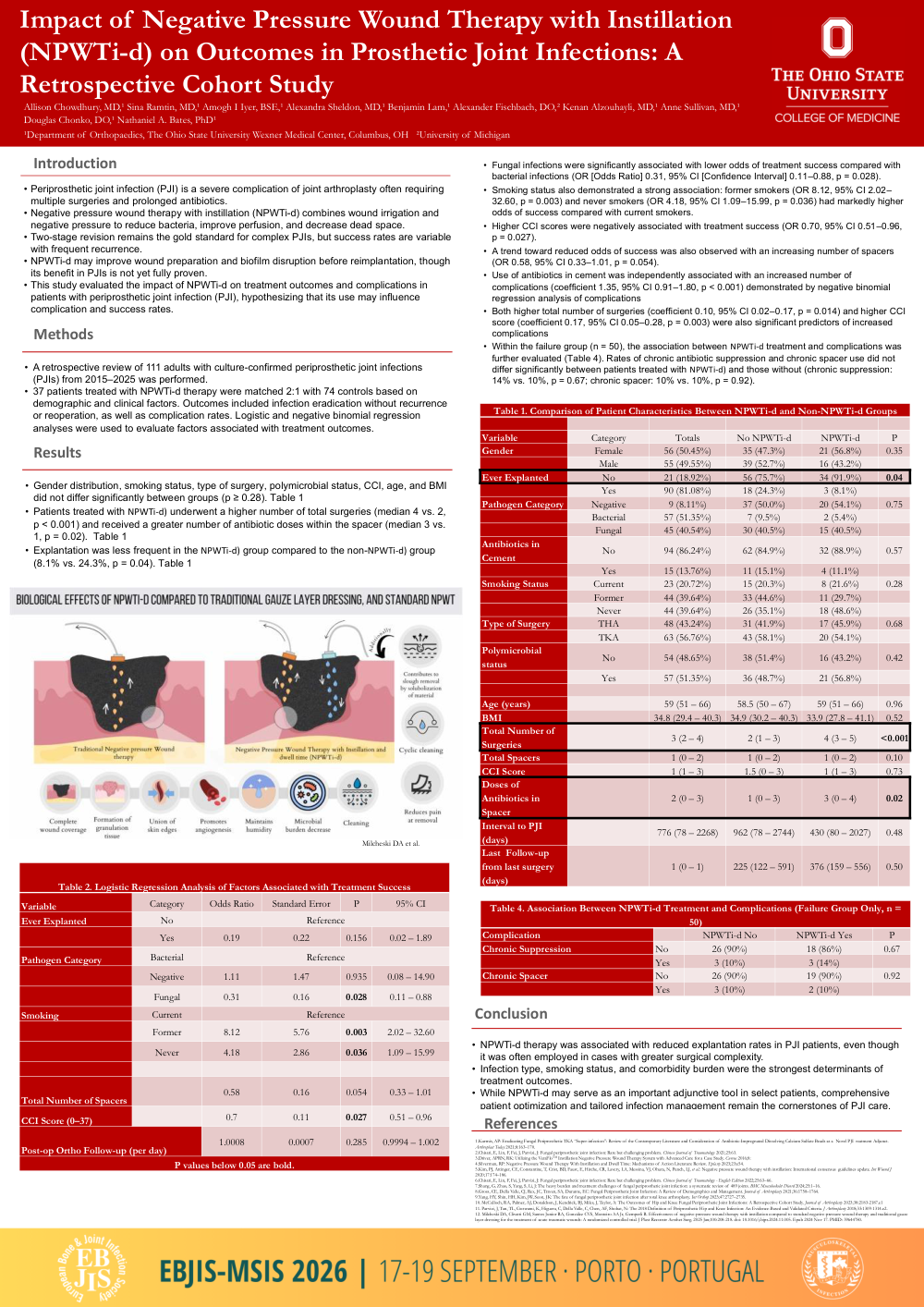
Impact of Negative Pressure Wound Therapy with Instillation on Outcomes in Prosthetic Joint Infections: A Retrospective Cohort Study
Poster Presenter
Part of Topic
Prosthetic Joint Infections
Introduction
• Periprosthetic joint infection (PJI) is a severe complication of joint arthroplasty often requiring
multiple surgeries and prolonged antibiotics.
• Negative pressure wound therapy with instillation (NPWTi-d) combines wound irrigation and
negative pressure to reduce bacteria, improve perfusion, and decrease dead space.
• Two-stage revision remains the gold standard for complex PJIs, but success rates are variable
with frequent recurrence.
• NPWTi-d may improve wound preparation and biofilm disruption before reimplantation, though
its benefit in PJIs is not yet fully proven.
• This study evaluated the impact of NPWTi-d on treatment outcomes and complications in
patients with periprosthetic joint infection (PJI), hypothesizing that its use may influence
complication and success rates.
Methods
A retrospective review of 111 adults with culture-confirmed periprosthetic joint infections
(PJIs) from 2015–2025 was performed.
• 37 patients treated with NPWTi-d therapy were matched 2:1 with 74 controls based on
demographic and clinical factors. Outcomes included infection eradication without recurrence
or reoperation, as well as complication rates. Logistic and negative binomial regression
analyses were used to evaluate factors associated with treatment outcomes.
Results
Gender distribution, smoking status, type of surgery, polymicrobial status, CCI, age, and BMI
did not differ significantly between groups (p ≥ 0.28). Table 1
• Patients treated with NPWTi-d) underwent a higher number of total surgeries (median 4 vs. 2,
p < 0.001) and received a greater number of antibiotic doses within the spacer (median 3 vs.
1, p = 0.02). Table 1
• Explantation was less frequent in the NPWTi-d) group compared to the non-NPWTi-d) group
(8.1% vs. 24.3%, p = 0.04). Table 1
• Fungal infections were significantly associated with lower odds of treatment success compared with
bacterial infections (OR [Odds Ratio] 0.31, 95% CI [Confidence Interval] 0.11–0.88, p = 0.028).
• Smoking status also demonstrated a strong association: former smokers (OR 8.12, 95% CI 2.02–
32.60, p = 0.003) and never smokers (OR 4.18, 95% CI 1.09–15.99, p = 0.036) had markedly higher
odds of success compared with current smokers.
• Higher CCI scores were negatively associated with treatment success (OR 0.70, 95% CI 0.51–0.96,
p = 0.027).
• A trend toward reduced odds of success was also observed with an increasing number of spacers
(OR 0.58, 95% CI 0.33–1.01, p = 0.054).
• Use of antibiotics in cement was independently associated with an increased number of
complications (coefficient 1.35, 95% CI 0.91–1.80, p < 0.001) demonstrated by negative binomial
regression analysis of complications
• Both higher total number of surgeries (coefficient 0.10, 95% CI 0.02–0.17, p = 0.014) and higher CCI
score (coefficient 0.17, 95% CI 0.05–0.28, p = 0.003) were also significant predictors of increased
complications
• Within the failure group (n = 50), the association between NPWTi-dtreatment and complications was
further evaluated (Table 4). Rates of chronic antibiotic suppression and chronic spacer use did not
differ significantly between patients treated with NPWTi-d) and those without (chronic suppression:
14% vs. 10%, p = 0.67; chronic spacer: 10% vs. 10%, p = 0.92).
• A retrospective review of 111 adults with culture-confirmed periprosthetic joint infections
(PJIs) from 2015–2025 was performed.
• 37 patients treated with NPWTi-d therapy were matched 2:1 with 74 controls based on
demographic and clinical factors. Outcomes included infection eradication without recurrence
or reoperation, as well as complication rates. Logistic and negative binomial regression
analyses were used to evaluate factors associated with treatment outcomes.
Conclusion
8.12 5.76 0.003 2.02 – 32.60
Never 4.18 2.86 0.036 1.09 – 15.99
0.58 0.16 0.054 0.33 – 1.01
Total Number of Spacers
CCI Score (0–37) Post-op Ortho Follow-up (per day)
• NPWTi-d therapy was associated with reduced explantation rates in PJI patients, even though
it was often employed in cases with greater surgical complexity.
• Infection type, smoking status, and comorbidity burden were the strongest determinants of
treatment outcomes.
• While NPWTi-d may serve as an important adjunctive tool in select patients, comprehensive
patient optimization and tailored infection management remain the cornerstones of PJI care.