477 posters, 14 topics, 2,065 authors, 1,055 institutions
ePostersLive by SciGen Technologies S.A. All rights reserved.
The Joint EBJIS-MSIS 2026 Conference
17 - 19 September, 2026 | Porto, Portugal

EP336
Quadrant-Based Risk Prediction for Periprosthetic Joint Infection Using Surgical Complexity Factors and a Frailty Index in Primary and Revision Arthroplasty
Poster Presenter
Authors
Kole Joachim, Casey Abernethy, Brandon Gettleman, Alexander King, Joshua Wiener, Christopher Hamad, Ezekiel Dingle, Amanda Perrotta, Alexandra Stavrakis, Alexander Christ
Affiliations
David Geffen School of Medicine, University Of California, Los Angeles, Los Angeles, United States, University Of California, Los Angeles, Ca, Usa, Department of Orthopaedic Surgery, University Of California, Los Angeles, Los Angeles, United States, Department of Orthopaedic Surgery, University Of California, Los Angeles, Los Angeles, United States; Department of Surgery, Greater Los Angeles VA Medical Center, Los Angeles, United States
Part of Topic
Prosthetic Joint Infections
Quadrant-Based Risk Prediction for Periprosthetic Joint Infection Using Surgical Complexity Factors and a Frailty Index in Primary and Revision Arthroplasty
Kole Joachim BA2, Casey Abernethy BS2, Brandon Gettleman MD1, Alexander H. King MD1, Joshua Wiener BS2, Christopher Hamad MD1, Ezekiel Dingle BS2, Amanda Perrotta MS2, Alexandra Stavrakis MD1, Alexander Christ MD1,3
Affiliations:
1Department of Orthopaedic Surgery, University of California, Los Angeles, CA, USA
2David Geffen School of Medicine at the University of California, Los Angeles, CA, USA
3Department of Surgery, Greater Los Angeles VA Medical Center, Los Angeles, CA, USA
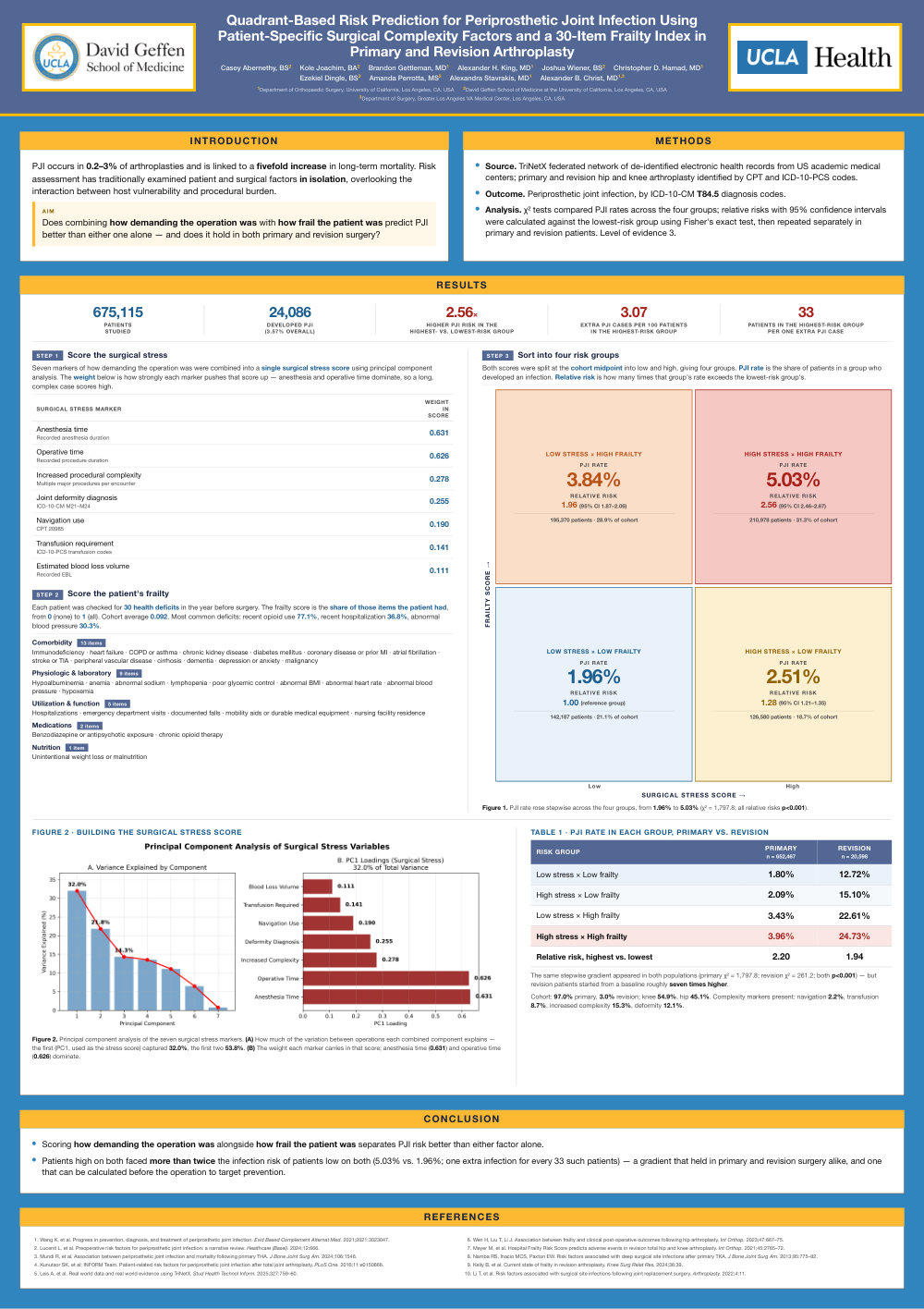
Introduction/Aim: Periprosthetic joint infection (PJI) remains a serious complication after total joint arthroplasty, occurring in 0.2-3% of cases and linked to a fivefold increase in mortality. Traditional risk assessment looks at patient and surgical factors separately, overlooking how frailty and procedural complexity can interact.
Methods: The TriNetX Research network identified patients undergoing primary or revision hip and knee arthroplasty. A 30-item Accumulated Frailty Index (AFI-Core30) was created. Seven surgical stress variables underwent principal component analysis to produce a composite measure. Patients were categorized into four quadrants based on median splits: Low versus High Stress and Low versus High Frailty.
Results: Among 675,115 patients, 24,086 (3.57%) developed PJI. PJI rates increased across quadrants from 1.96% (Low Stress × Low Frailty) to 5.03% (High Stress × High Frailty). Using Low Stress × Low Frailty as the reference, the relative risks were: High Stress × Low Frailty (RR 1.28), Low Stress × High Frailty (RR 1.96), and High Stress × High Frailty (RR 2.56), all p<0.001. The framework's validity was maintained in primary populations (PJI rates 1.80-3.96%) and revision populations (rates 12.72-24.73%).
Conclusion: Combining surgical complexity with frailty assessment offers better PJI risk stratification than using single-domain predictors. Highest-risk patients had twice the infection rates of lowest-risk patients, allowing for targeted perioperative optimization and infection-prevention strategies.