477 posters, 14 topics, 2,065 authors, 1,055 institutions
ePostersLive by SciGen Technologies S.A. All rights reserved.
The Joint EBJIS-MSIS 2026 Conference
17 - 19 September, 2026 | Porto, Portugal

EP335
Predicting 5-Year Mortality After Prosthetic Joint Infection Using a 30-Item Accumulated Frailty Index in a 13,371-Patient Multicenter Cohort
Poster Presenter
Authors
Kole Joachim, Casey Abernethy, Brandon Gettleman, Josh Wiener, Alexandra Richards, Othneil Sparks, Ezekiel Dingle, Tony Lam, Alexandra Stavrakis, Alexander Christ
Affiliations
David Geffen School of Medicine, University Of California, Los Angeles, Los Angeles, United States, University Of California, Los Angeles, Ca, Usa, Department of Orthopaedic Surgery, University Of California, Los Angeles, Los Angeles, United States, Department of Orthopaedic Surgery, University Of California, Los Angeles, Los Angeles, United States; Department of Surgery, Greater Los Angeles VA Medical Center, Los Angeles, United States
Part of Topic
Prosthetic Joint Infections
Predicting 5-Year Mortality After Prosthetic Joint Infection Using a 30-Item Accumulated Frailty Index in a 13,371-Patient Multicenter Cohort
Kole Joachim BA2, Casey Abernethy BS2, Brandon Gettleman MD1, Joshua Wiener BS2, Alexandra E. Richards MD1, Othneil Sparks BS2, Ezekiel Dingle BS2, Tony Lam BS2, Alexandra Stavrakis MD1, Alexander B. Christ MD1,3
Affiliations:
1Department of Orthopaedic Surgery, University of California, Los Angeles, CA, USA
2David Geffen School of Medicine at the University of California, Los Angeles, CA, USA
3Department of Surgery, Greater Los Angeles VA Medical Center, Los Angeles, CA, USA
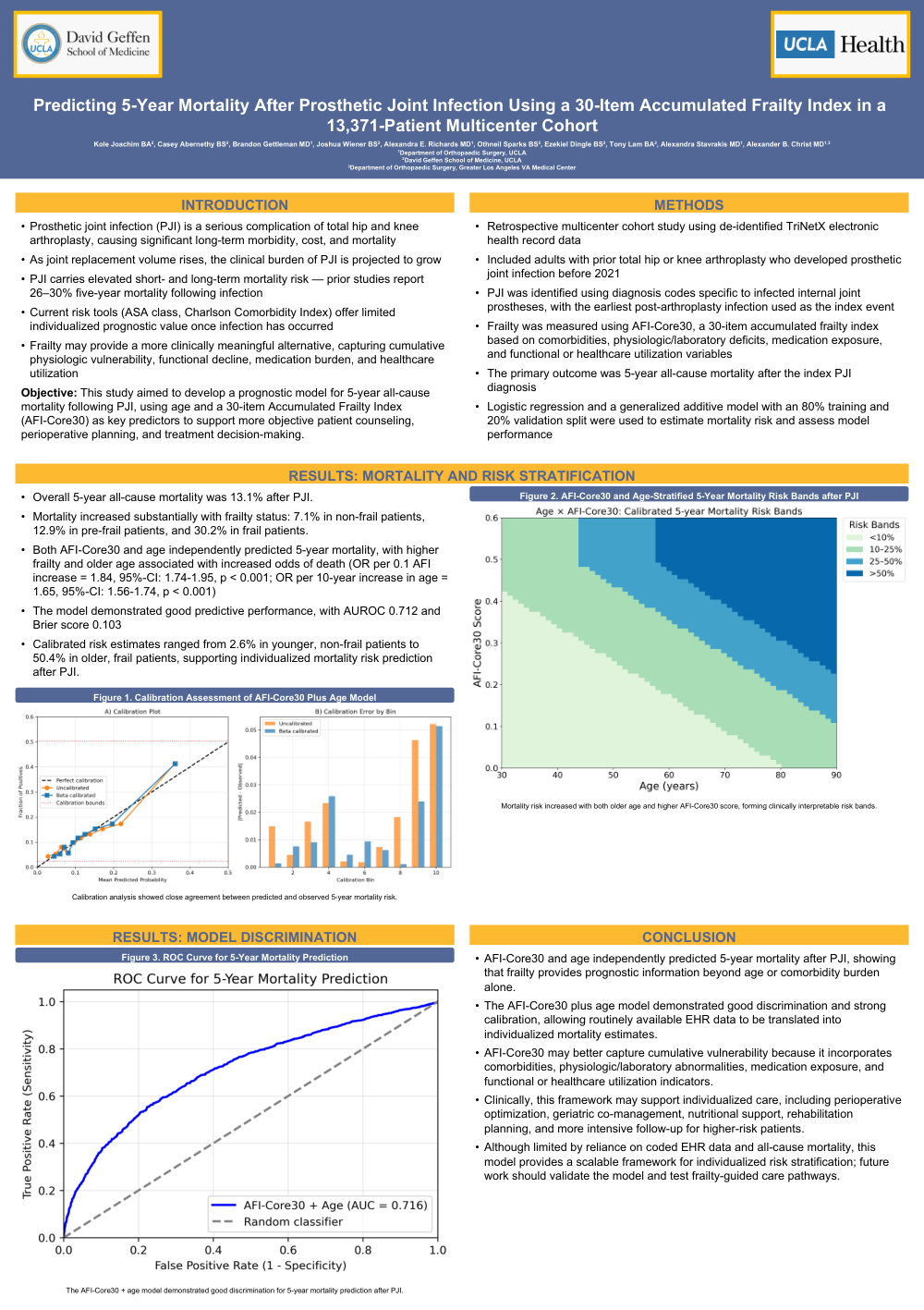
Introduction/Aim: Prosthetic joint infection (PJI) carries substantial long-term mortality, yet widely used perioperative risk tools provide limited prognostic specificity for patients after infection. We developed a frailty-based prognostic model to estimate 5-year all-cause mortality after PJI using a scalable electronic health record (EHR) framework.
Methods: We performed a retrospective multicenter cohort study using de-identified TriNetX EHR data. Adults with hip or knee arthroplasty and a PJI diagnosis (ICD-9 996.66/996.67; ICD-10 T84.5x/T84.6x/T84.7xx) occurring after the index arthroplasty and before 2021 were included to enable complete 5-year follow-up. Frailty was quantified with a 30-item deficit-accumulation index (AFI-Core30; range 0-1) derived from comorbidities, physiologic/laboratory deficit proxies, medication exposures, and functional/healthcare utilization indicators assessed primarily within 12 months before PJI. The primary outcome was death within five years of index PJI. We estimated independent associations with logistic regression and developed a generalized additive model (GAM) with smooth terms for age and AFI-Core30 (80% training/20% validation), using inverse-prevalence weighting and cross-validated smoothing penalties. Discrimination and calibration were evaluated using AUROC, precision-recall AUC (PR-AUC), and Brier score; calibration approaches (isotonic, Platt, beta) were compared.
Results: The cohort included 13,371 PJI patients (mean age 63.1±11.4 years; mean follow-up 9.3 years) with 13.1% 5-year mortality. Unadjusted mortality increased across frailty strata (non-frail 7.1%, pre-frail 12.9%, frail 30.2%; p<0.001). Age and AFI-Core30 independently predicted mortality (OR-per-0.1 AFI increase 1.84, 95% CI 1.74–1.95; OR-per-10-year age increase 1.65, 95%-CI 1.56–1.74; both p<0.001). The model demonstrated good discrimination (AUROC=0.712) and excellent calibration (Brier score=0.103). Predicted 5-year mortality ranged from 2.6% in younger, non-frail patients to 50.4% in older, highly frail individuals.
Conclusions: This study presents the first frailty-based prognostic model for long-term mortality following PJI. The AFI-Core30 enables individualized risk estimates that may guide treatment intensity and support personalized perioperative planning in this high-risk population.
References:
1. Kurtz SM, Lau EC, Son M-S, Chang ET, Zimmerli W, Parvizi J. Are We Winning or Losing the Battle With Periprosthetic Joint Infection: Trends in Periprosthetic Joint Infection and Mortality Risk for the Medicare Population. J Arthroplasty. 2018;33:3238–45.
2. Zmistowski B, Karam JA, Durinka JB, Casper DS, Parvizi J. Periprosthetic joint infection increases the risk of one-year mortality. J Bone Joint Surg Am. 2013;95:2177–84.