477 posters, 14 topics, 2,065 authors, 1,055 institutions
ePostersLive by SciGen Technologies S.A. All rights reserved.
The Joint EBJIS-MSIS 2026 Conference
17 - 19 September, 2026 | Porto, Portugal

EP334
Patient-Level Factors and Salvage Timing Associated with Progression to Above-Knee Amputation After Periprosthetic Knee Infection
Poster Presenter
Authors
Ezekiel Dingle, Casey Abernethy, Kole Joachim, Brandon Gettleman, Josh Wiener, Othneil Sparks, Alexander King, Amanda Perrotta, Timothy Ko, Alexandra Stavrakis, Alexander Christ
Affiliations
David Geffen School of Medicine, University Of California, Los Angeles, Los Angeles, United States, Department of Orthopaedics, University Of California, Los Angeles, Los Angeles, United States, Department of Orthopaedics, University Of California, Los Angeles, Los Angeles, United States; Department of Surgery, Greater Los Angeles VA Medical Center, Los Angeles, United States, University Of California, Los Angeles, Ca, Usa
Part of Topic
Prosthetic Joint Infections
Patient-Level Factors and Salvage Timing Associated with Progression to Above-Knee Amputation After Periprosthetic Knee Infection
Introduction/Aim: Periprosthetic joint infection (PJI) after total knee arthroplasty (TKA) can result in limb loss, yet risk factors for above-knee amputation (AKA) remain poorly characterized. We evaluated demographic factors, frailty burden, salvage timing, and treatment patterns associated with AKA after knee PJI.
Methods: We identified 10,160 patients with knee PJI following primary or revision TKA from the TriNetX Research Network. The primary outcome was AKA after PJI diagnosis. Exposures included sex, race/ethnicity, frailty measured using a 30-component accumulated frailty index weighted for amputation risk, and timing to first salvage procedure, categorized as early (≤7 days), intermediate (8-30 days), or delayed (>30 days). Multivariable logistic regression identified independent predictors of AKA.
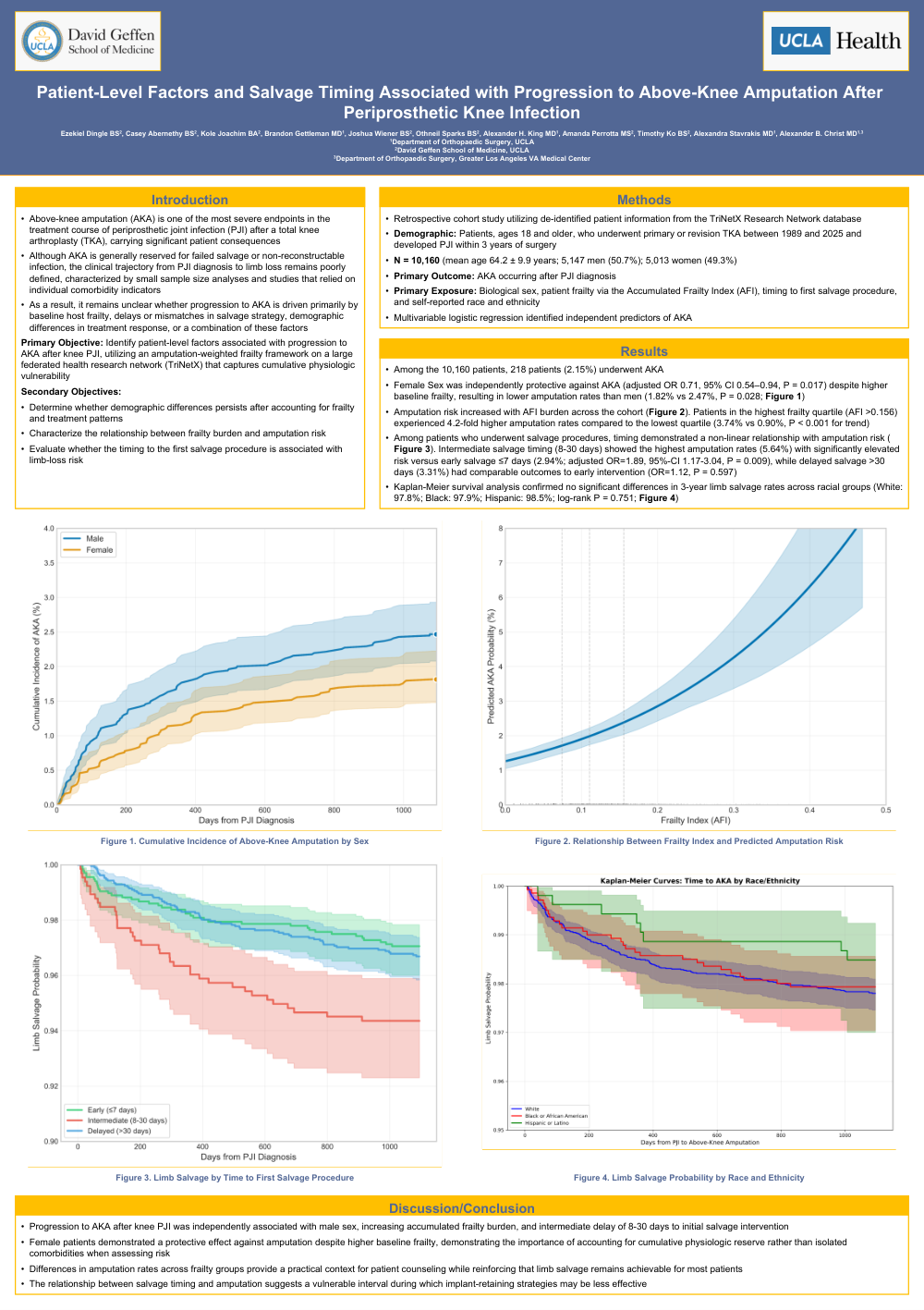
Results: Overall, 218 patients (2.15%) underwent AKA. Female sex was independently protective (adjusted odds ratio [OR] 0.71, 95% CI 0.54–0.94, p=0.017) despite higher baseline frailty (AFI 0.122 vs 0.118, p=0.007). The highest frailty quartile demonstrated a 4.2-fold increased amputation risk compared with the lowest (3.74% vs 0.90%, p<0.001). Intermediate salvage timing (8-30 days) showed the highest amputation rates (5.64%) with significantly elevated risk versus early salvage ≤7 days (2.94%; adjusted OR=1.89, 95%-CI 1.17-3.04, p=0.009), while delayed salvage >30 days (3.31%) had comparable outcomes to early intervention (OR=1.12, p=0.597). High-risk organisms (MRSA or documented resistance) were most prevalent in early salvage (11.3%) compared with intermediate (7.6%) and delayed (6.5%; p<0.001), yet debridement and implant retention were used similarly in the early and intermediate groups (94.7% vs 93.8%; p=0.512) and delayed salvage more frequently involved staged exchange (16.0%) (Figure 1). No racial disparities in amputation risk were observed.
Conclusions: Female sex protects against amputation despite higher frailty, while intermediate-delay salvage confers elevated risk despite similar treatment strategies and lower organism virulence, suggesting a window where biofilm maturation reduces effectiveness of implant-retaining procedures increasing risk of progression to AKA.