477 posters, 14 topics, 2,052 authors, 1,056 institutions
ePostersLive by SciGen Technologies S.A. All rights reserved.
The Joint EBJIS-MSIS 2026 Conference
17 - 19 September, 2026 | Porto, Portugal

EP319
Impact of Pre-TJA Cystoscopy on Early and Late Postoperative Complications: A Propensity-Matched Cohort Analysis
Part of Topic
Prosthetic Joint Infections
Impact of Pre-TJA Cystoscopy on Early and Late Postoperative Complications: A Propensity-Matched Cohort Analysis
Tarek Haj Shehadeh MD1; Jesus M. Villa MD1; Jared Warren DO1; Carlos A. Higuera MD1,2
1.Cleveland Clinic Florida, Levitetz Department of Orthopaedic Surgery, Weston, Florida
2.Case Western Reserve University, Cleveland, Ohio
Background
•Total joint arthroplasty (TJA) is an increasingly performed procedure worldwide.
•Periprosthetic joint infection (PJI) is one of the most devastating complications after TJA.
•Many patients undergoing TJA have medical conditions that necessitate preoperative evaluation, including cystoscopy. However, the impact of cystoscopy performed prior to TJA on perioperative risk and postoperative outcomes remains unclear.
•No literature exists on this topic.
Objective
We conducted a propensity-score matched analysis to:
Evaluate the association between cystoscopy performed within six months prior to primary TJA and subsequent medical and surgical complications at 90 days and 2 years postoperatively.
Methods
•We conducted a retrospective analysis using the TriNetX healthcare database (October 2005 – October 2023).
•We identified adult patients undergoing primary total knee (TKA) or hip (THA) arthroplasty using ICD-9/10 and CPT codes.
•Stratified patients based on whether they underwent cystoscopy within six months prior to TJA or not (control).
•1:1 propensity score matched for relevant comorbidities, including age, sex, body mass index, diabetes, insulin, HbA1C and history of urinary tract infection (UTI) among other variables.
•Compared outcomes after matching.
•Outcomes of interest included:
-90-day risk of PJI, venous thromboembolism (VTE), UTI, acute kidney injury (AKI), readmission, emergency department (ED) utilization, sepsis, cellulitis, and Foley catheter insertion.
-2-year risk of PJI and revision surgery.
•TriNetX built-in tool for statistical analysis.
•Chi-square test for categorical variables and student t-test for continuous variables
•Significance threshold was set at p<0.05.
TKA
•Initial query resulted in 280,779 patients.
•Cystoscopy: 1,290 patients vs Control: 279,489 patients.
•After 1:1 matching: 1,286 patients.
•Normalization of baseline demographics.
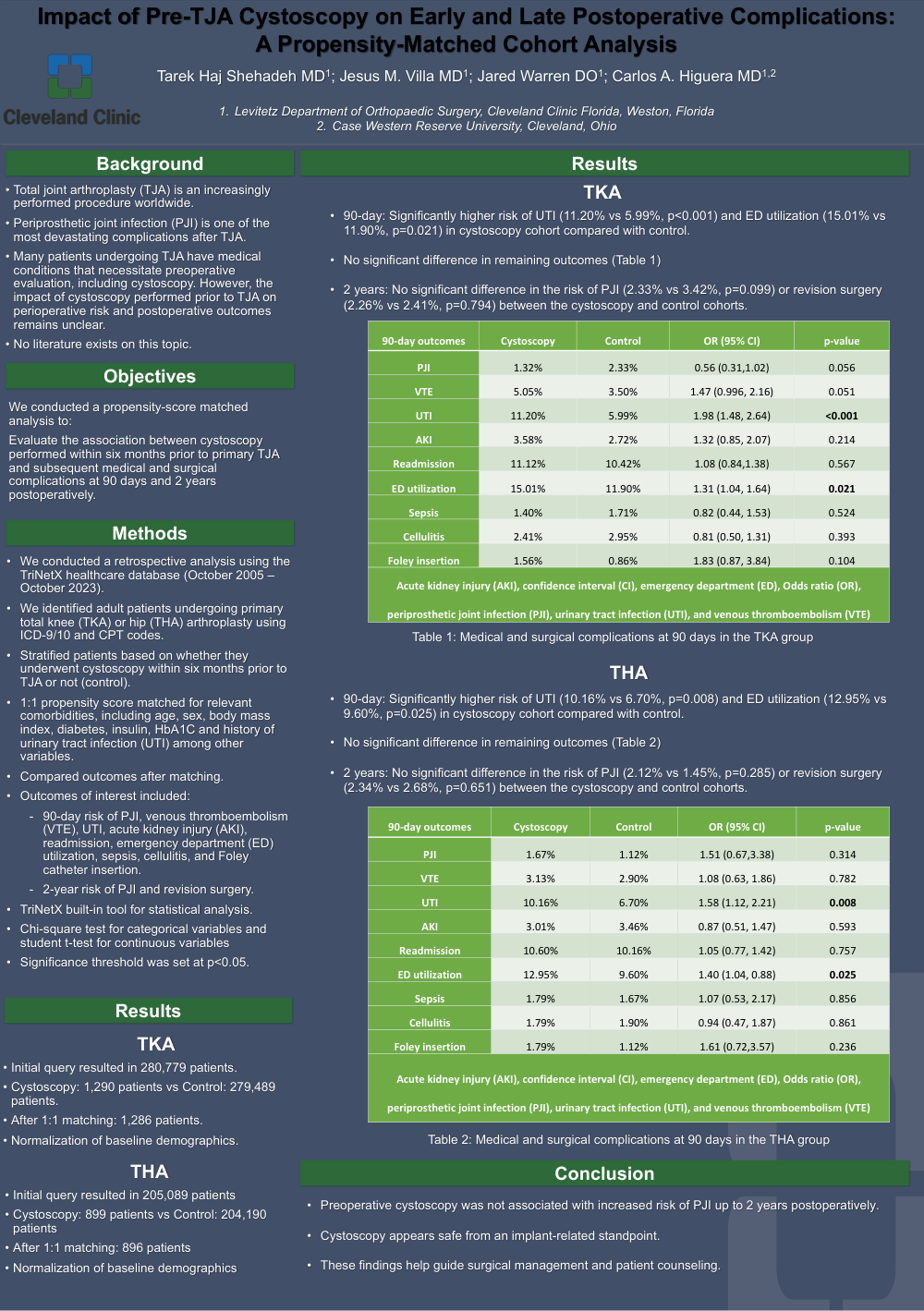
•90-day: Significantly higher risk of UTI (11.20% vs 5.99%, p<0.001) and ED utilization (15.01% vs 11.90%, p=0.021) in cystoscopy cohort compared with control.
•No significant difference in remaining outcomes (Table 1)
•2 years: No significant difference in the risk of PJI (2.33% vs 3.42%, p=0.099) or revision surgery (2.26% vs 2.41%, p=0.794) between the cystoscopy and control cohorts.
THA
•Initial query resulted in 205,089 patients
•Cystoscopy: 899 patients vs Control: 204,190 patients
•After 1:1 matching: 896 patients
•Normalization of baseline demographics
•90-day: Significantly higher risk of UTI (10.16% vs 6.70%, p=0.008) and ED utilization (12.95% vs 9.60%, p=0.025) in cystoscopy cohort compared with control.
•No significant difference in remaining outcomes (Table 2)
•2 years: No significant difference in the risk of PJI (2.12% vs 1.45%, p=0.285) or revision surgery (2.34% vs 2.68%, p=0.651) between the cystoscopy and control cohorts.
Conclusion
•Preoperative cystoscopy was not associated with increased risk of PJI up to 2 years postoperatively.
•Cystoscopy appears safe from an implant-related standpoint.
•These findings help guide surgical management and patient counseling.