477 posters, 14 topics, 2,065 authors, 1,055 institutions
ePostersLive by SciGen Technologies S.A. All rights reserved.
The Joint EBJIS-MSIS 2026 Conference
17 - 19 September, 2026 | Porto, Portugal

EP317
Time to Reimplantation: Waiting Longer May Increase the Risk of Subsequent Failure
Poster Presenter
Part of Topic
Prosthetic Joint Infections
Time to Reimplantation: Waiting Longer May Increase the Risk of Subsequent Failure
M. Lane Moore, MD, MBA; Collin L. Braithwaite, MD; Saad Tarabichi, MD; Jens T. Verhey, MD; Zachary K. Christopher, MD; David G. Deckey, MD; Henry D. Clarke, MD; Mark J. Spangehl, MD; Joshua S. Bingham, MD
BACKGROUND
METHODS
Retrospective review of 576 patients undergoing two-stage exchange for chronic knee PJI.
PJI defined using 2013 MSIS criteria.
Excluded reimplantation >180 days (n=76) and spacer exchange (n=49).
Final cohort: 451 patients; mean follow-up 5.8 ± 3.6 years.
Failure was defined as reoperation for infection or PJI-related mortality.
Interstage duration was analyzed per 10-day increase and by intervals of <76, 76–100, and ≥100 days.
Multivariable regression identified independent predictors of failure.
RESULTS
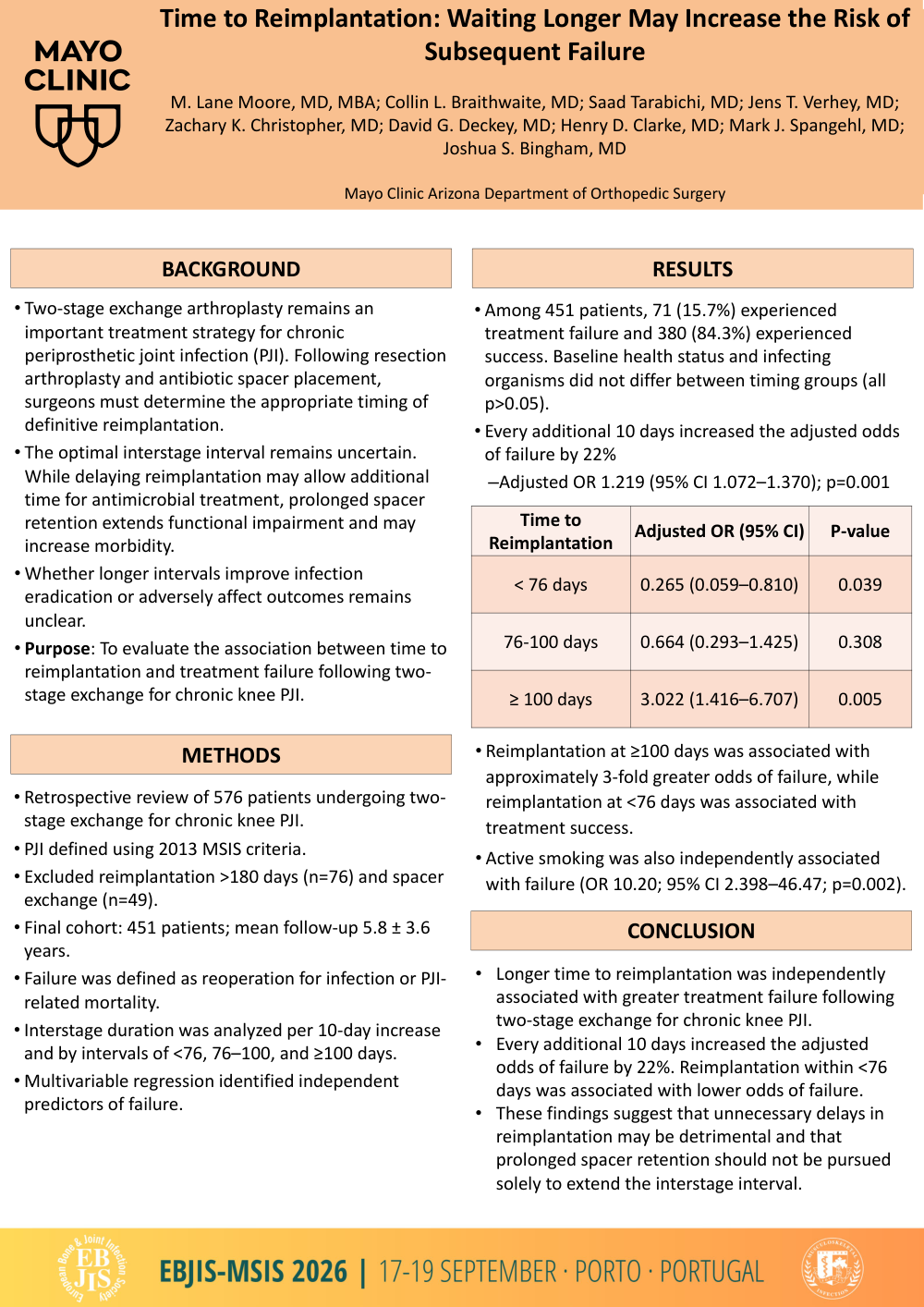
Among 451 patients, 71 (15.7%) experienced treatment failure and 380 (84.3%) experienced success. Baseline health status and infecting organisms did not differ between timing groups (all p>0.05).
Every additional 10 days increased the adjusted odds of failure by 22%
Adjusted OR 1.219 (95% CI 1.072–1.370); p=0.001
Reimplantation at ≥100 days was associated with approximately 3-fold greater odds of failure, while reimplantation at <76 days was associated with treatment success.
Active smoking was also independently associated with failure (OR 10.20; 95% CI 2.398–46.47; p=0.002).
CONCLUSION