477 posters, 14 topics, 2,065 authors, 1,055 institutions
ePostersLive by SciGen Technologies S.A. All rights reserved.
The Joint EBJIS-MSIS 2026 Conference
17 - 19 September, 2026 | Porto, Portugal

EP314
Outcomes after Surgery for Periprosthetic Knee Infection: A Study of 148 Knees
Poster Presenter
Authors
Sara Castellanos, Montserrat Sanmarti, Araceli Gonzalez-Cuevas, Juan Castellanos
Affiliations
Parc Sanitari Sant Joan De Deu, Department of Orthopedic Surgery and Traumatology, Parc Sanitari Sant Joan de Déu, Sant Boi de Llobregat (Barcelona), Spain, Infectious Diseases Unit, Parc Sanitari Sant Joan de Déu, Sant Boi de Llobregat (Barcelona), Spain, Department of Microbiology, Parc Sanitari Sant Joan de Déu, Sant Boi de Llobregat (Barcelona), Spain
Part of Topic
Prosthetic Joint Infections
Outcomes after Surgery for Periprosthetic Knee Infection:A Study of 148 Knees
Sara Castellanosa, Montserrat Sanmartib, Araceli González-Cuevasc, Juan Castellanosa
a Department of Orthopedic Surgery and Traumatology, b Infectious Diseases Unit, cDepartment of Microbiology
PARC SANITARI SANT JOAN DE DÉU –SANT BOI DE LLOBREGAT (BARCELONA), SPAIN
Objective: Periprosthetic joint infection (PJI) is one of the most devastating complications following knee arthroplasty. The aim of this study was to evaluate the outcomes of surgical treatment for knee PJI, with a minimum follow-up of one year, and to compare results according to the different surgical approaches performed.
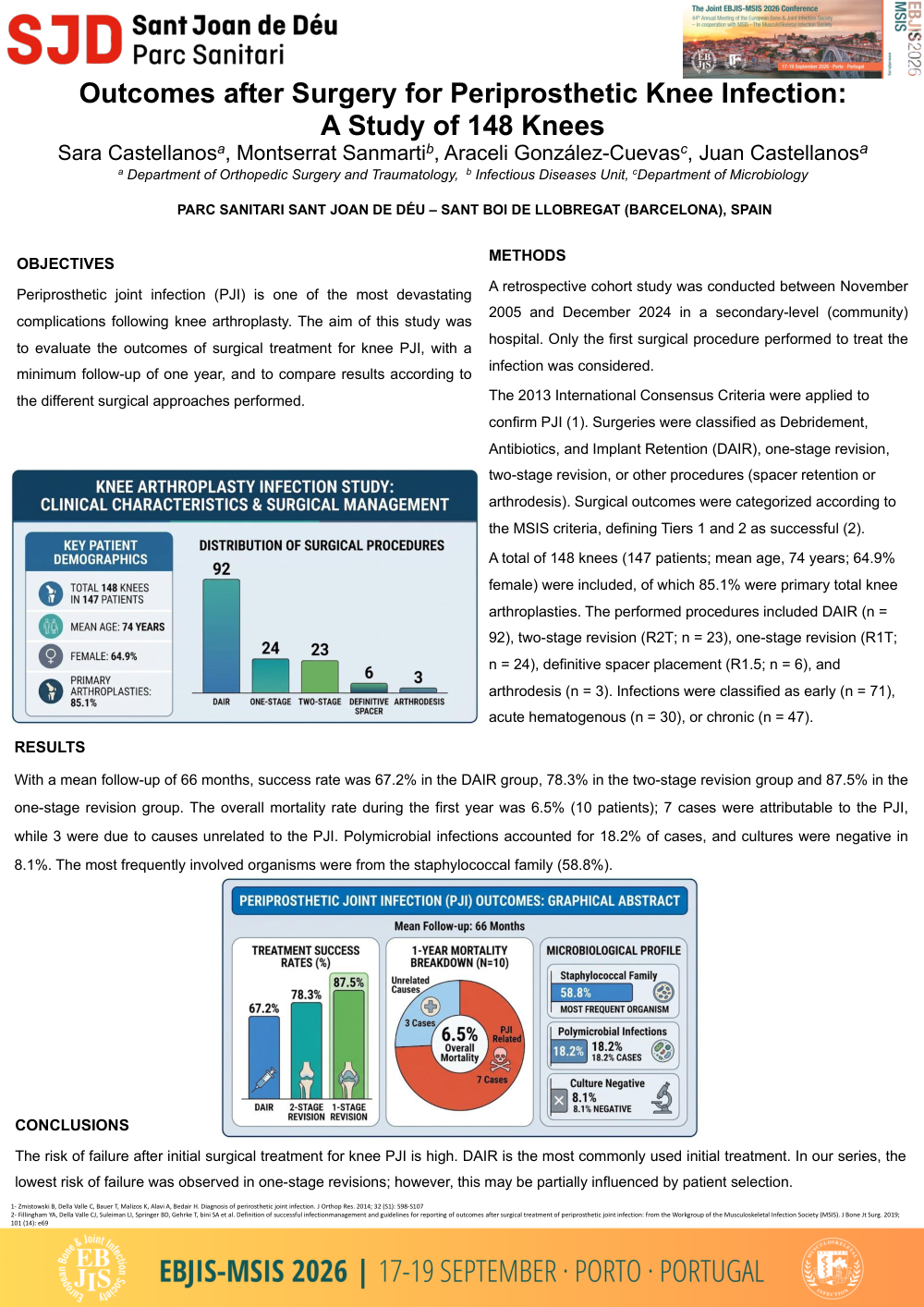
Methods:A retrospective cohort study was conducted between November 2005 and December 2024 in a secondary-level (community) infection was considered. hospital. Only the first surgical procedure performed to treat the The 2013 International Consensus Criteria were applied to confirm PJI (1). Surgeries were classified as Debridement, Antibiotics, and Implant Retention (DAIR), one-stage revision, two-stage revision, or other procedures (spacer retention or arthrodesis). Surgical outcomes were categorized according to the MSIS criteria, defining Tiers 1 and 2 as successful (2). A total of 148 knees (147 patients; mean age, 74 years; 64.9% female) were included, of which 85.1% were primary total knee arthroplasties. The performed procedures included DAIR (n = 92), two-stage revision (R2T; n = 23), one-stage revision (R1T; n = 24), definitive spacer placement (R1.5; n = 6), and arthrodesis (n = 3). Infections were classified as early (n = 71), acute hematogenous (n = 30), or chronic (n = 47).
Results: With a mean follow-up of 66 months, success rate was 67.2% in the DAIR group, 78.3% in the two-stage revision group and 87.5% in the one-stage revision group. The overall mortality rate during the first year was 6.5% (10 patients); 7 cases were attributable to the PJI, while 3 were due to causes unrelated to the PJI. Polymicrobial infections accounted for 18.2% of cases, and cultures were negative in 8.1%. The most frequently involved organisms were from the staphylococcal family (58.8%).
Conclusions: The risk of failure after initial surgical treatment for knee PJI is high. DAIR is the most commonly used initial treatment. In our series, the lowest risk of failure was observed in one-stage revisions; however, this may be partially influenced by patient selection.