477 posters, 14 topics, 2,052 authors, 1,056 institutions
ePostersLive by SciGen Technologies S.A. All rights reserved.
The Joint EBJIS-MSIS 2026 Conference
17 - 19 September, 2026 | Porto, Portugal

EP312
Management of the Failed Two-Stage Exchange for Periprosthetic Joint Infection: A Systematic Review of Treatment Options and Outcomes
Poster Presenter
Authors
Tim Ludwig Tuengler, Jette Zizmann, Susanne Baertl, Nike Walter, Jonas Pawelke, Christoph Biehl, Belal Abdo, Antonia F. Chen, Christian Heiss, Markus Rupp
Affiliations
Department of Trauma Surgery, University Hospital Regensburg, Regensburg, Germany, Department of Trauma, Hand, and Reconstructive Surgery, University Hospital Giessen, Giessen, Germany; Department of Experimental Trauma Surgery, Justus-Liebig-University, Giessen, Germany, Research Unit for Microbial Disease Prevention, Institute of Virology, Helmholtz Center Munich, Munich, Germany,
Part of Topic
Prosthetic Joint Infections
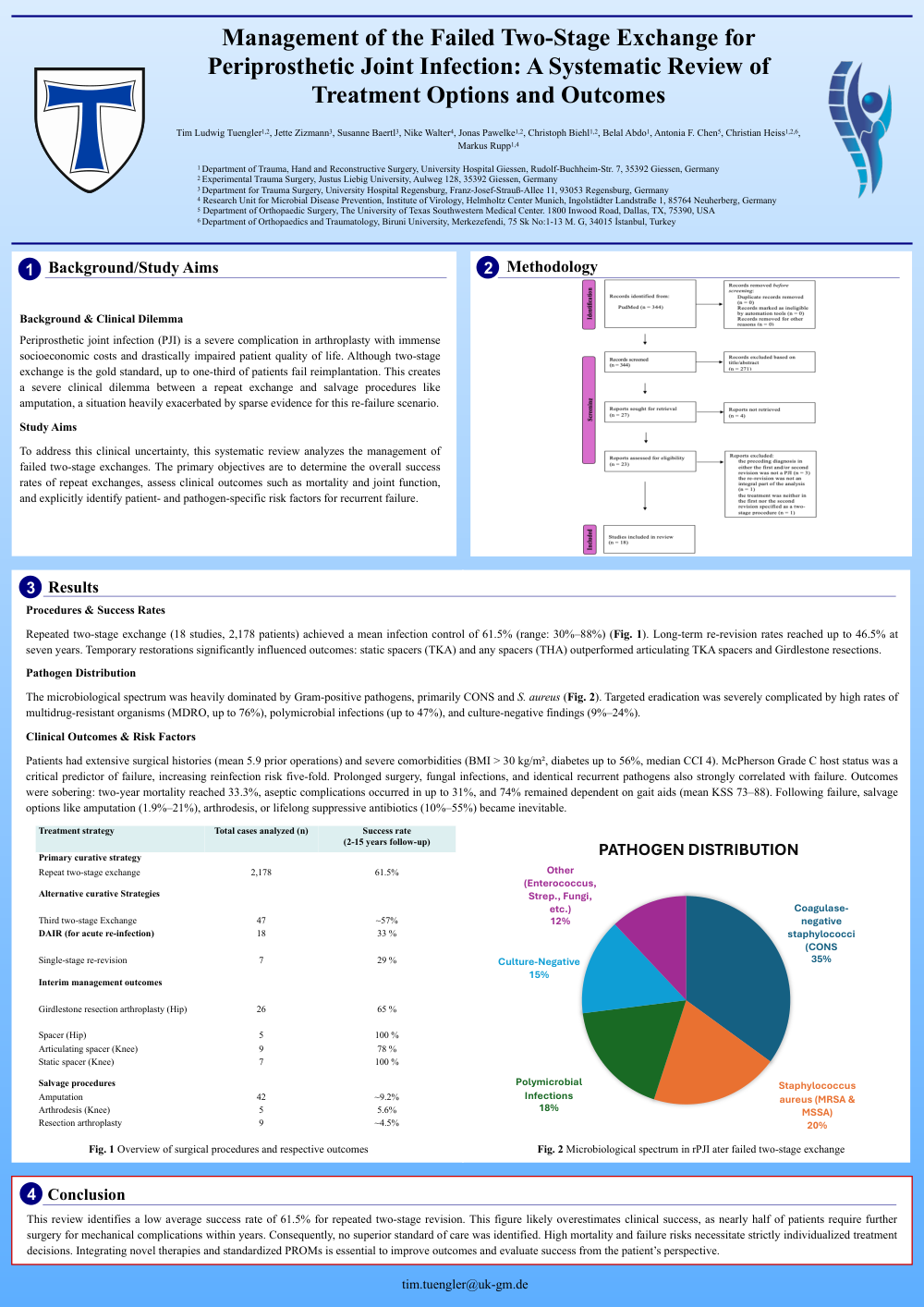
Aims: Periprosthetic joint infection (PJI) is a serious complication after total joint arthroplasty. While two-stage exchange arthroplasty is a common treatment for initial infection, the outcomes of repeated two-stage exchange arthroplasty after treatment failure are poorly understood. This systematic review aims to evaluate current evidence on the management of failed two-stage exchange for periprosthetic joint infection (PJI). The objectives were to: (1) determine the success rates of repeat two-stage exchange arthroplasty, (2) assess associated mortality, subsequent salvage procedures, and functional outcomes, and (3) identify patient- and pathogen-specific risk factors linked to recurrent treatment failure.
Methods: A systematic literature search of the PubMed database, including articles published between January 2009 and September 2025, was performed according to PRISMA guidelines. Data on patient characteristics, treatment protocols, infection control rates, mortality, and functional outcomes were extracted from 18 eligible studies.
Results: The 18 included studies comprised a total cohort of 2178 patients (1130 hips and 1048 knees). The calculated mean success rate for infection control after a repeated two-stage exchange was 61.5%, with a wide range from 30% to 88%. Failure to achieve treatment success often led to salvage procedures, such as amputation, arthrodesis, or long-term antibiotic suppression, and was associated with high mortality, reaching up to 33%. Microbiologically, coagulase-negative Staphylococci and multidrug-resistant pathogens were the most common organisms found in failed two-stage exchange arthroplasty. Functional outcomes were often poor and inconsistently recorded.
Conclusion: Repeated two-stage revision surgery for PJI has a low average success rate for infection control of only 61.5% compared to 81-85% reported in the literature for initial two-stage procedures. Due to low success rates, performing a two-stage approach should be weighed against other procedures often regarded as salvage procedures. The integration of patient-reported outcome measures is essential to evaluate treatment success more comprehensively in the future and might help to guide treatment decisions.
Keywords: Periprosthetic joint infection, two-stage exchange, treatment failure, re-revision, salvage procedures