477 posters, 14 topics, 2,065 authors, 1,055 institutions
ePostersLive by SciGen Technologies S.A. All rights reserved.
The Joint EBJIS-MSIS 2026 Conference
17 - 19 September, 2026 | Porto, Portugal

EP310
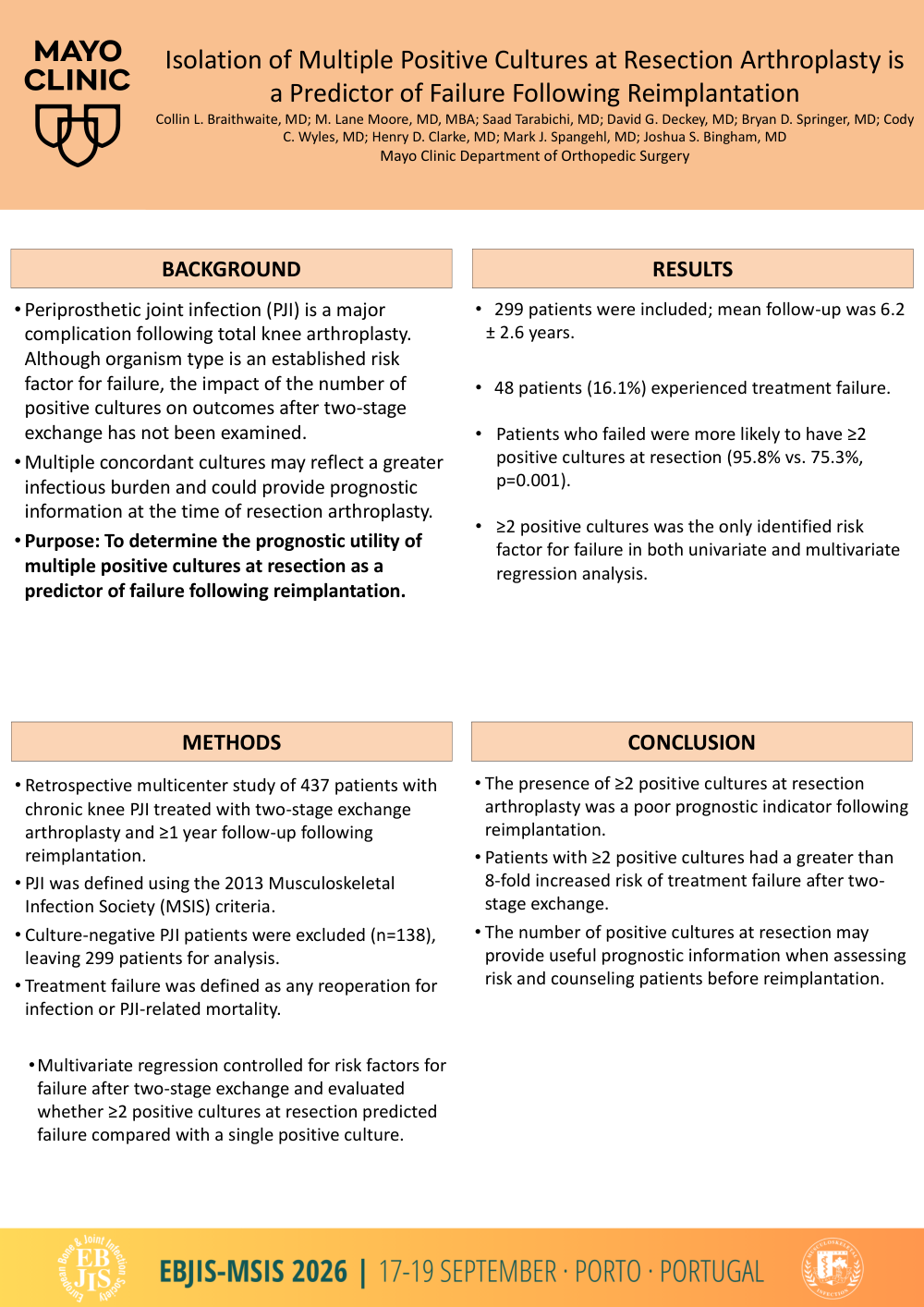
Isolation of Multiple Positive Cultures at Resection Arthroplasty is a Predictor of Failure Following Reimplantation
Poster Presenter
Authors
Collin Braithwaite, Michael L. Moore, Saad Tarabichi, David Deckey, Bryan Springer, Cody Wyles, Henry Clarke, Mark Spangehl, Joshua Bingham
Affiliations
Mayo Clinic, Mayo Clinic Department of Orthopaedic Surgery, Phoenix, United States, Mayo Clinic Department of Orthopaedic Surgery, Jacksonville, United States, Mayo Clinic Department of Orthopaedic Surgery, Rochester, United States
Part of Topic
Prosthetic Joint Infections
Background
Methods
Retrospective multicenter study of 437 patients with chronic knee PJI treated with two-stage exchange arthroplasty and ≥1 year follow-up following reimplantation.
PJI was defined using the 2013 Musculoskeletal Infection Society (MSIS) criteria.
Culture-negative PJI patients were excluded (n=138), leaving 299 patients for analysis.
Treatment failure was defined as any reoperation for infection or PJI-related mortality.
Multivariate regression controlled for risk factors for failure after two-stage exchange and evaluated whether ≥2 positive cultures at resection predicted failure compared with a single positive culture.
Results
299 patients were included; mean follow-up was 6.2 ± 2.6 years.
48 patients (16.1%) experienced treatment failure.
Patients who failed were more likely to have ≥2 positive cultures at resection (95.8% vs. 75.3%, p=0.001).
Conclusion
The presence of ≥2 positive cultures at resection arthroplasty was a poor prognostic indicator following reimplantation.
Patients with ≥2 positive cultures had a greater than 8-fold increased risk of treatment failure after two-stage exchange.
The number of positive cultures at resection may provide useful prognostic information when assessing risk and counseling patients before reimplantation.