477 posters, 14 topics, 2,065 authors, 1,055 institutions
ePostersLive by SciGen Technologies S.A. All rights reserved.
The Joint EBJIS-MSIS 2026 Conference
17 - 19 September, 2026 | Porto, Portugal

EP307
Prior Venous Thromboembolism Increases the Risk of Periprosthetic Joint Infection Following Total Knee Arthroplasty
Poster Presenter
Authors
Collin Braithwaite, Benjamin Paul, Michael L. Moore, Saad Tarabichi, Henry Clarke, Mark Spangehl, Joshua Bingham
Affiliations
Mayo Clinic, Mayo Clinic Department of Orthopaedic Surgery, Phoenix, United States, Mayo Clinic Department of Orthopaedic Surgery, Phoenix, United States; Creighton University School of Medicine, Phoenix, United States
Part of Topic
Prosthetic Joint Infections
Retrospective cohort study using a large national database of patients undergoing primary TKA.
Patients with prior VTE were stratified by the interval from VTE to TKA: 0–3, 3–6, 6–12, 12–18, 18–24 months, and yearly intervals up to 5 years.
Propensity-score matching (1:1) controlled for demographics and comorbidities.
The matched cohort included 22,447 patients with prior VTE and matched controls.
Outcomes included 90-day postoperative DVT, PE, hospital readmission, and 2-year PJI. Chi-square and Welch t-tests were used for statistical analysis.
Results:
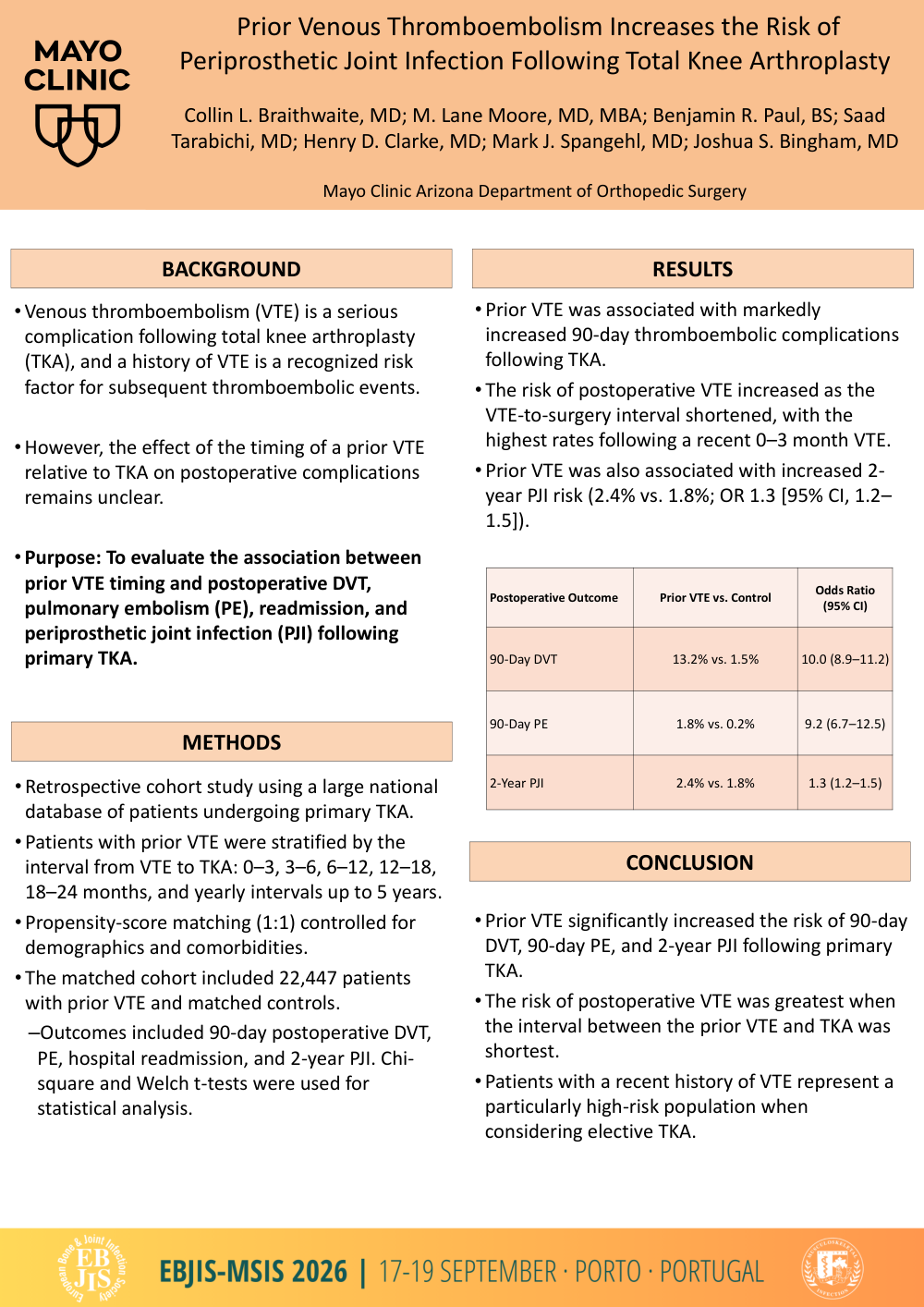
Prior VTE was associated with markedly increased 90-day thromboembolic complications following TKA.
The risk of postoperative VTE increased as the VTE-to-surgery interval shortened, with the highest rates following a recent 0–3 month VTE.
Prior VTE was also associated with increased 2-year PJI risk (2.4% vs. 1.8%; OR 1.3 [95% CI, 1.2–1.5]).
Conclusion:
Prior VTE significantly increased the risk of 90-day DVT, 90-day PE, and 2-year PJI following primary TKA.
The risk of postoperative VTE was greatest when the interval between the prior VTE and TKA was shortest.
Patients with a recent history of VTE represent a particularly high-risk population when considering elective TKA.