477 posters, 14 topics, 2,065 authors, 1,055 institutions
ePostersLive by SciGen Technologies S.A. All rights reserved.
The Joint EBJIS-MSIS 2026 Conference
17 - 19 September, 2026 | Porto, Portugal

EP303
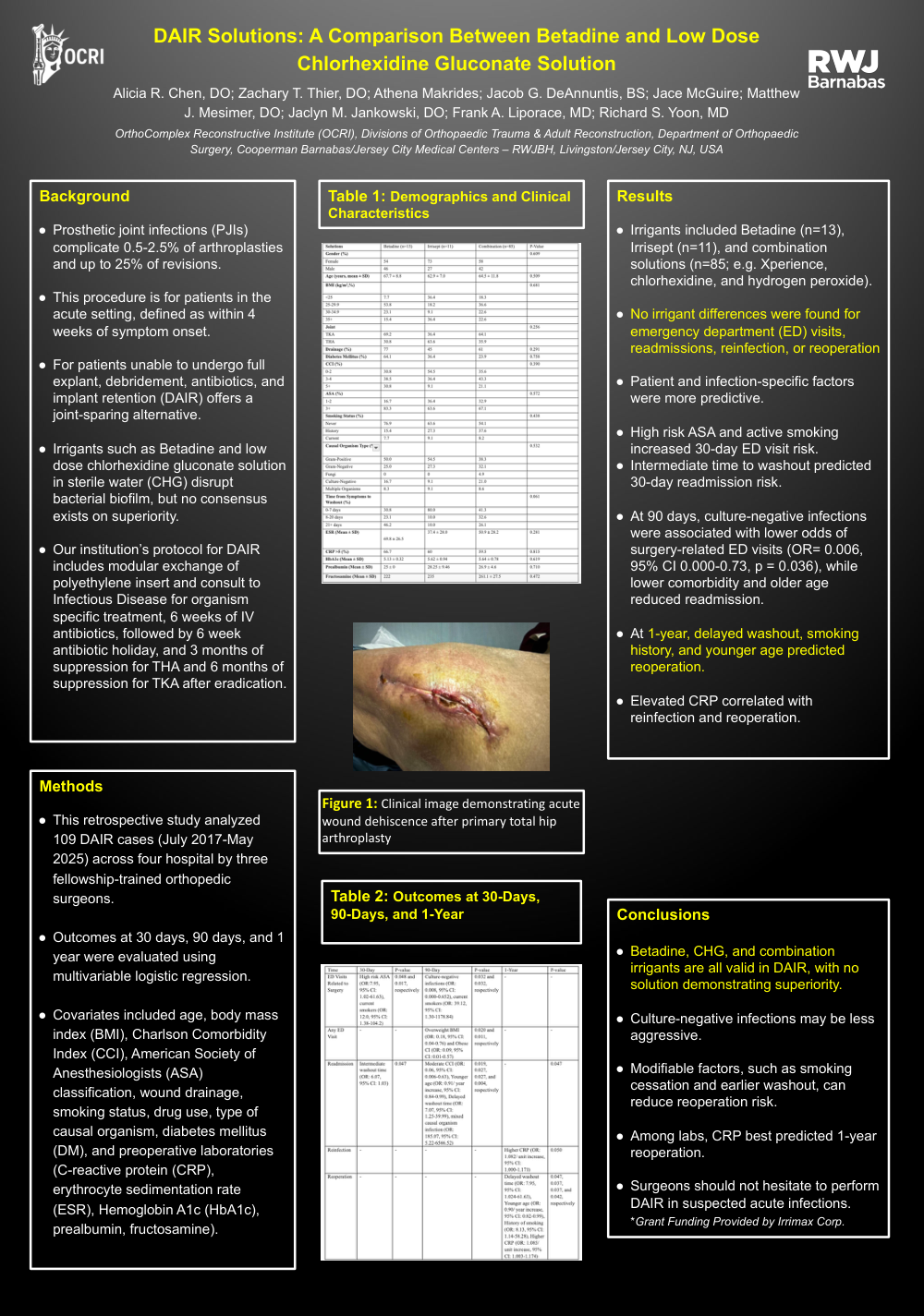
Modern Solutions Used in Debridement Antibiotics and Implant Retention (DAIR) for Infected Total Joint Arthroplasty: Is There A Clear Winner?
Part of Topic
Prosthetic Joint Infections
Modern Solutions Used in Debridement Antibiotics and Implant Retention (DAIR) for Infected Total Joint Arthroplasty: Is There A Clear Winner?
Abstract
Introduction
Prosthetic joint infections (PJIs) complicate 0.5-2.5% of arthroplasties and up to 25% of revision arthroplasties. For acute infections within four weeks of symptom onset, debridement, antibiotics, and implant retention (DAIR) offers a joint-sparing treatment. Although 10% povidone iodine and 0.05% low-dose chlorhexidine gluconate disrupt bacterial biofilm, their comparative effectiveness during DAIR remains unclear.
Methods
This retrospective study included 99 DAIR cases performed from July 2017 to April 2025 across four hospitals by three fellowship-trained orthopedic surgeons. The primary outcome was 1-year reoperation. Secondary outcomes included 30- and 90-day ED visits and readmissions, and 1-year reinfection. Patient, clinical, microbiologic, and laboratory covariates were evaluated.
Results
Irrigation solutions included 10% povidone-iodine (n=10), 0.05% chlorhexidine gluconate in sterile water (n=11), and combination solutions (n=78; e.g., citrate-based solution). No statistically significant differences in ED visits, readmission, reinfection, or reoperation were observed among irrigation groups. However, small and imbalanced groups limited detection of clinically meaningful differences. High-risk ASA and active smoking increased 30-day ED visit risk. Intermediate time to washout predicted 30-day readmission risk. At 90 days, culture-negative infections were associated with lower odds of surgery-related ED visits (OR= 0.006, 95% CI 0.000-0.73, p = 0.036). At 1 year, delayed washout, smoking history, and elevated CRP were associated with adverse outcomes, including reinfection and reoperation.
Conclusion
No significant association was identified between irrigation solutions and postoperative outcomes. Delayed washout and smoking were associated with selected adverse outcomes. Findings should be interpreted cautiously given the small sample size, group imbalance, and potential model instability.
Level of Evidence: IV
Keywords: 10% Povidone-Iodine, 0.05% Chlorhexidine Gluconate, DAIR, periprosthetic joint infection, total knee arthroplasty