477 posters, 14 topics, 2,065 authors, 1,055 institutions
ePostersLive by SciGen Technologies S.A. All rights reserved.
The Joint EBJIS-MSIS 2026 Conference
17 - 19 September, 2026 | Porto, Portugal

EP299
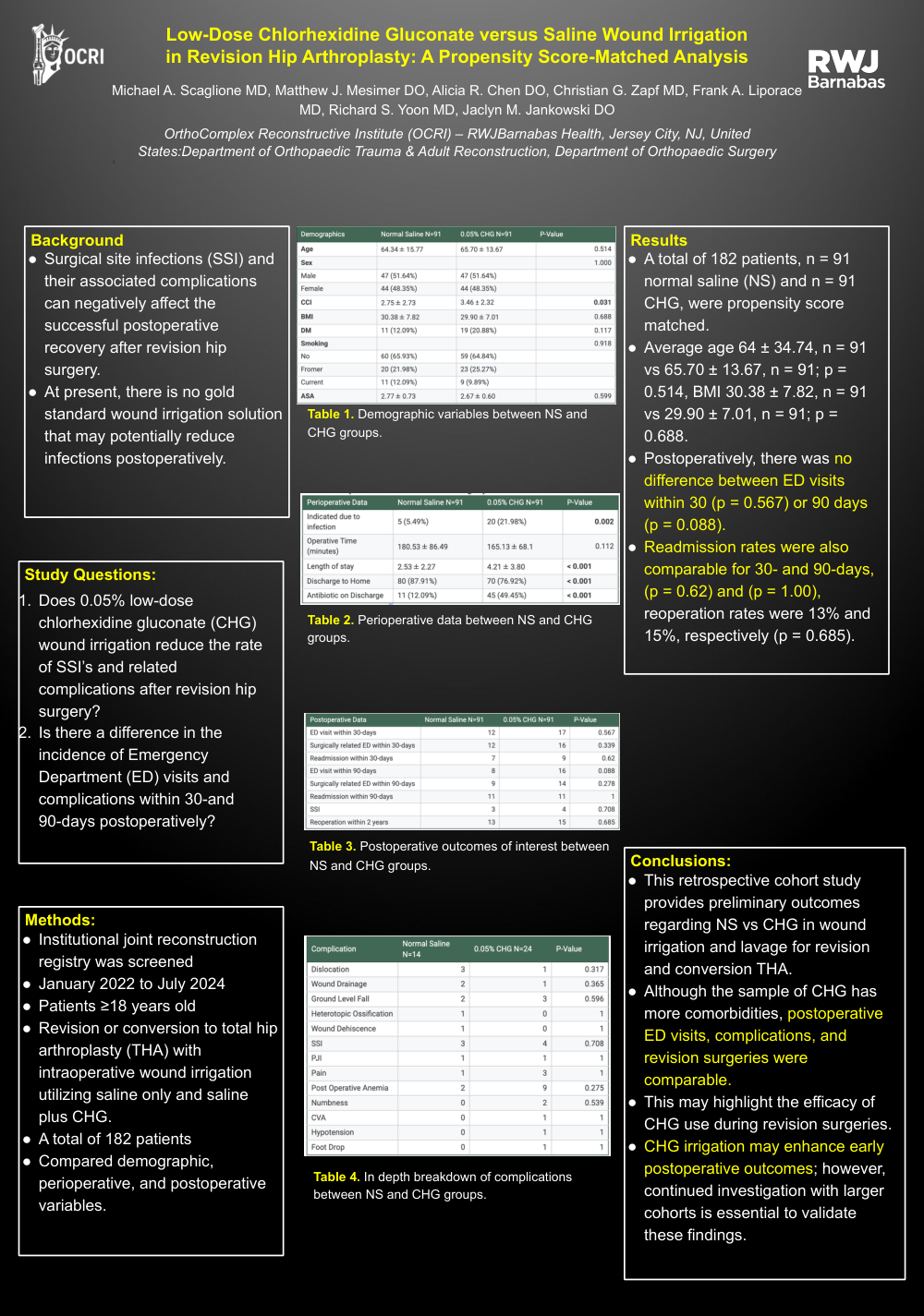
Low-Dose Chlorhexidine Gluconate versus Saline Wound Irrigation in Revision Hip Arthroplasty: A Propensity Score-Matched Analysis
Part of Topic
Prosthetic Joint Infections
Abstract
Title: Low-Dose 0.05% Chlorhexidine Gluconate versus Saline Wound Irrigation in Revision Hip Arthroplasty: A Propensity Score-Matched Analysis
Background and Rationale Surgical site infections (SSI) and their associated complications can negatively affect the successful postoperative recovery after revision hip surgery. At present, there is no gold standard wound irrigation solution that may potentially reduce infections postoperatively.
Study Questions:
-
Does 0.05% low-dose chlorhexidine gluconate (CHG) wound irrigation reduce the rate of SSI’s and related complications after revision hip surgery?
-
Is there a difference in the incidence of Emergency Department (ED) visits and complications within 30-and 90-days postoperatively?
Methods: Institutional joint reconstruction registry was screened from January 2022 to July 2024 to identify patients ≥18 years old who underwent revision or conversion to total hip arthroplasty (THA) with intraoperative wound irrigation utilizing saline only and saline plus CHG. A total of 182 patients were identified and compared across demographic, perioperative, and postoperative variables.
Results: A total of 182 patients, n = 91 normal saline (NS) and n = 91 CHG, were propensity score matched. Average age 64 ± 34.74, n = 91 vs 65.70 ± 13.67, n = 91; p = 0.514, BMI 30.38 ± 7.82, n = 91 vs 29.90 ± 7.01, n = 91; p = 0.688. Postoperatively, there was no difference between ED visits within 30 (p = 0.567) or 90 days (p = 0.088). Readmission rates were also comparable for 30- and 90-days, (p = 0.62) and (p = 1.00), reoperation rates were 13% and 15%, respectively (p = 0.685).
Discussion: This retrospective cohort study provides preliminary outcomes regarding NS vs CHG in wound irrigation and lavage for revision and conversion THA. Although the sample of CHG has more comorbidities, postoperative ED visits, complications, and revision surgeries were comparable. This may highlight the efficacy of CHG use during revision surgeries.
Conclusion: CHG irrigation may enhance early postoperative outcomes; however, continued investigation with larger cohorts is essential to validate these findings.
Level of Evidence: IV
Keywords: Total Hip arthroplasty, Revision arthroplasty, Wound Irrigation