477 posters, 14 topics, 2,065 authors, 1,055 institutions
ePostersLive by SciGen Technologies S.A. All rights reserved.
The Joint EBJIS-MSIS 2026 Conference
17 - 19 September, 2026 | Porto, Portugal

EP298
Implementation and Outcomes of a Preoperative Optimization and Infection Prevention Protocol in a High Risk Total Joint Practice Setting
Poster Presenter
Part of Topic
Prosthetic Joint Infections
Implementation and Outcomes of a Preoperative Optimization and Infection Prevention Protocol in a High-Risk Total Joint Practice Setting
Abstract
Introduction: Poor glycemic control can be devastating for surgical outcomes in the orthopaedic setting, and medical optimization is key to minimize risks. Elevated HbA1c has been associated with wound dehiscence, delayed wound healing, venous thromboembolism, and surgical site infection. This study aimed to understand the relationship between preoperative HbA1c, prealbumin, and fructosamine on postoperative complications.
Methods: A retrospective chart review was conducted on 1,004 primary total knee arthroplasties (TKA) across patients aged 24-95. Odds ratios for complications were calculated using logistic regression, controlling for several confounding variables. These rates were compared using t-test to calculate Pearson's correlation coefficient.
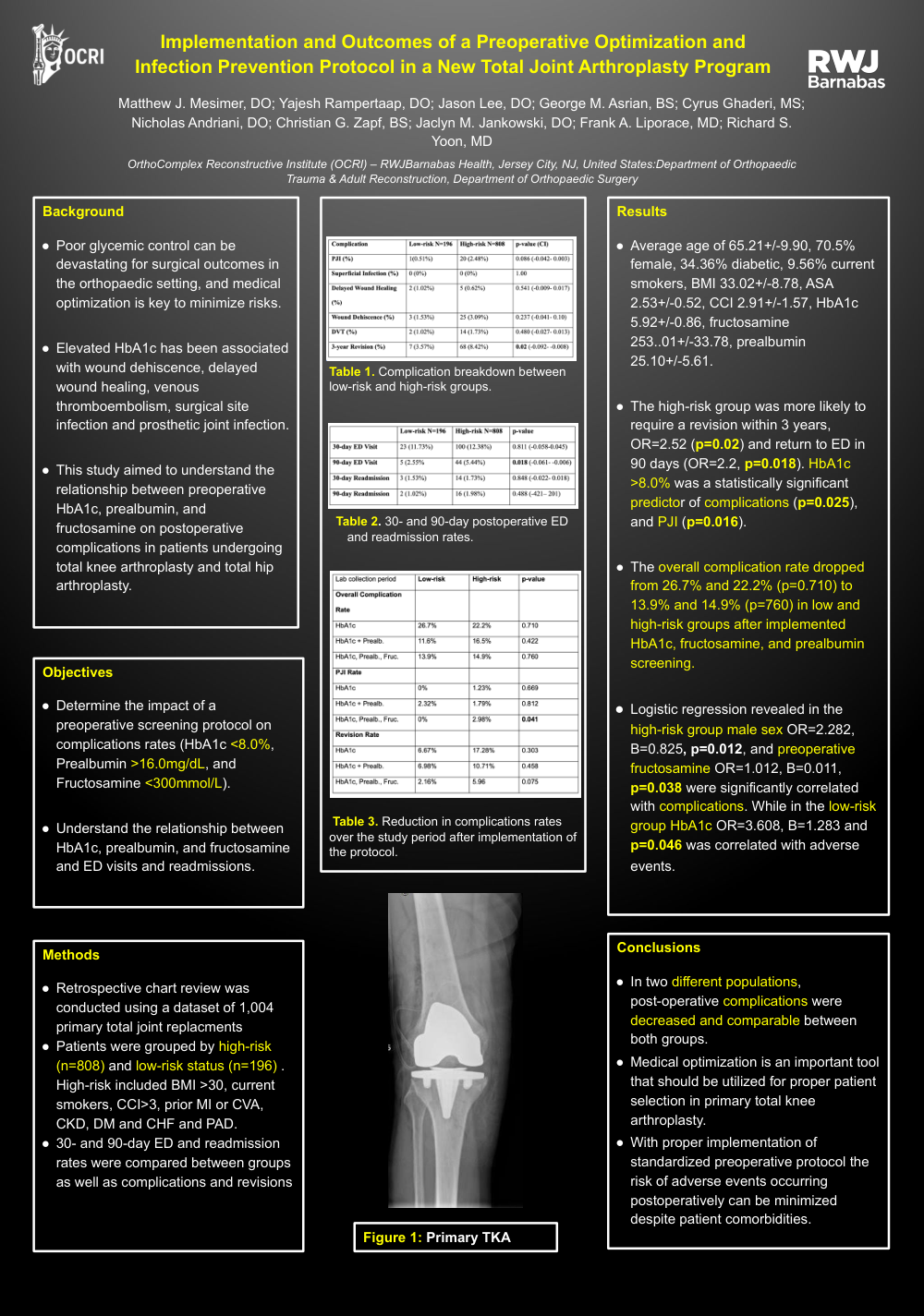
Results: Cohort consisted of 1,004 patients; average age of 65.21+/-9.90, 70.5% female, 34.36% diabetic, 9.56% current smokers, BMI 33.02+/-8.78, ASA 2.53+/-0.52, CCI 2.91+/-1.57, HbA1c 5.92+/-0.86, fructosamine 253.01+/-33.78, prealbumin 25.10+/-5.61. The high-risk group was more likely to require a revision within 3 years(OR=2.52, p=0.02) and return to ED in 90 days (OR=2.2, p=0.018). HbA1c >8.0% was a statistically significant predictor of complications (p=0.025), and PJI (p=0.016). The overall complication rate dropped from 26.7% and 22.2% to 13.9% and 14.9%.in low and high-risk groups. Logistic regression revealed in the high-risk group male sex OR=2.282, B=0.825, p=0.012, and preoperative fructosamine OR=1.012, B=0.011, p=0.038 were significantly correlated with complications. In the low-risk group HbA1c OR=3.608, B=1.283 and p=0.046 was correlated with adverse events.
Conclusion: Despite operating on two vastly different patient groups, 30- and 90-day ED and readmission rates were comparable between groups. Medical optimization is an important tool that should be utilized for proper patient selection in primary total knee arthroplasty. With proper implementation of standardized preoperative protocol the risk of adverse events occurring postoperatively can be minimized despite patient comorbidities.
Level of Evidence: III
Keywords: diabetes mellitus, TKA, fructosamine, A1c, medical optimization, preadmission testing