477 posters, 14 topics, 2,065 authors, 1,055 institutions
ePostersLive by SciGen Technologies S.A. All rights reserved.
The Joint EBJIS-MSIS 2026 Conference
17 - 19 September, 2026 | Porto, Portugal

EP296
Alternating Magnetic Fields (AMF) Reduce Cutibacterium acnes Biofilm in a Non-Invasive Fashion
Part of Topic
Prosthetic Joint Infections
Abstract
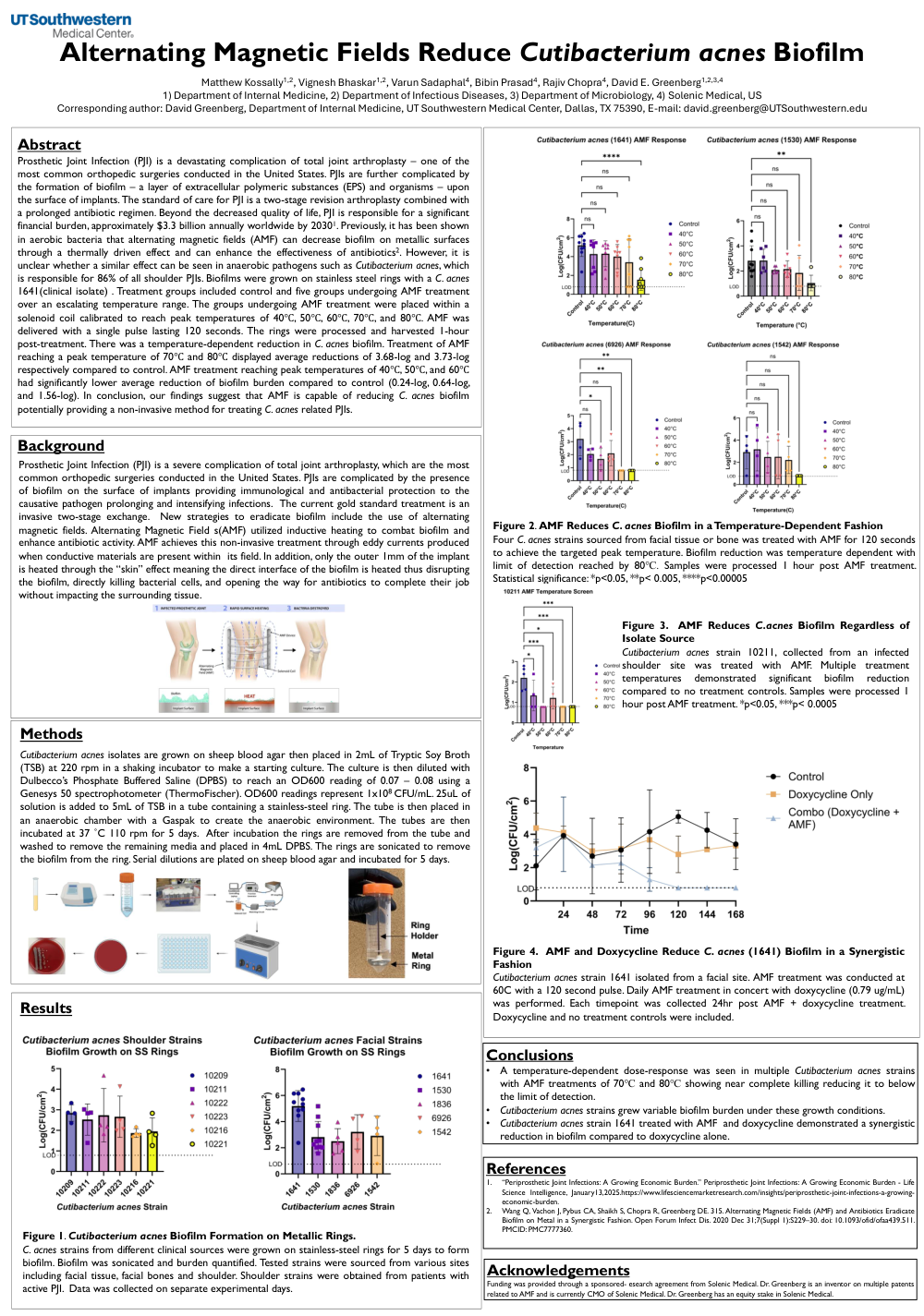
Prosthetic Joint Infection (PJI) is a devastating complication of total joint arthroplasty – one of the most common orthopedic surgeries conducted in the United States. PJIs are further complicated by the formation of biofilm – a layer of extracellular polymeric substances (EPS) and organisms – upon the surface of implants. The standard of care for PJI is a two-stage revision arthroplasty combined with a prolonged antibiotic regimen. Beyond the decreased quality of life, PJI is responsible for a significant financial burden, approximately $3.3 billion annually worldwide by 20301. Previously, it has been shown in aerobic bacteria that alternating magnetic fields (AMF) can decrease biofilm on metallic surfaces through a thermally driven effect and can enhance the effectiveness of antibiotics2. However, it is unclear whether a similar effect can be seen in anaerobic pathogens such as Cutibacterium acnes, which is responsible for 86% of all shoulder PJIs. Biofilms were grown on stainless steel rings with a C. acnes 1641(clinical isolate) . Treatment groups included control and five groups undergoing AMF treatment over an escalating temperature range. The groups undergoing AMF treatment were placed within a solenoid coil calibrated to reach peak temperatures of 40℃, 50℃, 60℃, 70℃, and 80℃. AMF was delivered with a single pulse lasting 120 seconds. The rings were processed and harvested 1-hour post-treatment. There was a temperature-dependent reduction in C. acnes biofilm. Treatment of AMF reaching a peak temperature of 70℃ and 80℃ displayed average reductions of 3.68-log and 3.73-log respectively compared to control. AMF treatment reaching peak temperatures of 40℃, 50℃, and 60℃ had significantly lower average reduction of biofilm burden compared to control (0.24-log, 0.64-log, and 1.56-log). In conclusion, our findings suggest that AMF is capable of reducing C. acnes biofilm potentially providing a non-invasive method for treating C. acnes related PJIs.
Background
Prosthetic Joint Infection (PJI) is a severe complication of total joint arthroplasty, which are the most common orthopedic surgeries conducted in the United States. PJIs are complicated by the presence of biofilm on the surface of implants providing immunological and antibacterial protection to the causative pathogen prolonging and intensifying infections. The current gold standard treatment is an invasive two-stage exchange. New strategies to eradicate biofilm include the use of alternating magnetic fields. Alternating Magnetic Fields (AMF) utilized inductive heating to combat biofilm and enhance antibiotic activity. AMF achieves this non-invasive treatment through eddy currents produced when conductive materials are present within its field. In addition, only the outer 1mm of the implant is heated through the “skin” effect meaning the direct interface of the biofilm is heated thus disrupting the biofilm, directly killing bacterial cells, and opening the way for antibiotics to complete their job without impacting the surrounding tissue.
Methods
Cutibacterium acnes isolates are grown on sheep blood agar then placed in 2mL of Tryptic Soy Broth (TSB) at 220 rpm in a shaking incubator to make a starting culture. The culture is then diluted with Dulbecco’s Phosphate Buffered Saline (DPBS) to reach an OD600 reading of 0.07 – 0.08 using a Genesys 50 spectrophotometer (ThermoFischer). OD600 readings represent 1x10⁸ CFU/mL. 25uL of solution is added to 5mL of TSB in a tube containing a stainless-steel ring. The tube is then placed in an anaerobic chamber with a Gaspak to create the anaerobic environment. The tubes are then incubated at 37 ˚C 110 rpm for 5 days. After incubation the rings are removed from the tube and washed to remove the remaining media and placed in 4mL DPBS. The rings are sonicated to remove the biofilm from the ring. Serial dilutions are plated on sheep blood agar and incubated for 5 days.
Results
Four C. acnes strains sourced from facial tissue or bone was treated with AMF for 120 seconds to achieve the targeted peak temperature. Biofilm reduction was temperature dependent with limit of detection reached by 80℃. Samples were processed 1 hour post AMF treatment. Cutibacterium acnes strain 10211, collected from an infected shoulder site was treated with AMF. Multiple treatment temperatures demonstrated significant biofilm reduction compared to no treatment controls. Cutibacterium acnes strain 1641 isolated from a facial site. AMF treatment was conducted at 60C with a 120 second pulse. Daily AMF treatment in concert with doxycycline (0.79 ug/mL) was performed. Each timepoint was collected 24hr post AMF + doxycycline treatment.
Conclusions