477 posters, 14 topics, 2,065 authors, 1,055 institutions
ePostersLive by SciGen Technologies S.A. All rights reserved.
The Joint EBJIS-MSIS 2026 Conference
17 - 19 September, 2026 | Porto, Portugal

EP295
Comparing Early Outcomes of Antibacterial-coated vs Uncoated Endoprostheses: A Single Institutions Experience with Quaternary Ammonium Technology
Poster Presenter
Part of Topic
Prosthetic Joint Infections
Background:
Periprosthetic infection remains a significant source of morbidity in endoprosthesis reconstruction
Quaternary ammonium coating technology [NanoCept; Onkos Surgical, Parsippany, NJ] was FDA approved on 12/19/2024
Purpose: compare early clinical outcomes between quaternary ammonium-coated (QAC) and uncoated lower extremity endoprostheses
Hypothesis: QAC implants would demonstrate lower rates of infection and revision
Methods:
A retrospective cohort study was performed between December 2022 and October 2025
Reconstructions included:
-Total Femur Replacement (TFR)
-Proximal Femur Replacement (PFR)
-Distal Femur Replacement (DFR)
-Proximal Tibia Replacement (PTR)
Stratified based on the use of QAC vs uncoated implants
Primary outcomes included periprosthetic infection and repeat surgery
Secondary outcomes included wound complications and implant survivorship
For QAC implants, the percentage of the implant’s surface area was coated was calculated
Results:
Reconstructions:
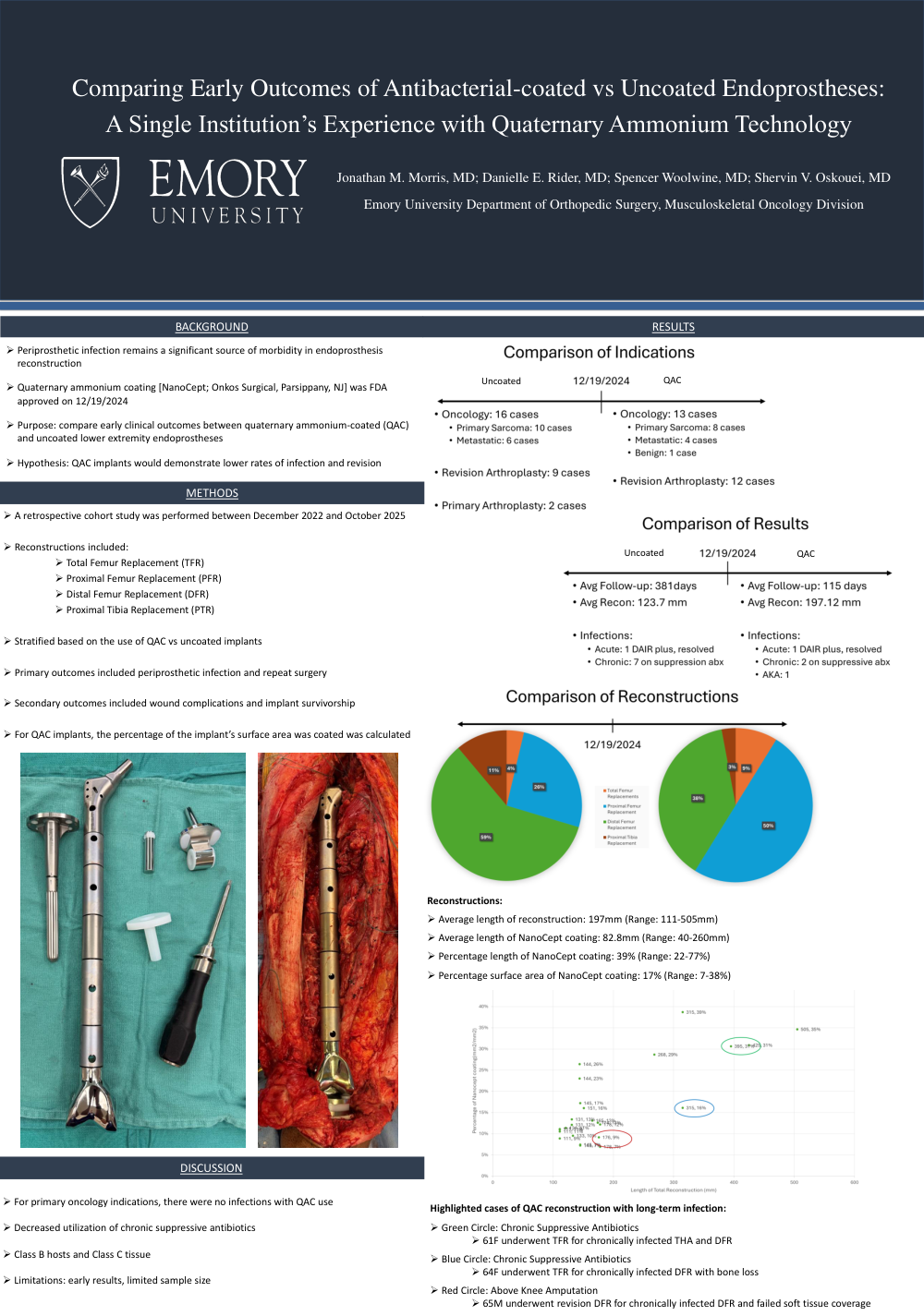
Average length of reconstruction: 197mm (Range: 111-505mm)
Average length of NanoCept coating: 82.8mm (Range: 40-260mm)
Percentage length of NanoCept coating: 39% (Range: 22-77%)
Percentage surface area of NanoCept coating: 17% (Range: 7-38%)
Highlighted cases of QAC reconstruction with long-term infection:
Green Circle: Chronic Suppressive Antibiotics
61F underwent TFR for chronically infected THA and DFR
Blue Circle: Chronic Suppressive Antibiotics
64F underwent TFR for chronically infected DFR with bone loss
Red Circle: Above Knee Amputation
65M underwent revision DFR for chronically infected DFR and failed soft tissue coverage
Discusssion:
For primary oncology indications, there were no infections with QAC use
Decreased utilization of chronic suppressive antibiotics
Class B hosts and Class C tissue make aseptic revisions still diffiicult
Limitations: early results, limited sample size