477 posters, 14 topics, 2,065 authors, 1,055 institutions
ePostersLive by SciGen Technologies S.A. All rights reserved.
The Joint EBJIS-MSIS 2026 Conference
17 - 19 September, 2026 | Porto, Portugal

EP289
Debridement, Antibiotics, and Implant Retention (DAIR) Utilizing Modern Techniques in the Subacute Period
Part of Topic
Prosthetic Joint Infections
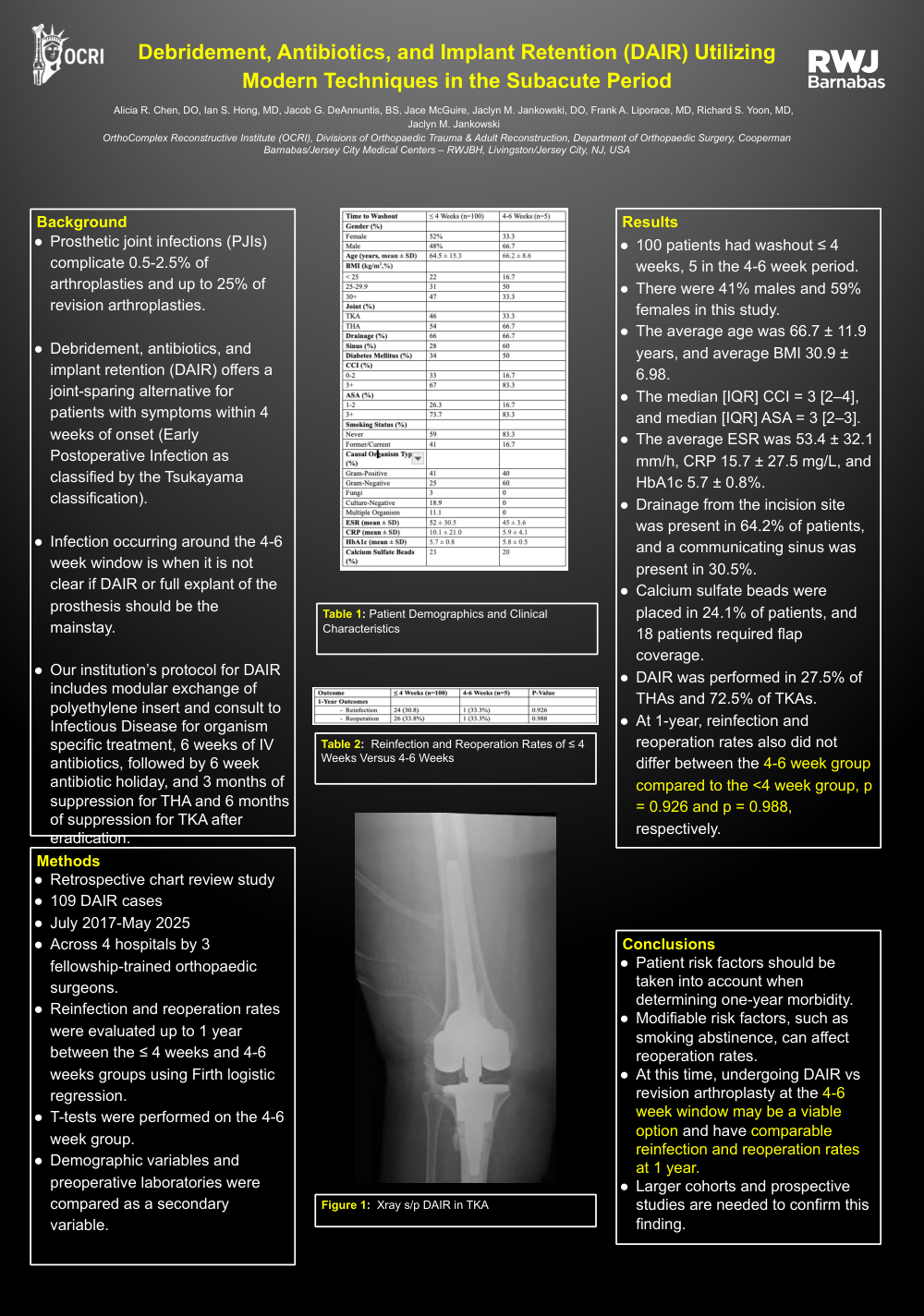
Debridement, Antibiotics, and Implant Retention (DAIR) Utilizing Modern Techniques in the Subacute Period
ABSTRACT
Introduction
Prosthetic joint infections (PJIs) complicate 0.5-2.5% of arthroplasties and up to 25% of revision arthroplasties.For patients unable to undergo full explant, debridement, antibiotics, and implant retention (DAIR) offers a joint-sparing alternative. The ideal time for DAIR to be performed is no more than 4 weeks once symptoms arise. Infection occurring around the 4-6 week window is when it is not clear if DAIR or full explant of the prosthesis should be the mainstay.
Methods
This retrospective study analyzed 109 DAIR cases (July 2017-May 2025) across four hospitals by three fellowship-trained orthopaedic surgeons. Reinfection and reoperation rates were evaluated up to 1 year between the ≤ 4 weeks and > 4 weeks groups using Firth logistic regression. T-tests were performed on the 4-6 week group. Demographic variables and preoperative laboratories were compared as a secondary variable.
Results
100 patients had washout ≤ 4 weeks, 9 in > 4 weeks and 5 in the 4-6 week period. There were 41% males and 59% females in this study. The average age was 66.7 ± 11.9 years, and average BMI 30.9 ± 6.98. The median [IQR] CCI = 3 [2–4], and median [IQR] ASA = 3 [2–3]. The average ESR was 53.4 ± 32.1 mm/h, CRP 15.7 ± 27.5 mg/L, and HbA1c 5.7 ± 0.8%. Drainage from the incision site was present in 64.2% of patients, and a communicating sinus was present in 30.5%. Calcium sulfate beads were placed in 24.1% of patients, and 18 patients required flap coverage. DAIR was performed in 27.5% of THAs and 72.5% of TKAs. At 1-year, reinfection and reoperation rates also did not differ between the 4-6 week group compared to the <4 week group, p = 0.926 and p = 0.988, respectively.
Conclusion
Patient risk factors should be taken into account when determining one-year morbidity. Modifiable risk factors, such as smoking abstinence, can affect reoperation rates. At this time, undergoing DAIR vs revision arthroplasty at the 4-6 week window may be a viable option and have comparable reinfection and reoperation rates at 1 year.
Level of Evidence: IV
Keywords: Prosthetic joint infection, DAIR, debridement antibiotics and implant retention, total knee arthroplasty, total hip arthroplasty