477 posters, 14 topics, 2,065 authors, 1,055 institutions
ePostersLive by SciGen Technologies S.A. All rights reserved.
The Joint EBJIS-MSIS 2026 Conference
17 - 19 September, 2026 | Porto, Portugal

EP288
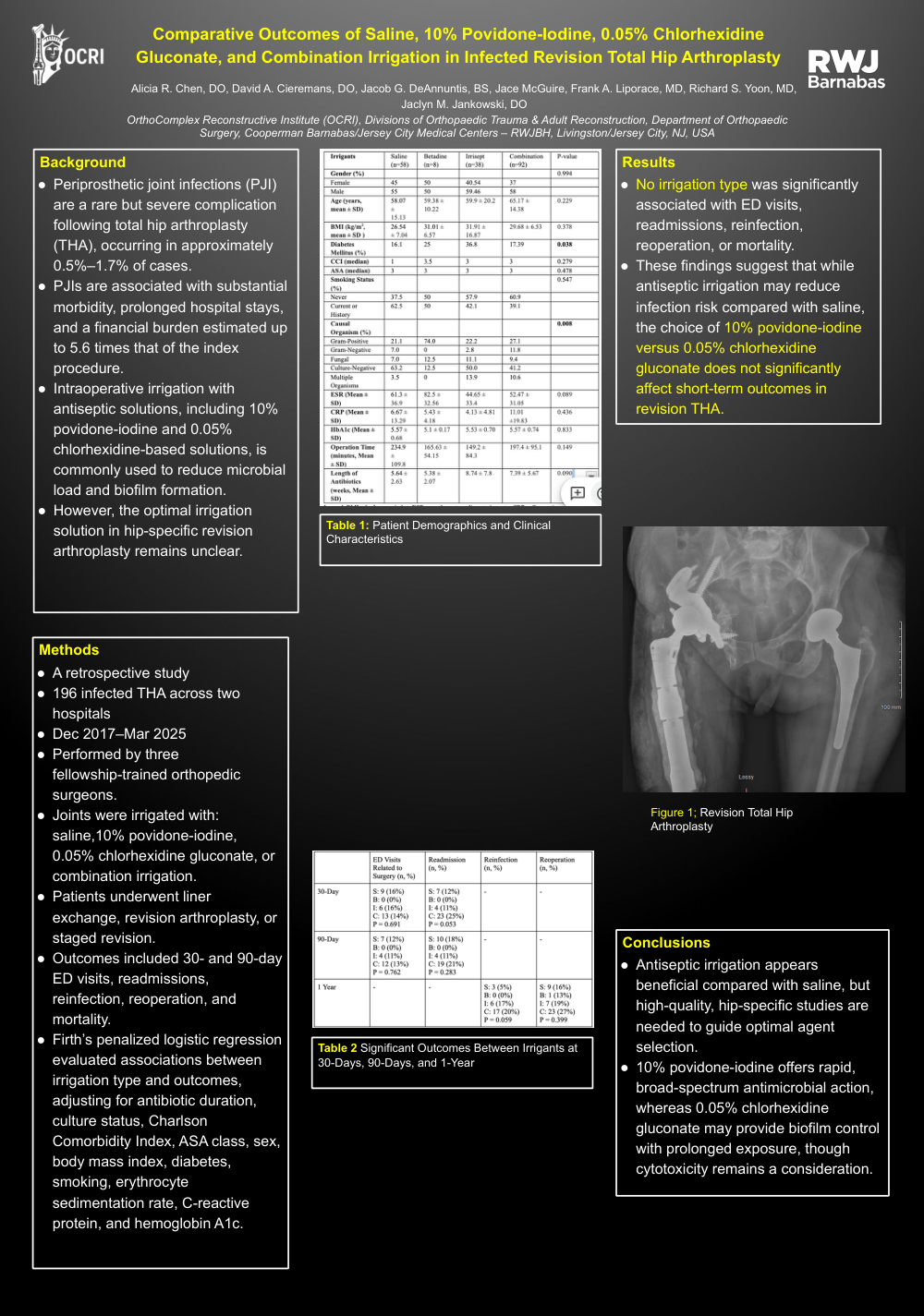
Comparative Outcomes of Saline, 10% Povidone-Iodine, 0.05% Chlorhexidine Gluconate, and Combination Irrigation in Infected Revision Total Hip Arthroplasty
Part of Topic
Prosthetic Joint Infections
Comparative Outcomes of Saline, 10% Povidone-Iodine, 0.05% Chlorhexidine Gluconate, and Combination Irrigation in Infected Revision Total Hip Arthroplasty
Abstract
Introduction: Periprosthetic joint infections (PJI) are a rare but severe complication following total hip arthroplasty (THA), occurring in approximately 0.5%–1.7% of cases. PJIs are associated with substantial morbidity, prolonged hospital stays, and a financial burden estimated up to 5.6 times that of the index procedure. Intraoperative irrigation with antiseptic solutions, including 10% povidone-iodine and 0.05% chlorhexidine-based solutions, is commonly used to reduce microbial load and biofilm formation. However, the optimal irrigation solution in hip-specific revision arthroplasty remains unclear.
Methods: We retrospectively analyzed 196 infected THA across two hospitals (Dec 2017–Mar 2025) performed by three fellowship-trained orthopedic surgeons. Joints were irrigated with saline,10% povidone-iodine, 0.05% chlorhexidine gluconate, or combination irrigation. Patients underwent liner exchange, revision arthroplasty, or staged revision. Outcomes included 30- and 90-day ED visits, readmissions, reinfection, reoperation, and mortality. Firth’s penalized logistic regression evaluated associations between irrigation type and outcomes, adjusting for antibiotic duration, culture status, Charlson Comorbidity Index, ASA class, sex, body mass index, diabetes, smoking, erythrocyte sedimentation rate, C-reactive protein, and hemoglobin A1c.
Results: No irrigation type was significantly associated with ED visits, readmissions, reinfection, reoperation, or mortality. These findings suggest that while antiseptic irrigation may reduce infection risk compared with saline, the choice of 10% povidone-iodine versus 0.05% chlorhexidine gluconate does not significantly affect short-term outcomes in revision THA.
Conclusions: Antiseptic irrigation appears beneficial compared with saline, but high-quality, hip-specific studies are needed to guide optimal agent selection. 10% povidone-iodine offers rapid, broad-spectrum antimicrobial action, whereas 0.05% chlorhexidine gluconate may provide biofilm control with prolonged exposure, though cytotoxicity remains a consideration.
Level of Evidence: IV
Keywords: Periprosthetic joint infection, total hip arthroplasty, 10% povidone-iodine, 0.05% chlorhexidine gluconate, irrigation, revision arthroplasty