477 posters, 14 topics, 2,065 authors, 1,055 institutions
ePostersLive by SciGen Technologies S.A. All rights reserved.
The Joint EBJIS-MSIS 2026 Conference
17 - 19 September, 2026 | Porto, Portugal

EP287
A Comparative Analysis of Saline, 10% Povidone-Iodine, 0.05% Chlorehexidine Gluconate, and Combination Irrigation Strategies in Infected Revision Total Knee Arthroplasty
Part of Topic
Prosthetic Joint Infections
A Comparative Analysis of Saline, 10% Povidone-Iodine, 0.05% Chlorhexidine Gluconate, and Combination Irrigation Strategies in Infected Revision Total Knee Arthroplasty
Introduction:
Periprosthetic joint infections (PJI) are an uncommon but serious complication following total knee arthroplasty (TKA), with reported rates ranging from 0.5% to 2.0%. Intraoperative irrigation is a commonly employed measure to reduce bacterial contamination and biofilm formation during knee arthroplasty to reduce risk of PJI. Much of the existing literature combines hip and knee arthroplasty populations, limiting knee-specific guidance.
Methods:
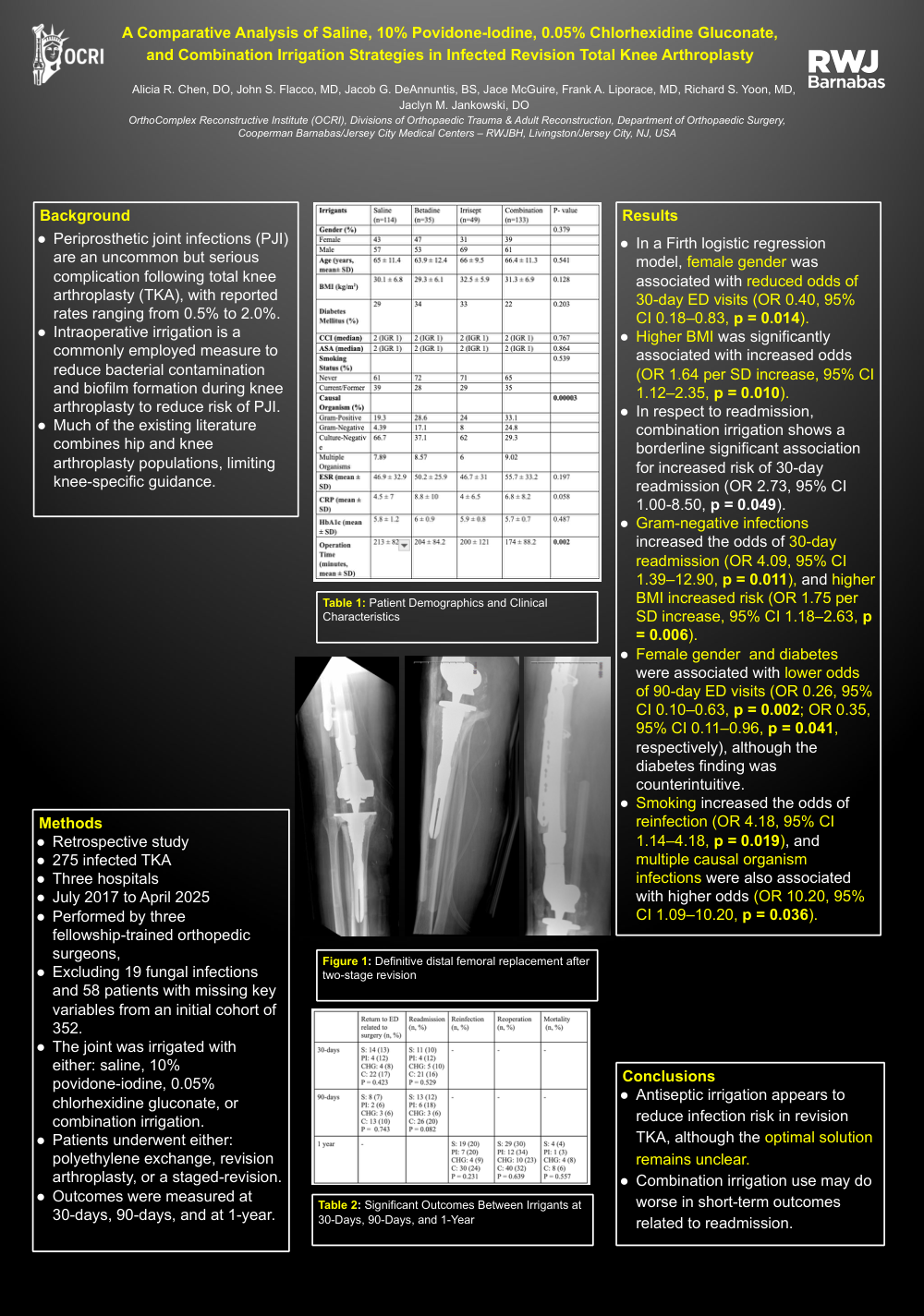
This retrospective study analyzed 275 infected TKA across three hospitals between July 2017 and April 2025, performed by three fellowship-trained orthopedic surgeons, after excluding 19 fungal infections and 58 patients with missing key variables from an initial cohort of 352. The joint was irrigated with either saline, 10% povidone-iodine, 0.05% chlorhexidine gluconate, or combination irrigation. Patients underwent either polyethylene exchange, revision arthroplasty, or a staged-revision. Outcomes were measured at 30-days, 90-days, and at 1-year.
Results:
In a Firth logistic regression model, female sex was associated with reduced odds of 30-day ED visits (OR 0.40, 95% CI 0.18–0.83, p = 0.014). Higher BMI was significantly associated with increased odds (OR 1.64 per SD increase, 95% CI 1.12–2.35, p = 0.010). In respect to readmission, combination irrigation shows a borderline significant association for increased risk of 30-day readmission (OR 2.73, 95% CI 1.00-8.50, p = 0.049). Gram-negative infections increased the odds of 30-day readmission (OR 4.09, 95% CI 1.39–12.90, p = 0.011), and higher BMI increased risk (OR 1.75 per SD increase, 95% CI 1.18–2.63, p = 0.006). Female sex and diabetes were associated with lower odds of 90-day ED visits (OR 0.26, 95% CI 0.10–0.63, p = 0.002; OR 0.35, 95% CI 0.11–0.96, p = 0.041, respectively), although the diabetes finding was counterintuitive. Smoking increased the odds of reinfection (OR 4.18, 95% CI 1.14–4.18, p = 0.019), and multiple causal organism infections were also associated with higher odds (OR 10.20, 95% CI 1.09–10.20, p = 0.036).
Conclusion:
Antiseptic irrigation appears to reduce infection risk in revision TKA, although the optimal solution remains unclear. Combination irrigation use may do worse in short-term outcomes related to readmission.
Level of Evidence: IV
Keywords: Revision knee arthroplasty, 0.05% chlorhexidine gluconate, total knee arthroplasty, 10% povidone-iodine