477 posters, 14 topics, 2,065 authors, 1,055 institutions
ePostersLive by SciGen Technologies S.A. All rights reserved.
The Joint EBJIS-MSIS 2026 Conference
17 - 19 September, 2026 | Porto, Portugal

EP285
Diabetes mellitus as a risk factor for infection-related revision in knee but not in hip arthroplasty
Poster Presenter
Part of Topic
Prosthetic Joint Infections
Diabetes mellitus is a risk factor for infection-related revision in knee but not hip arthroplasty
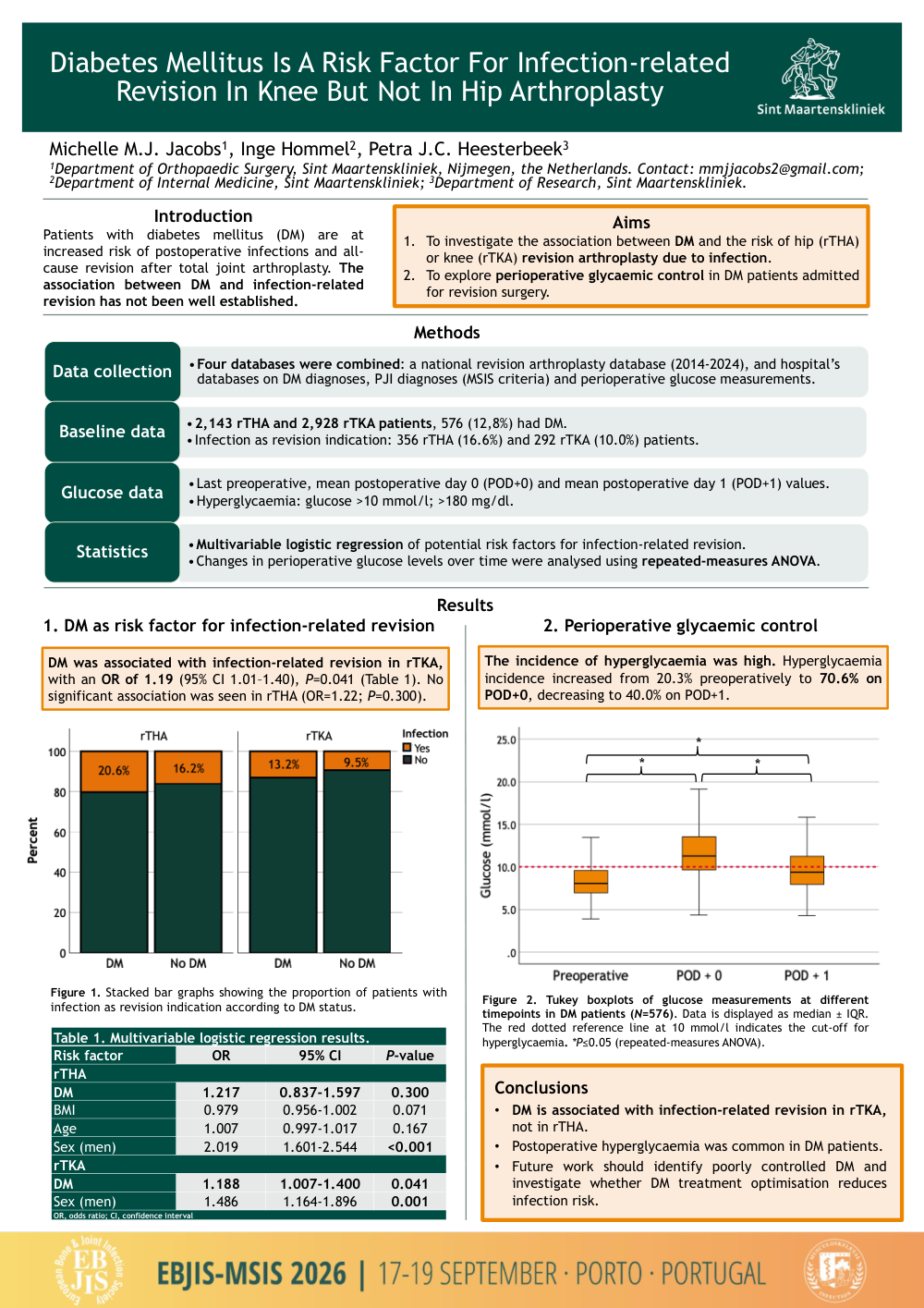
Background. Patients with diabetes mellitus (DM) are at increased risk of postoperative infections and all-cause revision after total joint arthroplasty. This retrospective study aimed to investigate the relationship between diabetes and the risk of hip (rTHA) or knee (rTKA) revision arthroplasty due to infection. In addition, we explored perioperative glycaemic control.
Methods. Data on revision arthroplasties was obtained from our revision database and combined with data on DM diagnoses, infection diagnoses and perioperative glucose measurements. 2,928 rTKA patients and 2,143 rTHA patients were included, of whom 576 had DM (12.8%). Univariate testing of potential risk factors for infection as revision indication was performed, followed by multivariable logistic regression. Glucose measurements in DM patients were transformed into last preoperative, mean postoperative day 0 (POD+0) and mean postoperative day 1 (POD+1) values, and the incidence of hyperglycaemia (glucose ≥10 mmol/l) per time point was evaluated. Changes in glucose levels over time were analyzed using a repeated-measures ANOVA.
Results. Infection as revision indication occurred in 10.0% (rTKA) and 16.6% (rTHA) of patients. In rTKA patients, both DM (P=0.041) and male sex (P=0.001) were associated with infection as revision indication. In rTHA patients, only male sex was significantly associated with infection (P<0.001). The mean glucose was 8.5 mmol/l preoperatively, 11.6 mmol/l on POD+0 (P<0.001) and 9.8 mmol/l on POD+1 (P<0.001). There was no difference in hyperglycaemia incidence between patients with infection as revision indication and other patients.
Conclusions. DM was associated with infection as revision indication in rTKA patients, but not in rTHA patients. Male sex was an independent nonmodifiable risk factor for both rTHA and rTKA patients. Postoperative hyperglycaemia occurred in the majority of patients with DM. Future studies should focus on identifying poorly regulated DM patients and investigate whether interventions to optimize glycaemic control can mitigate infection risk in these patients.