477 posters, 14 topics, 2,065 authors, 1,055 institutions
ePostersLive by SciGen Technologies S.A. All rights reserved.
The Joint EBJIS-MSIS 2026 Conference
17 - 19 September, 2026 | Porto, Portugal

EP283
TWO-STAGE REVISION IN PERIPROSTHETIC JOINT INFECTIONS WITH A MONOBLOC TAPERED STEM
Poster Presenter
Part of Topic
Prosthetic Joint Infections
BACKGROUND
Periprosthetic joint infections (PJIs) represent one of the most feared complications following hip arthroplasty. They are associated with prolonged hospital stays, increased healthcare costs, and higher morbidity and mortality rates.
The treatment of PJIs remains challenging, as these infections are poorly responsive to systemic antibiotic therapy alone, primarily due to the limited bioavailability of antibiotics at the joint site. Consequently, a surgical approach is almost invariably required, in conjunction with both local and systemic antibiotic therapy.
The incidence of hip PJIs is estimated to be approximately 1–2%. Given the progressive increase in the number of hip arthroplasty procedures performed worldwide, the overall burden of PJIs is expected to rise accordingly, further emphasizing the need for a dedicated and standardized diagnostic and therapeutic approach aimed at optimizing treatment strategies and patient outcomes.
STUDY DESIGN AND METHODS
We retrospectively reviewed the medical records of 124 patients treated at our institution between 2009 and 2019.
All patients were diagnosed with PJI according to the criteria proposed by the 2018 International Consensus Meeting (ICM) on Musculoskeletal Infection. All patients underwent two-stage revision arthroplasty, with implantation of an uncemented Zimmer Wagner SL femoral stem during the second stage.
The following data were collected: sex, age at diagnosis, number of previous surgical procedures, microbiological findings, associated bone defects, type of antibiotic-loaded spacer used, and the length and diameter of the Wagner SL stem.
All patients subsequently underwent functional assessment using the Harris Hip Score (HHS) and the Oxford Hip Score (OHS).
Treatment failures were recorded, including both septic and aseptic complications.
RESULTS
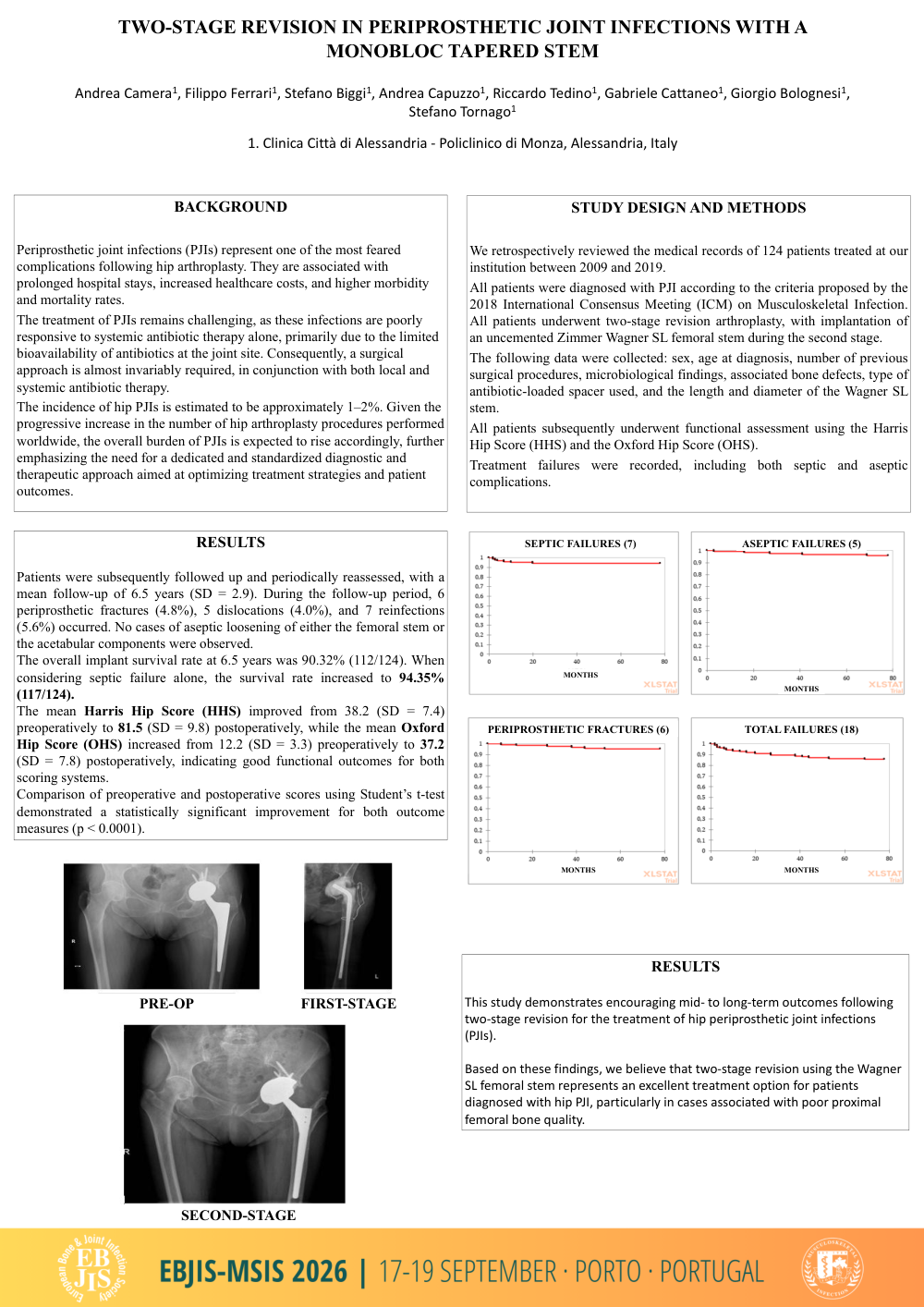
Patients were subsequently followed up and periodically reassessed, with a mean follow-up of 6.5 years (SD = 2.9). During the follow-up period, 6 periprosthetic fractures (4.8%), 5 dislocations (4.0%), and 7 reinfections (5.6%) occurred. No cases of aseptic loosening of either the femoral stem or the acetabular components were observed.
The overall implant survival rate at 6.5 years was 90.32% (112/124). When considering septic failure alone, the survival rate increased to 94.35% (117/124).
The mean Harris Hip Score (HHS) improved from 38.2 (SD = 7.4) preoperatively to 81.5 (SD = 9.8) postoperatively, while the mean Oxford Hip Score (OHS) increased from 12.2 (SD = 3.3) preoperatively to 37.2 (SD = 7.8) postoperatively, indicating good functional outcomes for both scoring systems.
Comparison of preoperative and postoperative scores using Student’s t-test demonstrated a statistically significant improvement for both outcome measures (p < 0.0001).
RESULTS
This study demonstrates encouraging mid- to long-term outcomes following two-stage revision for the treatment of hip periprosthetic joint infections (PJIs).
Based on these findings, we believe that two-stage revision using the Wagner SL femoral stem represents an excellent treatment option for patients diagnosed with hip PJI, particularly in cases associated with poor proximal femoral bone quality.