477 posters, 14 topics, 2,065 authors, 1,055 institutions
ePostersLive by SciGen Technologies S.A. All rights reserved.
The Joint EBJIS-MSIS 2026 Conference
17 - 19 September, 2026 | Porto, Portugal

EP264
Calcium Phosphate and silver coated implants in recurrent hip arthroplasty septic failures: a single center early experience
Part of Topic
Prosthetic Joint Infections
Calcium Phosphate and silver coated implants in recurrent hip arthroplasty septic failures: a single center early experience
Manzotti A1,2, Brioschi D1, Grassi M1, Rauch R2
1Ospedale L Sacco, Milano, , Italy, 2Università degli Studi, Milano, Italy
AIM:
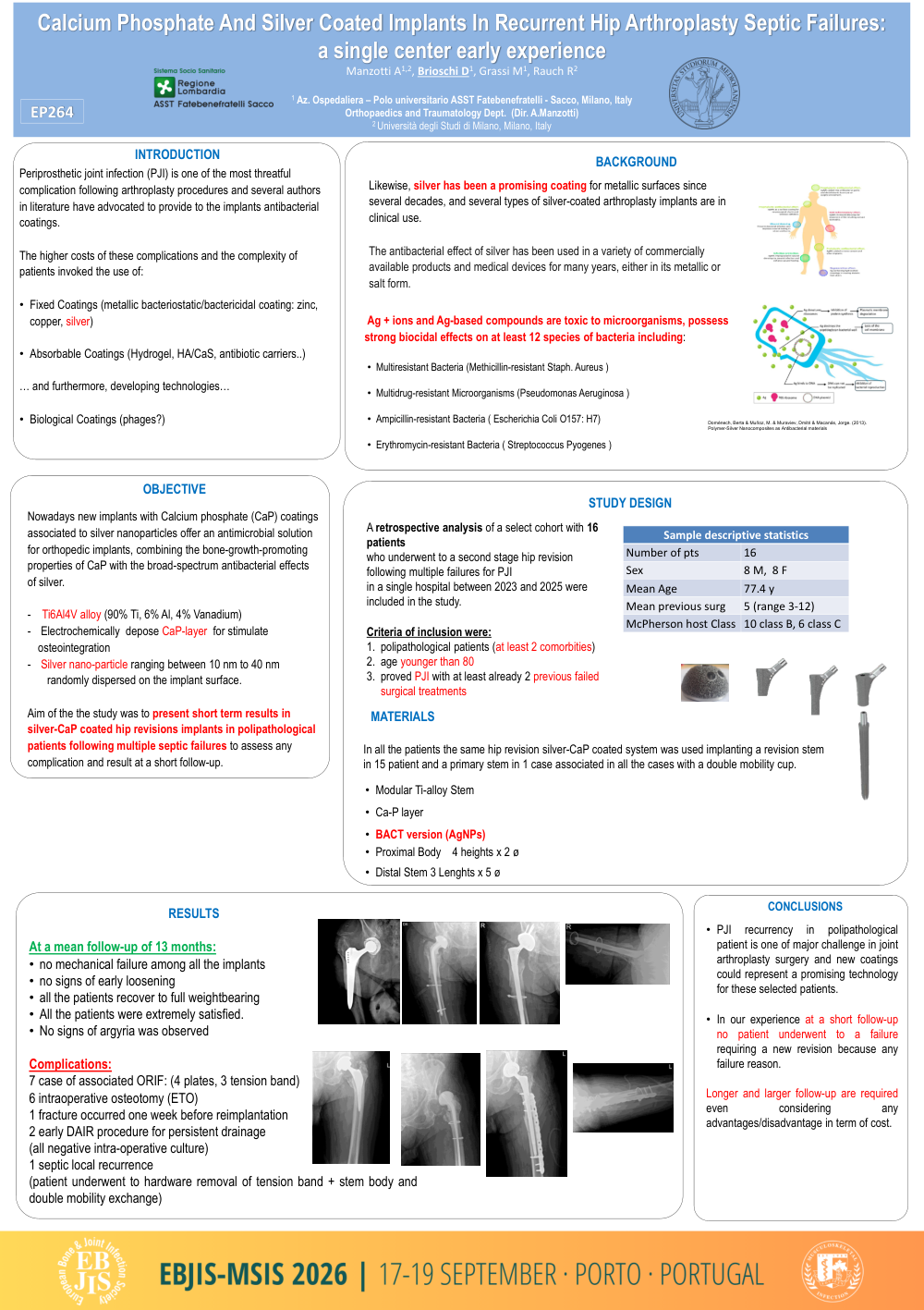
Periprosthetic joint infection (PJI) is one of the most threadfull complication following arthroplasty procedures and several authors in literature have advocated to provide to the implants available antibacterial coatings. Likewise silver has been promising since several decads, and several types of implants are in clinical use. Nowadays new implants with Calcium phosphate (CaP) coatings associated to silver nanoparticles offer an antimicrobial solution for orthopedic implants, combining the bone-growth-promoting properties of CaP with the broad-spectrum antibacterial effects of silver Aim of the the study was to present short term results in silver-CaP coated hip revisions implants in polipathological patients following multiple septic failures.
METHODS: A retrospective analysis of a select cohort of 16 patients who underwent to a second stage hip revision following multiple failures for PJI in a single hospital between 2023 and 2025. Criteria of inclusion were: polipathological patients (at least 2 comorbities), age younger than 80 yrs, proved PJI with at least already 2 previous failed surgical treatments. There were 8 male and 8 females with a mean ages of 77.4 yrs. The mean previous surgeries was 5 (range 3-12) and according to McPherson host classification there were 10 and 6 patients respectively included in class B and C. In all patients the same Hip revision silver-CaP coated system was used, implanting a revision stem in 15 and a primary stem in 1 case, always associated with dual mobility cup.
RESULTS:
At a mean follow-up of 13 months we registered no mechanical failure nor signs of early loosening. In 7 case revisions was associated to simultaneous ORIF (plates in 4 case, tension band in 1) because and intraoperative osteotomy (ETO) in 6 case and a fracture occurred one week before reimplation in 1 case. Two patient underwent to early DAIR procedure due to persistent drainage with all negative intra-operative cultures. One patient underwent to hardware removal (tension band) associated to a stem and dual mobility exchange. All patients recover to full weighbearing and were extremely satisfied. No signs of argyria was observed.
CONCLUSION:
PJI recurency in polipathological patient is one of major challenge in joint arthroplasty surgery and new coating could represent a promising technology for these selected patients. In our experience at short follow-up no patient underwent to a failure requiring new revision by any failure reason. Longer and larger follow-up are required even considering any advantages/disadvantage in terms of cost.