99 posters, 2 videos, 5 audios, 13 topics, 7 sessions, 418 authors, 180 institutions
ePostersLive by SciGen Technologies S.A. All rights reserved.
The 21st Meeting of the Diabetic Foot Study Group 2026
24-26 September, 2026 | Florence, Italy

EP98
Is there a more cost-effective method for performing lower-limb vascular assessment when comparing traditional Ankle Brachial Pressure Index (ABPI) with BlueDop?
Poster Presenter
Authors
Affiliations
Part of Topic
Peripheral arterial disease
Aim
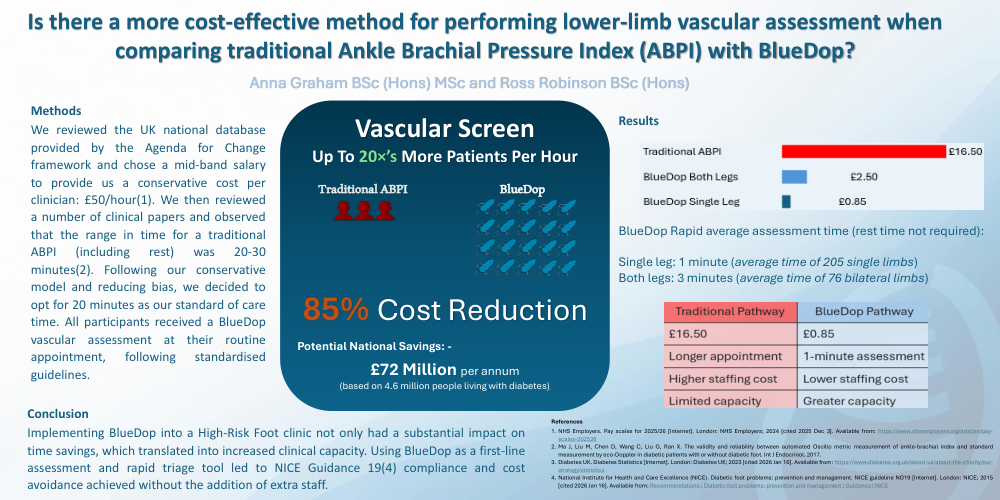
Is there a more cost-effective method for performing lower-limb vascular assessment when comparing traditional Ankle Brachial Pressure Index (ABPI) with BlueDop?
Methods
We reviewed the UK national database provided by the Agenda for Change framework and chose a mid-band salary to provide us a conservative cost per clinician: £50/hour(1). We then reviewed a number of clinical papers and observed that the range in time for a traditional ABPI (including rest) was 20-30 minutes(2). Following our conservative model and reducing bias, we decided to opt for 20 minutes as our standard of care time. All participants received a BlueDop vascular assessment at their routine appointment, following standardised guidelines.
Results
BlueDop Rapid average assessment time (rest time not required):
Single leg: 1 minute (average time of 205 single limbs)
Both legs: 3 minutes (average time of 76 bilateral limbs)
Cost Per Assessment
Traditional ABPI: -
20 minutes = 0.33 hours
Cost per patient: £16.50
BlueDop Assessment: -
Single leg 1 min = 0.017 hrs
Cost per patient: £0.85
Both legs 3 min = 0.05 hrs
Cost per patient: £2.50
Per-Patient Saving
|
Assessment Type |
Traditional |
Rapid |
Saving |
Reduction |
|
Single leg |
£16.50 |
£0.85 |
£15.65 |
95% |
|
Both legs |
£16.50 |
£2.50 |
£14.00 |
85% |
Annual Service Impact
|
Average Annual Assessments per clinic |
Annual Clinician Time Saving |
National Saving (4.6million diagnosed diabetics(3)) |
|
|
Single-Leg |
2,000 |
£31,300 |
£71.99 million (≈ £72.0m) |
|
Bilateral-Legs |
2,000 |
£28,000 |
£64.4 million |
Conclusion
Implementing BlueDop into a High-Risk Foot clinic not only had a substantial impact on time savings, which translated into increased clinical capacity. Using BlueDop as a first-line assessment and rapid triage tool led to NICE Guidance 19(4) compliance and cost avoidance achieved without the addition of extra staff.
References
- NHS Employers. Pay scales for 2025/26 [Internet]. London: NHS Employers; 2024 [cited 2025 Dec 3]. Available from: https://www.nhsemployers.org/articles/pay-scales-202526
- Ma J, Liu M, Chen D, Wang C, Liu G, Ran X. The validity and reliability between automated Oscillo metric measurement of ankle-brachial index and standard measurement by eco-Doppler in diabetic patients with or without diabetic foot. Int J Endocrinol. 2017.
- Diabetes UK. Diabetes Statistics [Internet]. London: Diabetes UK; 2023 [cited 2026 Jan 16]. Available from: https://www.diabetes.org.uk/about-us/about-the-charity/our-strategy/statistics
- National Institute for Health and Care Excellence (NICE). Diabetic foot problems: prevention and management. NICE guideline NG19 [Internet]. London: NICE; 2015 [cited 2026 Jan 16]. Available from: Recommendations | Diabetic foot problems: prevention and management | Guidance | NICE