99 posters, 2 videos, 5 audios, 13 topics, 7 sessions, 418 authors, 180 institutions
ePostersLive by SciGen Technologies S.A. All rights reserved.
The 21st Meeting of the Diabetic Foot Study Group 2026
24-26 September, 2026 | Florence, Italy

EP92
Dose-response effects of segmented, customised 3D-printed foot orthotics on plantar pressure in participants with diabetes and a central forefoot pressure pattern
Part of Topic
Foot clinics
Audio
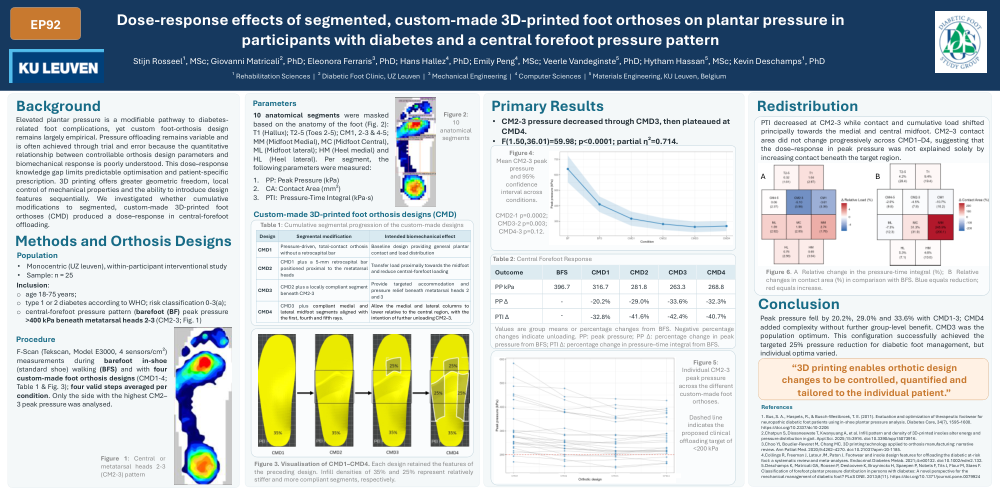
Elevated plantar pressure is a modifiable pathway to diabetes-related foot complications, yet custom foot-orthosis design remains largely empirical. 3D-printing permits greater geometric freedom, local control of mechanical properties, design-manufacturing flexibility and the possibility for design features to be introduced sequentially. We investigated whether cumulative modifications to segmented, customised 3D-printed foot orthoses produced a dose-response in central-forefoot offloading.
In this monocentric, within-participant interventional study, 25 people with diabetes (risk classification 0-3(a)) and a central-forefoot pressure pattern (barefoot peak pressure >400 kPa beneath metatarsal heads 2-3 (CM2-3), collected with VersaTek, Tekscan) walked in a study shoe alone and with four different custom-made foot orthotic designs (CMD1-4). CMD1 was a total-contact foot orthotic; one feature was added at each subsequent stage, varying segmentation, geometry, and gyroid infill density. In-shoe peak pressure, contact area, force-time integral, and pressure-time integral were measured using manual masking of CM2-3. Repeated-measures ANOVA with corrected degrees of freedom and Holm-adjusted paired comparisons assessed condition effects.
Mean peak pressure beneath CM2-3 dropped from 396.7 kPa (±132.8) in the shoe-only condition to 316.7 (±111.4) with CMD1, 281.8 (±91.4) with CMD2, 263.3 (±82.0) with CMD3, and 268.8 (±78.8) with CMD4 (F[1.50,36.01]=59.98; p<0.0001; partial η²=0.714). CMD2 improved on CMD1 (Holm-adjusted p=0.0002), and CMD3 improved on CMD2 (p=0.003); CMD4 provided no further reduction versus CMD3 (p=0.12). At CMD3, pressure was on average 33.6% below shoe-only values. Force-time and pressure-time integrals beneath CM2-3 decreased in parallel, while contact area analyses indicated transfer towards the midfoot.
Cumulative, digitally controlled orthosis modifications produced substantial central-forefoot offloading, but benefit plateaued after CMD3. This dose–response-and-plateau pattern suggests that increasing design complexity does not necessarily lead to further improvements in offloading, highlighting the need for further dose–response modelling to fully characterise the therapeutic potential of this medical device. Parametric 3D-printing could support more efficient, patient-specific optimisation of a key biomechanical target in preventing diabetes-related foot complications.