99 posters, 2 videos, 5 audios, 13 topics, 7 sessions, 418 authors, 180 institutions
ePostersLive by SciGen Technologies S.A. All rights reserved.
The 21st Meeting of the Diabetic Foot Study Group 2026
24-26 September, 2026 | Florence, Italy

EP08 - Top 10 E-Poster
It's Time to Bridge the Gap in Footcare Provision for Haemodialysis Patients: A Network Wide Service Evaluation
Poster Presenter
Authors
Patricia Lee, Bonnie Chow, Sandra Woolcock, Ali Mudhaffer, Alexandra Rankin, Paul Donohoe, Aileen Boyd, Erika Vainieri, Chris Manu
Affiliations
Mike Edmonds Foot Unit, King'S College Hospital NHS Foundation Trust, London, United Kingdom, Renal Medicine, King'S College Hospital NHS Foundation Trust, London, United Kingdom, Microbiology and Infectious Disease, King'S College Hospital NHS Foundation Trust, London, United Kingdom
Part of Topic
Other
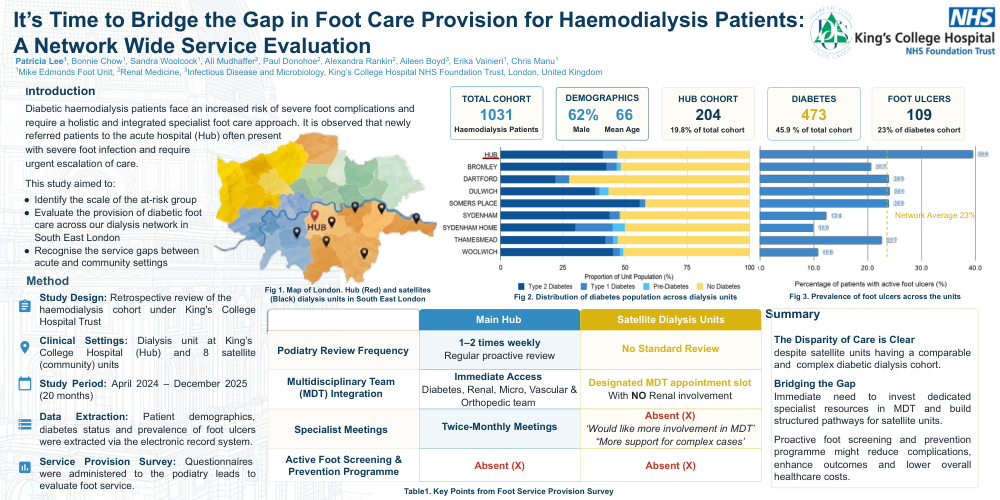
Diabetic patients undergoing haemodialysis face an exceptionally high risk of severe foot complications. It is observed that patients referred to the acute hospital ("the Hub") frequently presented with advanced, limb-threatening infections. A retrospective review was performed on the haemodialysis cohort under King's College Hospital Trust —1,031 patients—over a 20-month period, from April 2024 to December 2025. This study aimed to evaluate the distribution of diabetes and foot ulcers. A survey was given to the podiatry team to look into the foot service provision across the Main Hub and eight community-based satellite units
The data highlights a significant inequality in care. Although nearly 46% of the patient cohort has diabetes and 23% currently suffer from foot ulcers, the standard of care is location-dependent. Patients at the Main Hub benefit from proactive, weekly podiatry reviews and full, integrated multidisciplinary team (MDT) support. In contrast, satellite units lack formal, proactive screening and standardised specialist involvement, despite managing a patient population of similar complexity.
The study concludes that this current care model is unsustainable. To improve patient outcomes and reduce long-term healthcare costs, we advocate for the implementation of structured pathways and dedicated specialist resources across all satellite units. This research provides a clear roadmap for transitioning the network toward a more proactive, preventative foot screening program.