250 posters, 68 videos, 55 audios, 5 topics, 3 sessions, 367 authors, 223 institutions
ePostersLive by SciGen Technologies S.A. All rights reserved.
6th Commonwealth Chemistry Posters
United Kingdom | 1 - 2 October 2025

P253
Pea protein at the interface: Insights into adsorption and interfacial rheology
Poster Presenter
Authors
Affiliations
Part of Topic
Sustainable Planet (SDGs 2, 11, 13, 14 and 15)
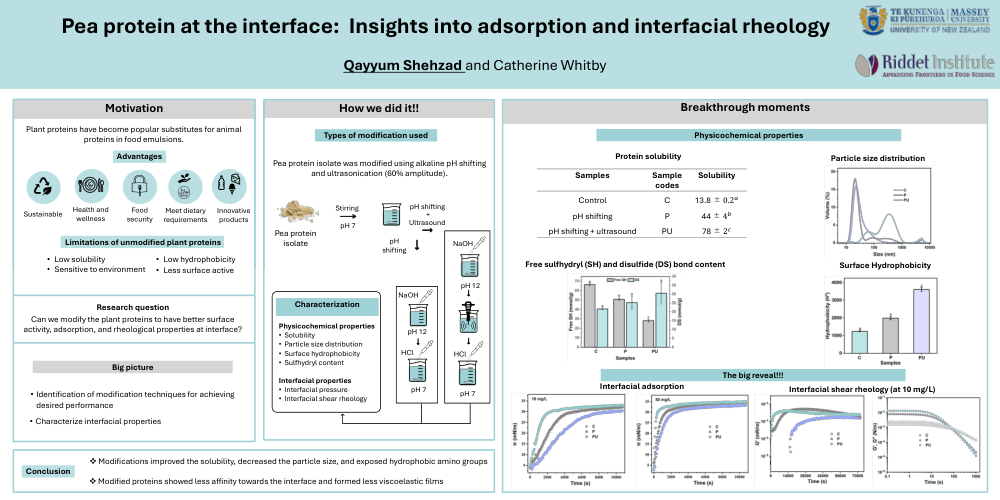
Plant proteins have emerged as promising natural emulsifiers in the food sector because of their eco-friendly nature, sustainability, and ability to meet the dietary preferences of vegans and vegetarians. They are also cost-effective compared to animal-derived proteins. However, their application is limited by structural drawbacks. Plant proteins generally possess compact, aggregated conformations that lower their solubility in aqueous systems.1 This structural compactness buries hydrophobic amino acid residues inside the protein core, restricting their ability to interact effectively at oil–water interfaces. Furthermore, compared to extensively studied dairy proteins, the structure, interactions, and surface rheology of plant protein adsorbed layers remain poorly understood.1
To address these limitations, the present study investigated the modification of pea protein and examined its physicochemical characteristics and interfacial shear rheological properties. The main focus was the application of pH shifting, a process in which protein solutions are first exposed to highly alkaline conditions and then neutralized to pH 7.2 This treatment was found to significantly reduce the size of protein aggregates, thereby improving dispersion in solution. Moreover, the unfolding and refolding associated with the pH shift exposed previously buried hydrophobic groups on the protein surface, which led to an increase in surface hydrophobicity.
In addition, the effect of combining pH shifting with ultrasonication was studied. The synergistic approach further reduced the average aggregate size and enhanced hydrophobicity to a greater extent than pH shifting alone. These modifications are expected to promote better interfacial activity by facilitating protein migration and adsorption to oil–water interfaces.
The adsorption behavior and viscoelastic properties of modified pea proteins at the oil–water interface were assessed using interfacial tension and shear rheology measurements. Results showed that native proteins adsorbed more rapidly to the interface compared to modified proteins. Furthermore, interfacial layers formed by native and modified proteins demonstrated almost similar final viscoelasticity and stiffness, however, native proteins reached the plateau much faster than the modified proteins.
Future research will extend this work by exploring additional modification strategies, such as high-pressure homogenization and thermal treatments. These methods may further enhance protein solubility, interfacial activity, and mechanical strength of interfacial films. Collectively, this study provides new insights into how structural modification of pea protein can improve its interfacial functionality, thereby advancing its use as a sustainable alternative to dairy proteins in emulsified food systems.