250 posters, 68 videos, 55 audios, 5 topics, 3 sessions, 367 authors, 223 institutions
ePostersLive by SciGen Technologies S.A. All rights reserved.
6th Commonwealth Chemistry Posters
United Kingdom | 1 - 2 October 2025

P228
Nitrate Reduction - an Investigation into Catalyst Structure for Selective Nitrogen Formation
Poster Presenter
Authors
Affiliations
Part of Topic
Sustainable Planet (SDGs 2, 11, 13, 14 and 15)
Video
Nitrate Reduction - an Investigation into Catalyst Structure for Selective Nitrogen Formation
S. M. McIntyre1 , C. A. Casey-Stevens1 , J. T. A. Gilmour1 , C. Ruffman1 and A. L. Garden1
1Department of Chemistry, University of Otago, Dunedin, New Zealand and the MacDiarmid Institute for Advanced Materials and Nanotechnology, New Zealand.
Introduction
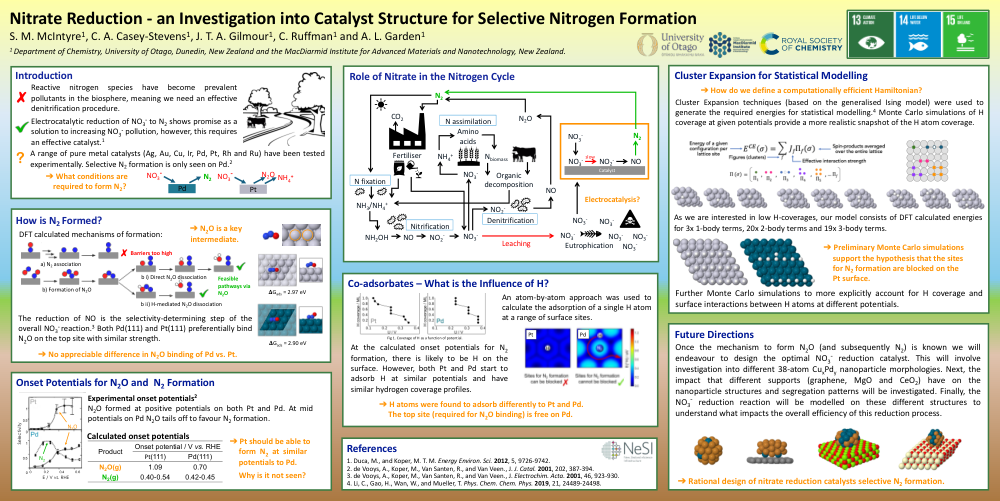
Reactive nitrogen species have become prevalent pollutants in the biosphere, meaning we need an effective denitrification procedure. Electrocatalytic reduction of NO3- to N2 shows promise as a solution to increasing NO3- pollution, however, this requires an effective catalyst.1 A range of pure metal catalysts (Ag, Au, Cu, Ir, Pd, Pt, Rh and Ru) have been tested experimentally. Selective N2 formation is only seen on Pd.2 ➔ What conditions are required to form N2?
How is N2 Formed?
DFT calculated mechanisms of formation ➔ N2O is a key intermediate. The reduction of NO is the selectivity determining step of the overall NO3- reaction.3 Both Pd(111) and Pt(111) preferentially bind N2O on the top site with similar strength. ➔ No appreciable difference in N2O binding of Pd vs. Pt.
Onset Potentials for N2O and N2 Formation
Experimental onset potentials:2 N2O formed at positive potentials on both Pt and Pd. At mid potentials on Pd N2O tails off to favour N2 formation. Calculated onset potentials: N2O 1.09 on Pt and 0.70 on Pd, while for N2 0.40-0.54 on Pt and 0.42-0.45 on Pd. ➔ Pt should be able to form N2 at similar potentials to Pd. Why is it not seen?
Co-adsorbates – What is the Influence of H?
At the calculated onset potentials for N2 formation, there is likely to be H on the surface. However, both Pt and Pd start to adsorb H at similar potentials and have similar hydrogen coverage profiles. An atom-by-atom approach was used to calculate the adsorption of a single H atom at a range of surface sites. ➔ H atoms were found to adsorb differently to Pt and Pd. The top site (required for N2O binding) is free on Pd.
Cluster Expansion for Statistical Modelling
➔ How do we define a computationally efficient Hamiltonian? Cluster Expansion techniques (based on the generalised Ising model) were used to generate the required energies for statistical modelling.4 Monte Carlo simulations of H coverage at given potentials provide a more realistic snapshot of the H atom coverage. As we are interested in low H-coverages, our model consists of DFT calculated energies for 3x 1-body terms, 20x 2-body terms and 19x 3-body terms. ➔ Preliminary Monte Carlo simulations support the hypothesis that the sites for N2 formation are blocked on the Pt surface.Further Monte Carlo simulations to more explicitly account for H coverage and surface interactions between H atoms at different potentials.
Future Directions
Once the mechanism to form N2O (and subsequently N2) is known we will endeavour to design the optimal NO3- reduction catalyst. This will involve investigation into different 38-atom CuxPdy nanoparticle morphologies. Next, the impact that different supports (graphene, MgO and CeO2) have on the nanoparticle structures and segregation patterns will be investigated. Finally, the NO3- reduction reaction will be modelled on these different structures to understand what impacts the overall efficiency of this reduction process. ➔ Rational design of nitrate reduction catalysts selective N2 formation.