250 posters, 68 videos, 55 audios, 5 topics, 3 sessions, 367 authors, 223 institutions
ePostersLive by SciGen Technologies S.A. All rights reserved.
6th Commonwealth Chemistry Posters
United Kingdom | 1 - 2 October 2025

P208
Evolution of Ultrathin CoFe-Nanomesh for Oxygen Evolution Reaction: From Slit Pores to Ink-Bottle Pores
Poster Presenter
Authors
Affiliations
Part of Topic
Responsible Energy (SDGs 7 and 12)
Greetings everyone,
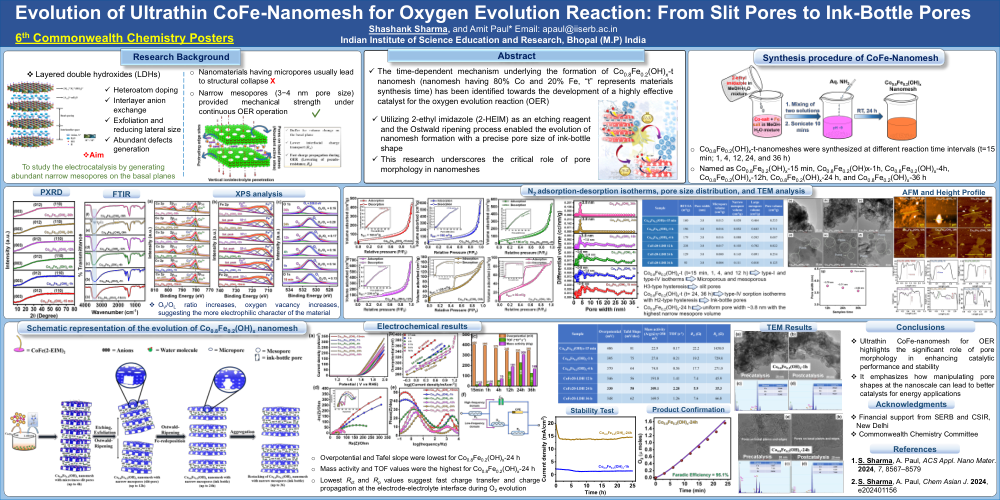
I'm Shashank Sharma, a research fellow in the Department of Chemistry at the Indian Institute of Science Education and Research Bhopal, India. I'm excited to share my research titled "Evolution of Ultrathin CoFe-Nanomesh for Oxygen Evolution Reaction: From Slit Pores to Ink-Bottle Pores" at the 6th Commonwealth Chemistry Posters.
This research examines the time-dependent formation mechanism of CoFe-Nanomesh, specifically Co₀.₈Fe₀.₂(OH)ₓ-t (t = 15 min, 1, 4, 12, 24, 36 h), using 80% cobalt and 20% iron concentrations with 2-ethyl imidazole as a base and etching agent. Over time, from Co0.8Fe0.2(OH)x-15min to Co0.8Fe0.2(OH)x-24h, the pore morphology transitions from slit pores to ink-bottle pores due to iron redeposition on the basal planes of nanosheets, confirmed by N2 adsorption-desorption isotherms. The samples from Co₀.₈Fe₀.₂(OH)ₓ-15min to Co₀.₈Fe₀.₂(OH)ₓ-12h exhibit H3-type isotherms, indicating slit pores, while a higher hydrolysis rate of iron thereafter leads to redeposition. At Co0.8Fe0.2(OH)x-24h and Co0.8Fe0.2(OH)x-36h, pore entrance shrinkage is observed, as confirmed by TEM analysis. A high narrow mesopore volume is crucial for OER performance, with Co0.8Fe0.2(OH)x-24h showing the highest volume. AFM analysis reveals the ultrathin nature of Co₀.₈Fe₀.₂(OH)ₓ-24h nanosheets, which provide more active sites compared to other samples. The best catalyst (Co0.8Fe0.2(OH)x-24 h) was developed after 24 h of synthesis, having 3.8 nm ink-bottle-shaped pores on the basal plane of nanosheets with only 3–4 layers. Co0.8Fe0.2(OH)x-24H nanomesh exhibited the best catalytic performance, characterised by a 330 mV overpotential, a mass activity of 309.1 A/g, and a turnover frequency of 2.28 s−1. Furthermore, electrochemical impedance spectroscopy indicated a low charge transfer resistance (5.9 Ω) and pseudoresistance (35.3 Ω), highlighting efficient electron transfer at the electrode/electrolyte interface and enhanced oxygen evolution reaction kinetics, respectively. The best material demonstrated remarkable stability during 25 h of electrolysis with a high average current density of 14.5 mA/cm². Hence, this research underscores the critical role of pore morphology in nanomeshes for optimising catalytic performance and providing stability under vigourous gas evolution due to catalysis.
I hope you find the poster presentation engaging and insightful. Please feel free to reach out if you have any questions or queries.
Thank you for your attention.
Best regards,
Shashank Sharma