250 posters, 68 videos, 55 audios, 5 topics, 3 sessions, 367 authors, 223 institutions
ePostersLive by SciGen Technologies S.A. All rights reserved.
6th Commonwealth Chemistry Posters
United Kingdom | 1 - 2 October 2025

P197
Investigating Energy Transfer and Dipole Coupling between Covalently Connected Gold Quantum Dots
Poster Presenter
Authors
Affiliations
Part of Topic
Responsible Energy (SDGs 7 and 12)
Audio
Introduction
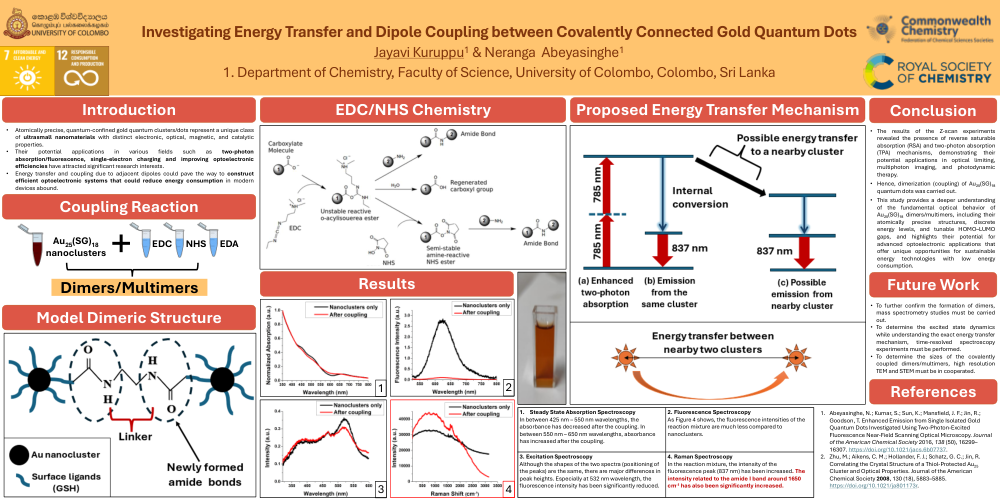
Atomically precise, quantum-confined gold quantum clusters/dots represent a unique class of ultrasmall nanomaterials with distinct electronic, optical, magnetic, and catalytic properties.
•Their potential applications in various fields such as two-photon absorption/fluorescence, single-electron charging and improving optoelectronic efficiencies have attracted significant research interests.
•Energy transfer and coupling due to adjacent dipoles could pave the way to construct efficient optoelectronic systems that could reduce energy consumption in modern devices abound.
Conclusion
•The results of the Z-scan experiments revealed the presence of reverse saturable absorption (RSA) and two-photon absorption (TPA) mechanisms, demonstrating their potential applications in optical limiting, multiphoton imaging, and photodynamic therapy.
•Hence, dimerization (coupling) of Au₂₅(SG)₁₈ quantum dots was carried out.
•This study provides a deeper understanding of the fundamental optical behavior of Au₂₅(SG)₁₈ dimers/multimers, including their atomically precise structures, discrete energy levels, and tunable HOMO–LUMO gaps, and highlights their potential for advanced optoelectronic applications that offer unique opportunities for sustainable energy technologies with low energy consumption.
Future Work
•To further confirm the formation of dimers, mass spectrometry studies must be carried out.
•To determine the excited state dynamics while understanding the exact energy transfer mechanism, time-resolved spectroscopy experiments must be performed.
•To determine the sizes of the covalently coupled dimers/multimers, high resolution TEM and STEM must be in cooperated.