250 posters, 68 videos, 55 audios, 5 topics, 3 sessions, 367 authors, 223 institutions
ePostersLive by SciGen Technologies S.A. All rights reserved.
6th Commonwealth Chemistry Posters
United Kingdom | 1 - 2 October 2025

P194
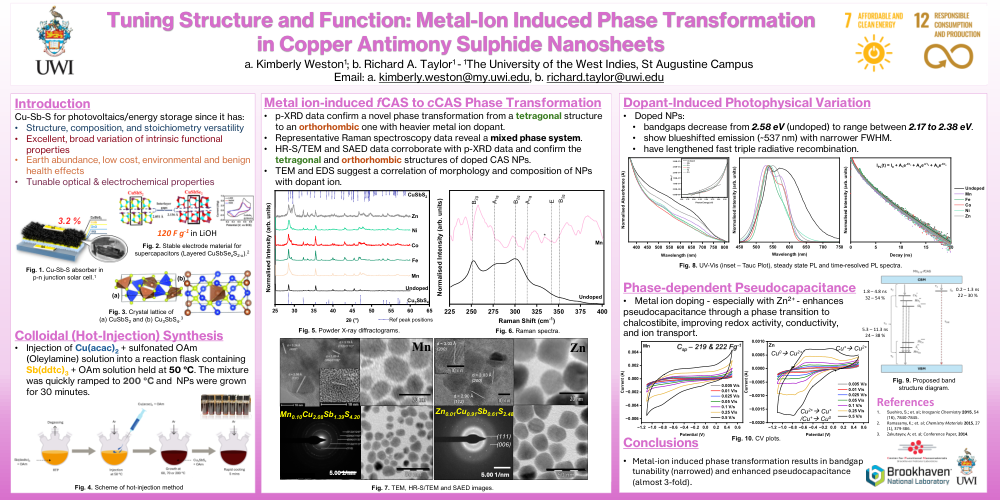
Tuning Structure and Function: Metal-Ion Induced Phase Transformation in Copper Antimony Sulphide Nanosheets
Poster Presenter
Authors
Affiliations
Part of Topic
Responsible Energy (SDGs 7 and 12)
Tuning Structure and Function: Metal-Ion Induced Phase Transformation in Copper Antimony Sulphide Nanosheets
a. Kimberly Weston1; b. Richard A. Taylor1
1The University of the West Indies, St Augustine Campus
Email: a. kimberly.weston@my.uwi.edu, b. richard.taylor@uwi.edu
Introduction
Cu-Sb-S for photovoltaics/energy storage since it has:
- Structure, composition, and stoichiometry versatility
- Excellent, broad variation of intrinsic functional properties
- Earth abundance, low cost, environmental and benign health effects
- Tunable optical & electrochemical properties
Colloidal (Hot-Injection) Synthesis
- Injection of Cu(acac)2 + sulfonated OAm (Oleylamine) solution into a reaction flask containing Sb(ddtc)3 + OAm solution held at 50 °C. The mixture was quickly ramped to 200 °C and NPs were grown for 30 minutes.
Metal ion-induced fCAS to cCAS Phase Transformation
- p-XRD data confirm a novel phase transformation from a tetragonal structure to an orthorhombic one with heavier metal ion dopant.
- Representative Raman spectroscopy data reveal a mixed phase system.
- HR-S/TEM and SAED data corroborate with p-XRD data and confirm the tetragonal and orthorhombic structures of doped CAS NPs.
- TEM and EDS suggest a correlation of morphology and composition of NPs with dopant ion.
Dopant-Induced Photophysical Variation
- Doped NPs:
- bandgaps decrease from 2.58 eV (undoped) to range between 2.17 to 2.38 eV.
- show blueshifted emission (~537 nm) with narrower FWHM.
- have lengthened fast triple radiative recombination.
Phase-dependent Pseudocapacitance
- Metal ion doping - especially with Zn2+ - enhances pseudocapacitance through a phase transition to chalcostibite, improving redox activity, conductivity, and ion transport.
Conclusions
- Metal-ion induced phase transformation results in bandgap tunability (narrowed) and enhanced pseudocapacitance (almost 3-fold).
References
- Suehiro, S.; et. al; Inorganic Chemistry 2015, 54 (16), 7840-7845.
- Ramasamy, K.; et. al; Chemistry Materials 2015, 27 (1), 379-386.
- Zakutayev, A; et. al; Conference Paper, 2014.