250 posters, 68 videos, 55 audios, 5 topics, 3 sessions, 367 authors, 223 institutions
ePostersLive by SciGen Technologies S.A. All rights reserved.
6th Commonwealth Chemistry Posters
United Kingdom | 1 - 2 October 2025

P181
Investigating Dissolution Dynamics of Aggregation-Induced Emission Molecules for Efficient Optoelectronic Applications
Poster Presenter
Authors
Affiliations
Part of Topic
Responsible Energy (SDGs 7 and 12)
Audio
Investigating Dissolution Dynamics of Aggregation-Induced Emission Molecules for Efficient Optoelectronic Applications
Susith Mendis & Neranga Abeyasinghe*
Department of Chemistry, Faculty of Science, University of Colombo, SriLanka
*neranga@chem.cmb.ac.lk
Introduction
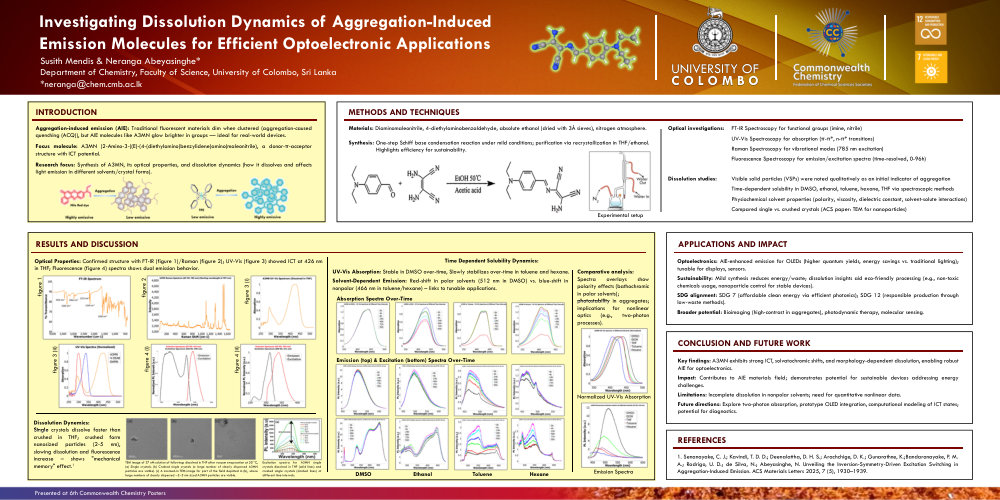
Aggregation-induced emission (AIE): Traditional fluorescent materials dim when clustered (aggregation-caused quenching (ACQ)), but AIE molecules like A3MN glow brighter in groups – ideal for real-world devices.
Focus molecule: A3MN (2-Amino-3-((E)-(4-(diethylamino)benzylidene)amino)maleonitrile), a donor-π-acceptor structure with ICT potential.
Research focus: Synthesis of A3MN, its optical properties, and dissolution dynamics (how it dissolves and affects light emission in different solvents/crystal forms).
Methods and Techniques
Materials: Diaminomaleonitrile, 4-diethylaminobenzaldehyde, absolute ethanol (dried with 3Å sieves), nitrogen atmosphere.
Synthesis: One-step Schiff base condensation reaction under mild conditions; purification via recrystallization in THF/ethanol. Highlights efficiency for sustainability.
Optical investigations: FT-IR Spectroscopy for functional groups (imine, nitrile)
UV-Vis Spectroscopy for absorption (π-π*, n-π* transitions)
Raman Spectroscopy for vibrational modes (785 nm excitation)
Fluorescence Spectroscopy for emission/excitation spectra (time-resolved, 0-96h).
Dissolution studies: Visible solid particles (VSPs) were noted qualitatively as an initial indicator of aggregation
Time-dependent solubility in DMSO, ethanol, toluene, hexane, THF via spectroscopic methods Physiochemical solvent properties (polarity, viscosity, dielectric constant, solvent-solute interactions)
Compared single vs. crushed crystals (ACS paper: TEM for nanoparticles)
Results and Discussion
Optical Properties: Confirmed structure with FT-IR (figure1)/Raman (figure2); UV-Vis (figure3) showed ICT at 426nm in THF; Fluorescence (figure4) spectra shows dual emission behavior.
Time Dependent Solubility Dynamics:
UV-Vis Absorption: Stable in DMSO over-time, Slowly stabilizes over-time in toluene and hexane.
Solvent-Dependent Emission: Red-shift in polar solvents (512 nm in DMSO) vs. blue-shift in nonpolar (466 nm in toluene/hexane) – links to tunable applications.
Comparative analysis: Spectra overlays show polarity effects (bathochromic in polar solvents); photostability in aggregates; implications for nonlinear optics (e.g., two-photon processes).
Dissolution Dynemics: Single crystals dissolve faster than crushed in THF; crushed form nanosized particles (2-5 nm), slowing dissolution and fluorescence increase – shows "mechanical memory" effect.
Applicaions and Impact
Optoelectronics: AIE-enhanced emission for OLEDs (higher quantum yields, energy savings vs. traditional lighting); tunable for displays, sensors.
Sustainability: Mild synthesis reduces energy/waste; dissolution insights aid eco-friendly processing (e.g., non-toxic chemicals usage, nanoparticle control for stable devices).
SDG alignment: SDG 7 (affordable clean energy via efficient photonics); SDG 12 (responsible production through low-waste methods).
Broader potential: Bioimaging (high-contrast in aggregates), photodynamic therapy, molecular sensing.
Conclusion and Future Work
Key findings: A3MN exhibits strong ICT, solvatochromic shifts, and morphology-dependent dissolution, enabling robust AIE for optoelectronics.
Impact: Contributes to AIE materials field; demonstrates potential for sustainable devices addressing energy challenges.
Limitations: Incomplete dissolution in nonpolar solvents; need for quantitative nonlinear data.
Future directions: Explore two-photon absorption, prototype OLED integration, computational modeling of ICT states; potential for diagnostics.
References
Senanayake, C. J.; Kavindi, T. D. D.; Deenalattha, D. H. S.; Arachchige, D. K.; Gunarathne, K.;Bandaranayake, P. M. A.; Rodrigo, U. D.; de Silva, N.; Abeyasinghe, N. Unveiling the Inversion-Symmetry-Driven Excitation Switching in Aggregation-Induced Emission. ACS Materials Letters 2025, 7 (5), 1930–1939.