253 posters, 14 videos, 27 audios, 14 topics, 392 authors, 132 institutions
ePostersLive by SciGen Technologies S.A. All rights reserved.
4th Commonwealth Chemistry Posters
October 4 - 5, 2023 | Online, United Kingdom

P80
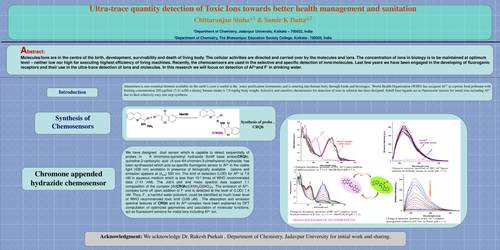
Ultra-trace quantity detection of Toxic Ions towards better health management and sanitation
Poster Presenter
Authors
Part of Topic
Clean water and sanitation
Ultra
trace quantity detection of Toxic Ions towards better health management and sanitation
Chittaranjan Sinha*
1 & Samir K 2
1
Department of Chemistry, Jadavpur University, Kolkata 700032, India
2
Department of Chemistry, The Bhawanipur Education Society College, Kolkata 700020, India
.
Molecules/Ions are in the centre of the birth, development, survivability and death of living body. The cellular activities a
re directed and carried over by the molecules and ions. The concentration of ions in biology is to be maintained at optimum
level neither low nor high for executing highest efficiency of living machines. Recently, the chemosensors are used in the sel ective and specific detection of ions/molecules. Last few years we have been engaged in the developing of fluorogenic
receptors and their use in the ultra trace detection of ions and molecules. In this research we will focus on detection of Al 3+ and F in drinking water.
.
A
bstract:
(i)
Acknowledgment:
We acknowledge Dr. Rakesh Purkait , Department of Chemistry, Jadavpur University for initial work and sharing.
Introduction
Aluminium
is non essential element available on the earth’s crust is useful in the water purification instruments and is entering into human body through foods and beverages World Health Organization ( has assigned Al 3 as a prime food pollutant with
limiting concentration 200 g/litre 7 41 mM) a dietary human intake is 7 0 mg/kg body weight Selective and sensitive chemosensor for detection of ions in solution has been designed Schiff base ligands act as fluorescent sensors for metal ions including Al 3
due to their relatively easy one step synthesis
Synthesis of
Chemosensors
Chromone
appended
hydrazide chemosensor
We
have designed dual sensor which is capable to detect sequentially of
probes in A chromone quinolinyl hydrazide Schiff base probe( CRQh
quinoline 2 carboxylic acid 4 oxo 4 H chromen 3 ylmethylene) hydrazide has
been synthesized which acts as specific fluorogenic sensor to Al 3 in the visible
light 438 nm) excitation in presence of biologically available cations and
emission appears at (λ em 520 nm The limit of detection ( for Al 3 is 7 6
nM in aqueous medium which is less than 10 3 times of WHO recommended
data 7 41 mM) The Job’s plot and mass spectral data support 1 1
composition of the complex [ CRQh )(OH)H 2 O](NO 3 2 The emission of Al 3
complex turns off upon addition of F and is detected at the level of ( 7 4
nM Thus, F a harmful water pollutant, could be identified at much lower level
of WHO recommended toxic limit 3 68 M) The absorption and emission
spectral features of CRQh and its Al 3 complex have been explained by DFT
computation of optimized geometries and calculation of molecular functions
act as fluorescent sensors for metal ions including Al 3 ion
Synthesis of probe ,
CRQh