253 posters, 14 videos, 27 audios, 14 topics, 392 authors, 132 institutions
ePostersLive by SciGen Technologies S.A. All rights reserved.
4th Commonwealth Chemistry Posters
October 4 - 5, 2023 | Online, United Kingdom

P79
Sodium alginate-activated carbon composite beads: adsorption studies towards the removal of organic and inorganic pollutants in environmental water samples
Poster Presenter
Authors
Part of Topic
Clean water and sanitation
SODIUM ALGINATE-activated carbon COMPOSITE BEADs: adsorption studies towards THE REMOVAL OF ORGANIC AND INORGANIC Pollutants IN environmental water samples
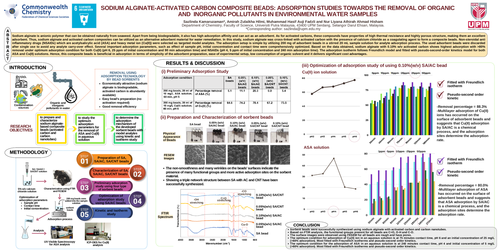
Sodium alginate is anionic polymer that can be obtained naturally from seaweed. Apart from being biodegradable, it also has high adsorption affinity and can act as an adsorbent. As for activated carbons, these compounds have properties of high thermal resistance and highly porous structure, making them an excellent adsorbent. Thus, sodium alginate and activated carbon composites can be utilized as an alternative adsorbent material for water remediation. In this study, sodium alginate was cross-linked with activated carbon with the presence of calcium chloride as a coagulating agent to form a composite beads. Non-steroidal anti inflammatory drugs (NSAIDs) which are acetylsalicylic acid (ASA) and mefenamic acid (MEF) and Cu(II) ion were selected as targeted model analytes. The adsorption setup is simple by utilizing 200 mg of adsorbent beads in a stirred 20 mL sample solution for analyte adsorption process. The used adsorbent beads were discarded after single use to avoid any analyte carry-over effect. Several important adsorption parameters, such as effect of sample pH, initial concentration and contact time were comprehensively optimized. Based on the data obtained, sodium alginate with 0.01%w/v activated carbon shows highest adsorption with >80% removal under optimum adsorption condition for both Cu(II) (pH 6, 25 ppm of initial concentration and 90 min adsorption time) and NSAIDs (pH 2-4, 5 ppm of initial concentration and 180-240 min adsorption time). The adsorption isotherm follows Freundlich model and fitted with pseudo-second-order kinetics model for both NSAIDs and Cu(II) solutions. Hence, this composite beads is beneficial in adsorption in terms of simplicity of the adsorbent preparation, ease of experimental setup, low consumption of organic solvent and it delivers significant cost advantages.