253 posters, 14 videos, 27 audios, 14 topics, 392 authors, 132 institutions
ePostersLive by SciGen Technologies S.A. All rights reserved.
4th Commonwealth Chemistry Posters
October 4 - 5, 2023 | Online, United Kingdom

P77
Exploring the use of melon husk an agriculture waste for the removal of dye molecules from aqueous solution
Poster Presenter
Part of Topic
Clean water and sanitation
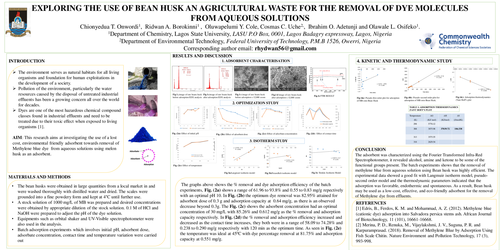
EXPLORING THE USE OF BEAN HUSK AN AGRICULTURAL WASTE FOR THE REMOVAL OF DYE MOLECULES FROM AQUEOUS SOLUTIONS.
INTRODUCTION
The environment serves as natural habitats for all living organisms and foundation for human exploitations in the development of a society.
Pollution of the environment, particularly the water resources caused by the disposal of untreated industrial effluents has been a growing concern all over the world for decades.
Dyes are one of the most hazardous chemical compound classes found in industrial effluents and need to be treated due to their toxic effect when exposed to living organisms [1].
AIM: This research aims at investigating the use of a lost cost, environmental friendly adsorbent towards removal of Methylene blue dye from aqueous solutions using melon husk as an adsorbent.
METHODS
The bean husks were obtained in large quantities from a local market in and were washed thoroughly with distilled water and dried. The scales were grounded into a fine powdery form and kept at 4°C until further use.
A stock solution of 1000 mg/L of MB was prepared and desired concentrations were obtained by appropriate dilution of the stock solution. 0.1 M of HCl and NaOH were prepared to adjust the pH of the dye solution.
Equipments such as orbital shaker and UV-Visible spectrophotometer were also used in the analysis.
Batch adsorption experiments which involves initial pH, adsorbent dose, adsorbate concentration, contact time and temperature variation were carried out.
CONCLUSION
The adsorbent was characterized using the Fourier Transformed Infra-Red Spectrophotometer, it revealed alcohol, amine and ketone to be some of the functional groups present. The batch experiments shows that the removal of methylene blue from aqueous solution using Bean husk was highly efficient. The experimental data showed a good fit with Langmuir isotherm model, pseudo-second order model and the thermodynamic parameters indicated that the adsorption was favorable, endothermic and spontaneous. As a result, Bean husk may be used as a low-cost, effective, and eco-friendly adsorbent for the removal of Methylene dye from effluents.