253 posters, 14 videos, 27 audios, 14 topics, 392 authors, 132 institutions
ePostersLive by SciGen Technologies S.A. All rights reserved.
4th Commonwealth Chemistry Posters
October 4 - 5, 2023 | Online, United Kingdom

P76
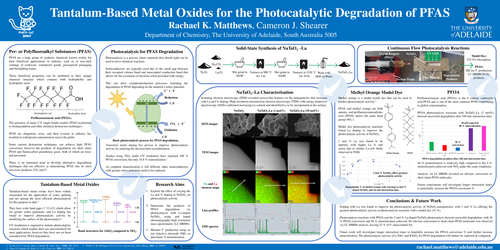
Tantalum-Based Metal Oxides for the Photocatalytic Degradation of Per- or Polyfluoroalkyl Substances (PFAS)
Poster Presenter
Authors
Part of Topic
Clean water and sanitation
Tantalum-Based Metal Oxides for the Photocatalytic Degradation of PFAS
Per- or Polyfluoroalkyl Substances (PFAS):
PFAS are a large group of synthetic chemicals known widely for their beneficial applications in industry, such as in non-stick coatings of cookware, waterproof goods, greaseproof packaging and firefighting foams.
These beneficial properties can be attributed to their unique chemical structure which contains both hydrophobic and hydrophilic areas.
The presence of many C-F single bonds renders PFAS recalcitrant to biodegradation and other chemical destruction techniques.
PFAS are ubiquitous, toxic, and their overuse in industry has resulted in widespread contamination across the globe.
Some current destruction techniques can achieve high PFAS conversion, however the products of degradation are short chain PFAS and fluorocarbon greenhouse gases, both of which are toxic and persistent.
There is an imminent need to develop alternative degradation techniques that are effective at mineralising PFAS into its most non-toxic products, CO2 and F-.
Photocatalysis for PFAS Degradation:
Photocatalysis is a process where materials that absorb light can be used to drive chemical reactions.
Semiconductors are typically used due to the small gap between their occupied valence band and unoccupied conduction band that allows for the excitation of electrons when provided with energy.
This can drive oxidation/reduction processes including the degradation of PFAS depending on the material’s redox potential.
Transition metal doping has proven to improve photocatalytic activity by reducing the electron-hole recombination.
Studies using TiO2 under UV irradiation have reported 100 % PFAS conversion, but only 34.8 % mineralisation.1
As complete mineralisation is still difficult, other semiconductors with greater redox potentials need to be explored.
Tantalum-Based Metal Oxides:
Tantalum-based metal oxides have been widely researched for the application of water splitting and are among the most efficient photocatalysts for this purpose to date.2
They have wide band gaps (> 3.5 eV) which allow for greater redox potentials, and La doping has found to improve photocatalytic activity by modifying the surface of the photocatalyst.2
UV irradiation is required to initiate photocatalytic reactions which renders their use uneconomical for most applications, however they have not yet been considered for PFAS degradation.
Research Aims: