253 posters, 14 videos, 27 audios, 14 topics, 392 authors, 132 institutions
ePostersLive by SciGen Technologies S.A. All rights reserved.
4th Commonwealth Chemistry Posters
October 4 - 5, 2023 | Online, United Kingdom

P71
Polyaniline (PANI) -BFO based nanocomposite photocatalyst immobilized on liquid natural rubber as integrated adsorbents photocatalyst for removal of antibiotic.
Poster Presenter
Authors
Part of Topic
Clean water and sanitation
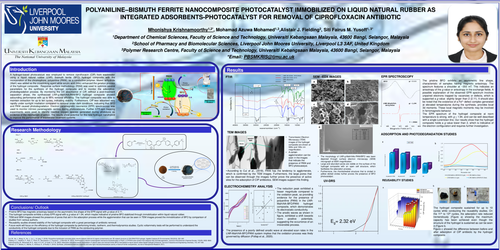
POLYANILINE–BISMUTH FERRITE NANOCOMPOSITE PHOTOCATALYST IMMOBILIZED ON LIQUID NATURAL RUBBER AS INTEGRATED ADSORBENTS-PHOTOCATALYST FOR REMOVAL OF CIPROFLOXACIN ANTIBIOTIC
Mhonishya Krishnamoorthy1,2*, Mohamad Azuwa Mohamed1,3,Alistair J. Fielding2, Siti Fairus M. Yusoff1, 3*
1Department of Chemical Sciences, Faculty of Science and Technology, Universiti Kebangsaan Malaysia, 43600 Bangi, Selangor, Malaysia
2School of Pharmacy and Biomolecular Sciences, Liverpool John Moores University, Liverpool L3 3AF, United Kingdom
3Polymer Research Centre, Faculty of Science and Technology, Universiti Kebangsaan Malaysia, 43600 Bangi, Selangor, Malaysia
*Email: PBSMKRIS@ljmu.ac.uk
INTRODUCTION
A hydrogel-based photocatalyst was employed to remove ciprofloxacin (CIP) from wastewater using a liquid natural rubber (LNR) /bismuth ferrite (BFO) hydrogel composite with the incorporation of the chromophore, polyaniline (PANI), as a conductive polymer. Maleic anhydride (MaH) was added as the crosslinking agent while acrylic acid (AAc) enhanced the gelation process of the hydrogel composite. Response surface methodology (RSM) was used to optimize several parameters for the synthesis of the hydrogel composite and to monitor the adsorptive-photodegradation process. By monitoring the UV absorbance of CIP, without a post-treatment separation phase, the synthesized LNR-g-MaH/AA-PANI/BFO hydrogel composite showed astounding performance with up to 95% removal efficiency. The hydrogel composite was able to maintain extraction for up to ten cycles, indicating stability. Furthermore, CIP was adsorbed very rapidly under sunlight irradiation compared to removal under dark conditions, indicating that BFO and PANI caused photodegradation. Electron paramagnetic resonance (EPR) spectroscopy was used to monitor intrinsic paramagnetic centres during photocatalysis. Further EPR-spin trapping experiments were used to identify reactive oxygen species generated during photolysis as evidence of the mechanism of action. The results show potential for the new hydrogel nanohybrid to improve the performance of wastewater treatment systems.