253 posters, 14 videos, 27 audios, 14 topics, 392 authors, 132 institutions
ePostersLive by SciGen Technologies S.A. All rights reserved.
4th Commonwealth Chemistry Posters
October 4 - 5, 2023 | Online, United Kingdom

P59
A Theoretical Investigation into the Application of Nanoscale Zero Valent Iron for Groundwater Contaminant Removal
Poster Presenter
Authors
Affiliations
Part of Topic
Clean water and sanitation
Video
A Theoretical Investigation into the Application of Nanoscale Zero Valent Iron for Groundwater Contaminant Removal
Motivation:
•Groundwater is a vital resource worldwide, with over 2.5 billion people using it as their primary source of drinking water
•However, our waterways are becoming increasingly polluted with a wide variety of contaminants due to agricultural, industrial and mining use
•Chlorinated organic compounds such as cis-DCE, PCE and TCE can lead to serious health issues such as cancers and other chronic diseases
•Contaminated water not only has dire consequences for human health but also for the surrounding environment, which in turn impacts the well-being and livelihood of the population
•Worldwide, there are incidents of residents living in towns near contaminated water sources suffering from severe health issues
•One example is Cabbage Tree Road in rural New South Wales, Australia, where the residents noticed a high rate of diagnosed cancers. The cause was traced back to contaminated groundwater from the old flying base where PFAS (a common chemical used in fire fighting foams) was used. As groundwater is connected to surface water, this contaminant not only affected humans but even livestock such as cow’s milk and chicken eggs
What can we do?
Investigate nanoscale zero valent iron (nZVI) as a remediation material:
•great reductant
•high reactivity
•greater surface area
HOWEVER: nZVI is susceptible to corrosion, therefore S-nZVI has been gaining popularity
Investigation:
•Although experimentally, there have been studies showing the success of nZVI in the remediation of contaminants, it struggles to give information at an atomic level, such as the remediation pathways. This makes it challenging to enhance the material to its optimal level
•
•This study therefore uses theoretical methods Density Functional Theory and Ab Initio Molecular Dynamics (DFT and AIMD) to gain a better insight into the atomic level of the nZVI/water contaminant interface
•
•Three chlorinated organic compounds (cis-DCE, TCE and PCE) were chosen due to their high toxicity and concentration in groundwater
Clues:
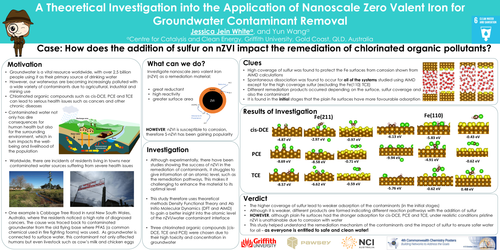
•High coverage of sulfur was found to protect the Fe surfaces from corrosion shown from AIMD calculations
•Spontaneous dissociation was found to occur for all of the systems studied using AIMD except for the high coverage sulfur (excluding the Fe(110) TCE)
•Different remediation products occurred depending on the surface, sulfur coverage and also the contaminant
•It is found in the initial stages that the plain Fe surfaces have more favourable adsorption
Verdict:
•The higher coverage of sulfur lead to weaker adsorption of the contaminants (in the initial stages)
•Although it is weaker, different products are formed indicating different reaction pathways with the addition of sulfur
•HOWEVER, although plain Fe surfaces had the stronger adsorption for cis-DCE, PCE and TCE, under realistic conditions pristine nZVI is unattainable due to corrosion with water
•This study helped understand the remediation mechanism of the contaminants and the impact of sulfur to ensure safer water for all – as everyone is entitled to safe and clean water!