253 posters, 14 videos, 27 audios, 14 topics, 392 authors, 132 institutions
ePostersLive by SciGen Technologies S.A. All rights reserved.
4th Commonwealth Chemistry Posters
October 4 - 5, 2023 | Online, United Kingdom

P44
A 50-year record for perfluoroalkyl acids in the High Arctic: Implications for global and local transport
Poster Presenter
Authors
Part of Topic
Clean water and sanitation
A 50-year Record of Perfluoroalkyl Acids in the High Arctic: Implications for Global and Local Transport
Daniel Persaud1, Alison S. Criscitiello2, Christine Spencer3, Igor Lehnherr4, Derek C G. Muir3, Amila O. De Silva3, and Cora J. Young1
1Department of Chemistry, York University, Toronto, ON, 2Department of Earth and Atmospheric Sciences, University of Alberta, Edmonton, Alberta, Canada. 3Aquatic Contaminants Research Division, Environmental and Climate Change Canada, Burlington, Ontario, Canada. 4Department of Geography, Geomatics and Environment, University of Toronto-Mississauga, Mississauga, Ontario, Canada
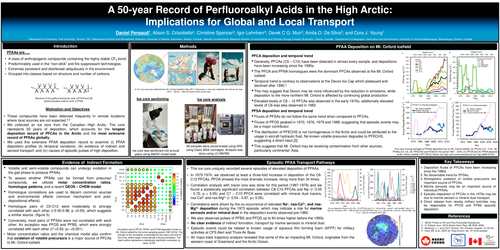
Perfluoroalkyl acids (PFAAs) are persistent compounds that are ubiquitous globally, though long-range transport mechanisms remain uncertain. They are frequently detected in pristine locations, where local sources may be unimportant. Our study investigates PFAA deposition trends and transport mechanism using a 16.5 metre ice core collected on northern Ellesmere Island, Nunavut, Canada. This work represents fifty years of deposition (1967-2016), which accounts for the most extensive deposition record of perfluoroalkylcarboxylic acids (PFCAs) in the Arctic and the most extensive record of perfluoroalkylsulfonic acids (PFSAs) globally. PFCAs were detected frequently after the 1990s and have been increasing since. Homologue pair correlations, molar concentration ratios, and model comparisons all suggest that PFCAs are primarily formed through oxidation of volatile precursors. PFSAs showed no discernable trend, with concentrations at least an order of magnitude lower than PFCAs. We also observed episodic deposition of some PFSAs, notably perfluorooctane sulfonic acid (PFOS) and perfluorobutane sulfonic acid (PFBS) before the 1990s, which may be linked to nearby Arctic military activities. Tracer analysis suggests that sea spray and mineral dust are relevant as transport vectors for selected PFAAs. These observations highlight the complex mechanisms responsible for the transport and deposition of PFAAs in the High Arctic