253 posters, 14 videos, 27 audios, 14 topics, 392 authors, 132 institutions
ePostersLive by SciGen Technologies S.A. All rights reserved.
4th Commonwealth Chemistry Posters
October 4 - 5, 2023 | Online, United Kingdom

P41
Effect of different parameters on photocatalytic degradation to remove pesticide intermediates and synthetic dyes in water
Poster Presenter
Authors
Part of Topic
Clean water and sanitation
Audio
Effect of Different Parameters on Photocatalytic Degradation to Remove Pesticides Intermediates and Synthetic Dyes in Water
S S A Fernando1 U S K Weliwegamage1 G W C S Perera1
College of Chemical Sciences, Institute of Chemistry Ceylon, welikada, Rajagiriya,10107, Sri Lanka.
Introduction
• water pollution due to pesticides and organic pollutants is a serious environmental problem that can harm the ecosystem and human health.
• photocatalytic degradation is a promising technology for the removal of pesticides and organic pollutants as it is effective, environmentally friendly, and cost- effective.
• photocatalytic degradation depends on such as radiation type, pH of the solution, type of photocatalyst, particle size, Initial concentration of dyes and pesticide precursors, amount of H2O2 concentration, reaction temperature, and photocatalyst load.
Methodology
Different parameters were changed in the solution
Dark Adsorption Process was carried out
Then Beakers of samples were kept under UV light
Absorbance was measured in 30-minute time intervals
Results and Discussion
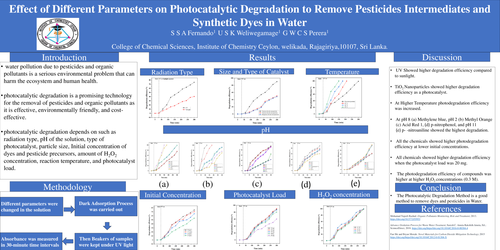
UV Showed higher degradation efficiency compared to sunlight.
TiO2 Nanoparticles showed higher degradation efficiency as a photocatalyst.
At Higher Temperature photodegradation efficiency was increased.
At pH 8 (a) Methylene blue, pH 2 (b) Methyl Orange (c) Acid Red 1, (d) p-nitrophenol, and pH 11
(e) p- -nitroaniline showed the highest degradation.
All the chemicals showed higher photodegradation efficiency at lower initial concentrations.
All chemicals showed higher degradation efficiency when the photocatalyst load was 20 mg.
The photodegradation efficiency of compounds was higher at higher H2O2 concentrations (0.3 M).
Conclusion
The Photocatalytic Degradation Method is a good method to remove dyes and pesticides in Water.
References
Mohamad Najeeb Rashed. Organic Pollutants Monitoring, Risk and Treatment; 2013. https://doi.org/10.5772/55953
Advance Oxidation Process for Waste Water Treatment; Suresh C. Ameta Rakshith Ameta, Ed.; ScienceDirect, 2018. https://doi.org/https//doi.org/10.1016/C2016-0-00384-4
Fan Shi and Bryan Morale. Novel Materials for Carbon Dioxide Mitigation Technology; 2015 https://doi.org/https//doi.org/10.1016/C2012-0-01304-