253 posters, 14 videos, 27 audios, 14 topics, 392 authors, 132 institutions
ePostersLive by SciGen Technologies S.A. All rights reserved.
4th Commonwealth Chemistry Posters
October 4 - 5, 2023 | Online, United Kingdom

P178
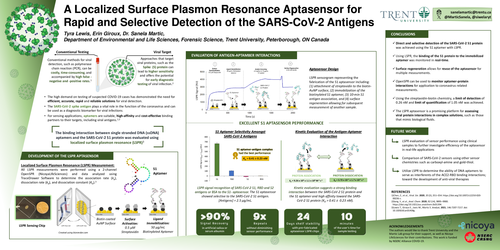
A Localized Surface Plasmon Resonance Aptasensor for Rapid and Selective Detection of the SARS-CoV-2 Antigens
Poster Presenter
Authors
Affiliations
Part of Topic
Good health and well-being
A Localized Surface Plasmon Resonance Aptasensor for Rapid and Selective Detection of the SARS-CoV-2 Antigens
Tyra Lewis, Erin Giroux, Dr. Sanela Martic,
Department of Environmental and Life Sciences, Forensic Science, Trent University, Peterborough, ON Canada
Conventional Testing
Conventional methods for viral detection, such as polymerase chain reaction (PCR), can be costly, time-consuming, and accompanied by high false -negative and -positive rates.1
Viral Target
Approaches that target viral proteins, such as the Spike (S) protein can lead to higher sensitivity and offers the potential for early diagnostic testing of viral infection.2
The binding interaction between single stranded DNA (ssDNA) aptamers and the SARS-CoV-2 S1 protein was evaluated using localized surface plasmon resonance (LSPR).3
DEVELOPEMENT OF THE LSPR APTASENSOR
Localized Surface Plasmon Resonance (LSPR) Measurement:
All LSPR measurements were performed using a 2-channel OpenSPR (NicoyaLifeSciences) and data analyzed using TraceDrawer Software to determine the association rate (ka), dissociation rate (kd), and dissociation constant (KD).3
EVALUATION OF ANTIGEN-APTAMER INTERACTIONS
Aptamer Design
LSPR sensorgram representing the fabrication of the S1 aptasensor including: (1) attachment of streptavidin to the biotin-AuNP surface, (2) immobilization of the biotinylated S1 aptamer, (3) 10-min S1 antigen association, and (4) surface regeneration allowing for subsequent measurement of another sample.
S1 Aptamer Selectivity Amongst SARS-CoV-2 Antigens
S1 aptamer-antigen complex had the best performance KD = 0.41 +/- 0.23 nM. LSPR signal recognition of SARS-CoV-2 S1, RBD and S2 antigens or BSA to the S1- aptasensor. The S1 aptasensor showed selective to the SARS-CoV-2 S1 antigen. [Antigens] = 2.5 μg/mL.
Kinetic Evalutation of the Antigen-Aptamer Interaction
Kinetic evaluation suggests a strong binding interaction between the SARS-CoV-2 S1 protein and the S1 aptamer and high affinity toward the SARS-CoV-2 S1 protein (KD = 0.41 ± 0.23 nM).
CONCLUSIONS
FUTUTRE WORK
LSPR evaluation of sensor performance using clinical samples to further investigate efficiency of the aptasensor in real-life applications
Comparison of SARS-CoV-2 sensors using other sensor chemistries such as carboxyl-amine and gold-thiol.
Utilize LSPR to determine the ability of DNA aptamers to serve as interferents of the ACE2-RBD binding interactions; toward the development of anti-viral therapies
REFERENCES
ACKNOWLEDGEMENTS
The authors would like to thank Trent University and the Martic Lab group for their support, as well as Nicoya LifeSciences for their contributions. This work is funded by NSERC Alliance COVID-19.