253 posters, 14 videos, 27 audios, 14 topics, 392 authors, 132 institutions
ePostersLive by SciGen Technologies S.A. All rights reserved.
4th Commonwealth Chemistry Posters
October 4 - 5, 2023 | Online, United Kingdom

P177
Fabrication of hybrid polycaprolactone nanofibers enriched with curcumin, zinc oxide and titanium dioxide nanoparticles for wound dressing applications
Poster Presenter
Authors
Part of Topic
Good health and well-being
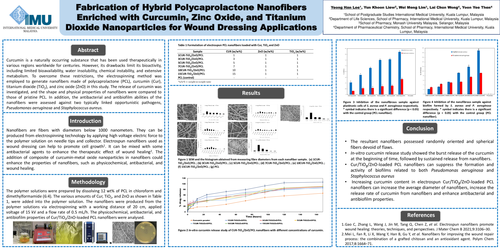
Fabrication of Hybrid Polycaprolactone Nanofibers Enriched with Curcumin, Zinc Oxide, and Titanium Dioxide Nanoparticles for Wound Dressing Applications
Curcumin is a naturally occurring substance that has been used therapeutically in various regions worldwide for centuries. However, its drawbacks limit its bioactivity, including limited bioavailability, water insolubility, chemical instability, and extensive metabolism. To overcome these restrictions, the electrospinning method was employed to generate nanofibers made of polycaprolactone (PCL), curcumin (Cur), titanium dioxide (TiO2), and zinc oxide (ZnO) in this study. The release of curcumin was investigated, and the shape and physical properties of nanofibers were compared to those of pristine PCL. In addition, the antibacterial and antibiofilm abilities of the nanofibers were assessed against two typically linked opportunistic pathogens, Pseudomonas aeruginosa and Staphylococcus aureus.
Nanofibers are fibers with diameters below 1000 nanometers. They can be produced from electrospinning technology by applying high voltage electric force to the polymer solution on needle tips and collector. Electrospun nanofibers used as wound dressing can help to promote cell growth1. It can be mixed with some antibacterial agents to enhance the therapeutic effect of wound healing2. The addition of composite of curcumin-metal oxide nanoparticles in nanofibers could enhance the properties of nanofibers, such as physicochemical, antibacterial, and wound healing.
The polymer solutions were prepared by dissolving 12 wt% of PCL in chloroform and dimethylformamide (6:4). The various amounts of Cur, TiO2, and ZnO as shown in Table 1, were added into the polymer solution. The nanofibers were produced from the polymer solutions via electrospinning with a working distance of 20 cm, applied voltage of 15 kV and a flow rate of 0.5 mL/h. The physicochemical, antibacterial, and antibiofilm properties of Cur/TiO2/ZnO-loaded PCL nanofibers were analysed.