253 posters, 14 videos, 27 audios, 14 topics, 392 authors, 132 institutions
ePostersLive by SciGen Technologies S.A. All rights reserved.
4th Commonwealth Chemistry Posters
October 4 - 5, 2023 | Online, United Kingdom

P176
Smart Topical Patches: Applications in Dual-Action Treatment Against Microbial Infections
Part of Topic
Good health and well-being
Smart Topical Patches: Applications in Dual-Action Treatment Against Microbial Infections
Tejesvi Patel1, Roselyn Lata1, Reeha Sharma1 and David Rohindra1*
1School of Agriculture, Geography, Environment, Oceans and Natural Sciences
The University of the South Pacific, Suva, Fiji
Introduction
•There has been an increase in microbial skin infections due to rising global temperatures.
•Conventional treatment methods have drawbacks in that they are not site specific, are slow acting and require constant reapplication.
•Polyvinylpyrrolidone (PVP) is a biocompatible polymer that is used in various medical application.
•Tannic Acid (TA) is a natural polyphenol that has the potential to be used in wound dressing.
•The purpose of this study was to prepare hydrogels of PVP by crosslinking with TA and loading with an antifungal drug, Nystatin (NYS).
Methodology
•PVP/TA/NYS hydrogels were prepared.
Results and Discussion
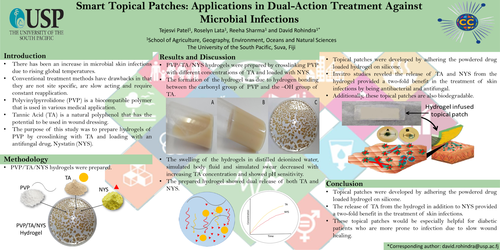
•PVP/TA/NYS hydrogels were prepared by crosslinking PVP with different concentrations of TA and loaded with NYS.
•The formation of the hydrogel was due to hydrogen bonding between the carbonyl group of PVP and the –OH group of TA.
•The swelling of the hydrogels in distilled deionized water, simulated body fluid and simulated swear decreased with increasing TA concentration and showed pH sensitivity.
•The prepared hydrogel showed dual release of both TA and NYS.
•Topical patches were developed by adhering the powdered drug loaded hydrogel on silicone.
•Invitro studies reveled the release of TA and NYS from the hydrogel provided a two-fold benefit in the treatment of skin infections by being antibacterial and antifungal.
•Additionally, these topical patches are also biodegradable.
Conclusion
•Topical patches were developed by adhering the powdered drug loaded hydrogel on silicone.
•The release of TA from the hydrogel in addition to NYS provided a two-fold benefit in the treatment of skin infections.
•These topical patches would be especially helpful for diabetic patients who are more prone to infection due to slow wound healing.
*Corresponding author: david.rohindra@usp.ac.fj