253 posters, 14 videos, 27 audios, 14 topics, 392 authors, 132 institutions
ePostersLive by SciGen Technologies S.A. All rights reserved.
4th Commonwealth Chemistry Posters
October 4 - 5, 2023 | Online, United Kingdom

P169
Thin Layer Chromatographic Profiling and Antioxidant Activity of Extracts from a Muscadine Grape Skin Commercial Preparation
Poster Presenter
Authors
Part of Topic
Good health and well-being
Thin Layer Chromatographic Profiling and Antioxidant Activity of Extracts from a Muscadine Grape Skin Commercial Preparation
Sian Ramdass1,2 , Milena Mechkarska1
1Department of Life Sciences, 2Department of Chemical Engineering, The UWI, St. Augustine, Trinidad and Tobago
Introduction:
The muscadine grape Vitis rotundifolia:
• is a rich source of bioactive secondary metabolites - potential for development into anticancer therapeutic agents;
• has increased levels of polyphenolic compounds relative to other grape species - thus, able to suppress the growth of cancer cells (Mendonca et al., 2019);
• contains high amount of natural antioxidants (phenolic compounds & other phytochemical compounds) - ability to reduce/prevent free radical-mediated oxidative damage of cells; protective effect against certain cancers (Dawish et al., 2023, Sandhu and Gu, 2010).
Our preliminary research revealed that the dichloromethane extract from a commercially available muscadine grape skin has high cytotoxic potency against PC-3 prostate cancer cells [the concentration that inhibits cell growth by 50% (IC50) = 0.714µg/mL].
Objectives:
1. To determine the phenolic content and the in vitro antioxidant activity of various extracts from the grape skin of a muscadine cultivar.
2. To calculate their subsequent correlation with the cytotoxic activities.
3. To assess the phytochemical constituents of the extracts with the highest content/activity.
Methodology:
Presented as a schematic diagram
Results & Summary:
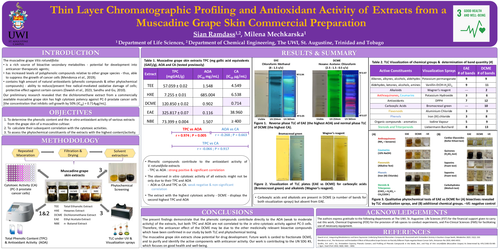
• Phenolic compounds contribute to the antioxidant activity of V. rotundifolia extracts - TPC vs AOA : strong positive & significant correlation
• The observed in vitro cytotoxic activity of all extracts might not be only due to their TPC and AOA - AOA vs CA and TPC vs CA: weak negative & non-significant correlation
• The extract with the highest cytotoxic activity - DCME - displays the second highest TPC and AOA
• Carboxylic acids and alkaloids are present in DCME (a number of bands for both visualization sprays) but absent from EAE.
Conclusions:
The present findings demonstrate that the phenolic compounds contribute directly to the AOA (weak to moderate activity) of the extracts, but both TPC and AOA are not correlated to the in vitro cytotoxic activity against PC-3 cells. Therefore, the anticancer effect of the DCME may be due to the other medicinally relevant bioactive compounds which have been confirmed in our study by both TLC and phytochemical testing. The muscadine grape skin extracts show potential for drug development. Future work is carded to fractionate DCME, and to purify and identify the active components with anticancer activity. Our work is contributing to the UN SDG #3, which focuses on good health and well-being.
Acknowledgements:
The authors express gratitude to the following departments at The UWI, St. Augustine: Life Sciences (FST) for the financial support given to carry out this work, Chemical Engineering (FOE) for the provision of lab spaces to conduct experiments, and Pre-Clinical Sciences (FMS) for facilitating use of necessary equipment.
References:
Dawish et al., Integrating Metabolomics and Gene Expression Underlying Potential Biomarkers Compounds Associated with Antioxidant Activity in Southern Grape Seeds, Metabolites 2023, 13(2): 210.
Mendonca et al., The Anticancer and Antioxidant Effects of Muscadine Grape Extracts on Racially Different Triple-negative Breast Cancer Cells, Anticancer Res 2019, 4043-4053.
Sandhu, A.K. and L. Gu, Antioxidant Capacity, Phenolic Content, and Profiling of Phenolic Compounds in the Seeds, Skin, and Pulp of Vitis rotundifolia (Muscadine Grapes) As Determined by HPLC-DAD-ESI-MS . J. Agric. Food Chem 2010, 58(8): 4681 – 4692