253 posters, 14 videos, 27 audios, 14 topics, 392 authors, 132 institutions
ePostersLive by SciGen Technologies S.A. All rights reserved.
4th Commonwealth Chemistry Posters
October 4 - 5, 2023 | Online, United Kingdom

P163
Nanoscale lipid drug conjugates as an efficient and alternative wound healing agent compared to conventional therapeutic agents.
Poster Presenter
Authors
Affiliations
Part of Topic
Good health and well-being
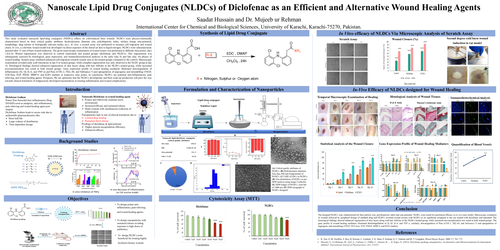
This study evaluated nanoscale lipid-drug conjugates (NSDCs) effects on cold-induced burn wounds. NLDCs were physico-chemically characterized based on their critical quality attributes (hydrodynamic diameter size, polydispersity index, surface charge zeta-potential, morphology, drug release in biologically relevant media, etc.). In vitro, a scratch assay was performed to measure cell migration and wound closer. In vivo, a cold burn wound model was developed via direct exposure of the dorsal rat skin to liquid nitrogen. NLDCs were subcutaneously injected after 15 min of burn wound induction. The gross macroscopic examination of wound tissues was performed at different time points; days 1,4,8,16. Wound regeneration was observed in control (untreated) and treated groups (diclofenac and NLDCs). This regeneration was subsequently assessed by histological, gene expression, and immunohistochemical analyses at the early (day 8) and late (day 16) phases of wound healing. Scratch assay exhibited enhanced cell migration towards scratch area in the treated groups compared to the control. Macroscopic examination revealed early scab formations at day 8 in treated groups, while complete regeneration was only observed in the NLDC group at day 16. Histological findings showed enhanced regeneration of skin layers along with hair follicles in the NLDCs-treated group, while increased neovascularization was noted in both treated groups. Gene expression profile of wound healing mediators illustrated downregulation of inflammatory (IL-1β, IL-6, and TNF α) and Pain (COX-2, YKL-40, and Substance-7) and upregulation of angiogenic and remodeling (VEGF, TGF-beta, FGF, PDGF, MMP-9, and EGF) markers at respective time points. In conclusion, NLDCs are potential anti-inflammatory, pain relieving, and wound-healing agents. Prospects; We are optimistic that the NLDCs development and their scale-up production will pave the way towards clinical translation of indigenously developed nanomedicine in treating inflammation and wound complications.