253 posters, 14 videos, 27 audios, 14 topics, 392 authors, 132 institutions
ePostersLive by SciGen Technologies S.A. All rights reserved.
4th Commonwealth Chemistry Posters
October 4 - 5, 2023 | Online, United Kingdom

P159
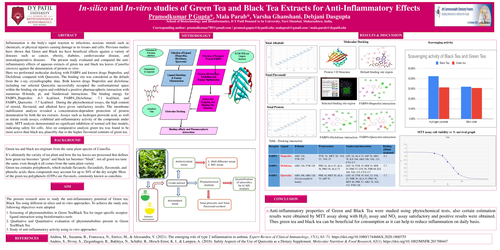
In-silico and in-vitro studies of green tea and black tea extracts for anti-inflammatory effects
Part of Topic
Good health and well-being
Title: In-silico and In-vitro studies of Green Tea and Black Tea Extracts for Anti-Inflammatory Effects
Author: Pramodkumar P Gupta*, Mala Parab*, Varsha Ghanshani, Debjani Dasgupta
Affiliation: School of Biotechnology and Bioinformatics, D Y Patil Deemed to be University, Navi Mumbai, Maharashtra, India.
Corresponding author: pramodkumar785@gmail.com / pramod.gupta@dypatil.edu; malaprab@gmail.com / mala.parab@dypatil.edu
Abstract:
Inflammation is the body's rapid reaction to infections, noxious stimuli such as chemicals, or physical injuries causing damage to its tissues and cells. Previous studies have shown that Green and Black tea have beneficial effects against a variety of diseases such as cancer, obesity, diabetes, cardiovascular disease, and neurodegenerative diseases. The present study evaluated and compared the anti-inflammatory effects of aqueous extracts of green tea and black tea leaves (Camellia sinensis) against the denaturation of protein in vitro.
Here we performed molecular docking with FABP4 and known drugs Ibuprofen, and Diclofenac compared with Quercetin. The binding site was considered as the default from the x-ray crystallographic data. Both known drugs Ibuprofen and diclofenac including our selected Quercetin successfully occupied the conformational space within the binding site region and exhibited a positive pharmacophoric interaction with numerous H-bonds, pi, and Vanderwaal interactions. The binding energy for FABP4_Ibuprofen: -6.3 kcal/mol, FABP4_Diclofenac: -7.1 kcal/mol, and FABP4_Quercetin: -7.7 kcal/mol. During the phytochemical essays, the high content of steroid, flavonoid, and alkaloid have given satisfactory results. The membrane stabilization analysis revealed a concentration-dependent protection of protein denaturation by both the tea extracts. Assays such as hydrogen peroxide acid, as well as nitrate oxide assays, exhibited anti-inflammatory activity of the compounds under study. MTT analysis demonstrated no significant inhibition of normal cell line models, indicating safety for cells. Also on comparative analysis green tea was found to be more active than black tea, plausibly due to the higher flavonoid contents of green tea.
Background:
Green tea and black tea originate from the same plant species of Camellia.
It’s ultimately the variety of tea plant and how the tea leaves are processed that defines how green tea becomes “green” and black tea becomes “black”. not all green tea taste the same, even though it all comes from the same plant variety
Green tea contains polyphenols, which include flavanols, flavandiols, flavonoids, and phenolic acids; these compounds may account for up to 30% of the dry weight. Most of the green tea polyphenols (GTPs) are flavonols, commonly known as catechins.
Aim:
The present research aims to study the anti-inflammatory potential of Green tea, Black Tea using different in-silico and in-vitro approaches. To achieve the study aim, following objectives were adopted
Conclusion:
References:
Andrea, M., Susanna, B., Francesca, N., Enrico, M., & Alessandra, V. (2021). The emerging role of type 2 inflammation in asthma. Expert Review of Clinical Immunology, 17(1), 63–71. https://doi.org/10.1080/1744666X.2020.1860755
Andres, S., Pevny, S., Ziegenhagen, R., Bakhiya, N., Schäfer, B., Hirsch-Ernst, K. I., & Lampen, A. (2018). Safety Aspects of the Use of Quercetin as a Dietary Supplement. Molecular Nutrition & Food Research, 62(1). https://doi.org/10.1002/MNFR.201700447