253 posters, 14 videos, 27 audios, 14 topics, 392 authors, 132 institutions
ePostersLive by SciGen Technologies S.A. All rights reserved.
4th Commonwealth Chemistry Posters
October 4 - 5, 2023 | Online, United Kingdom

P151
Evaluation of Cell Viability of (Zn)CuInS/ZnS-TPPS₄ Conjugates Against Various Cell Lines as a Potential Fluorescent Probe
Poster Presenter
Part of Topic
Good health and well-being
Title: Evaluation of Cell Viability of (Zn)CuInS/ZnS-TPPS₄ Conjugates Against Various Cell Lines as a Potential Fluorescent Probe
1. Background:
Quantum dots (QDs) are fluorescent semiconductor materials having optoelectronic, shape, and size-dependent capabilities that outperform other nanomaterials [1]. Toxic materials utilized in synthesizing group II-VI (e.g., CdSe) and group IV-VI (e.g., PbTe) based QDs have prompted health and environmental concerns. This has necessitated the search for alternatives to traditional binary QDs. Many of the drawbacks of binary QDs have been solved by quaternary QDs (e.g., ZnCuInS/ZnS) consisting of group I-III-VI elements. Porphyrins are cyclic macromolecule dyes that are widely employed in the treatment of cancer and various non-malignant illnesses. They are great light harvesters because they can generate singlet oxygen and reactive oxygen species necessary to eradicate tumors. Porphyrins have desirable properties such as low dark toxicity, high molecular singlet oxygen generation, and other bio-advantageous properties [2], but they also have several biological drawbacks such as poor bio-distribution, low bio-specificity, and low activity under physiological conditions [3]. The increased interest in developing innovative multi-functional materials that can be efficiently fine-tuned to operate as photosensitizers and other distinct photochemical functions has led to the coupling of porphyrins to nanomaterials. As a result, porphyrin nanomaterial conjugates have expanded into domains where porphyrins or QDs alone would be insufficient. The anionic 10,15,20-(4-sulphonatophenyl) porphyrin (TPPS4) has sparked interest due to its high water dispersibility, stability, and capacity to create singlet oxygen. Herein, we present the synthesis of ZnCuInS/ZnS QDs, TPPS4 and ZnCuInS/ZnS QDs-TPPS4 conjugate as a promising material for imaging and phototherapy applications.
2. Aims and Objectives:
Aim: Synthesis QDs –porphyrin conjugates as fluorescent probes for biological application.
Objective (s) : The objective of the study were :
(1) Synthesis luminescent, water soluble and bio-compatible ZnCuInS/ZnS QDs.
(2) Synthesis TPPS4 porphyrins and their QDs conjugates (ZnCuInS/ZnS–TPPS4).
(3) Evaluation of the bio-compatibility of the conjugates and potential use as fluorescent bio-probes.
3. Methodology:
Synthesis of ZnCuInS/ZnS QDs: As per scheme 1 (refer to poster)
Synthesis of TPPS4: 0.3952 g TPPH2 + 10 mL H2SO4 heated at 141◦ C for 6 h. The green residue was washed with 12 mL acetone, allowed to dry, neutralized using NaHCO3. and rewashed with CH3OH. The solid brown residue formed was then oven dried and recrystallized with CH3CH2OH/CH3OH (1:5). Distilled water was used to dissolve the product to form TPPS4 porphyrin.
Synthesis of ZnCuInS/ZnS QDs- TPPS4: As per scheme 2 (refer to poster)
Characterization: The synthesized materials were characterized using: Ultraviolet-Visible spectrophotometry (UV–Vis), Energy Dispersive (EDS), Transmission Electron Microscopy (TEM), Photoluminescence (PL) and Fourier-Transform Infrared spectroscopy (FT-IR).
4. Results and discussion:
4.1. Characterization of ZnCuInS/ZnS Quantum Dots
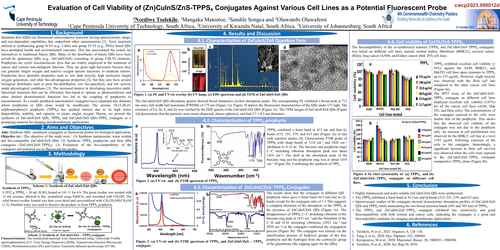
The ZnCuInS/ZnS QDs absorption spectra showed broad featureless exciton absorption peaks. The corresponding PL exhibited a broad peak at 713 nm and a full-width half maximum (FWHM) of 175 nm (Figure 1a). Figure 1b depicts the fluorescent characteristics of the QDs under UV light. The existence of Cu, In, S, and Zn was verified by the EDS spectra of the ZnCuInS/ZnS QDs (Figure 1c). The TEM images of ZnCuInS/ZnS QDs (Figure 1d) demonstrate that the particles were mono-dispersed, almost spherical, and had 2.7 ± 0.5 nm diameters.
4.2. Characterization of TPPS4 porphyrin
TPPS4 exhibited a Soret band at 412 nm and four Q-bands (515, 551, 579, and 633 nm) (Figure 2a) in line with reported studies [4]. Characteristic FTIR peaks of TPPS4 with sharp bands at 1118 cm−1 and 1026 cm−1 attributed to S–O str. The benzene and porphyrin rings' C–C stretching vibration absorption peak was about 1419 cm−1. The shift in the absorption peak of the benzene ring and the porphyrin ring was at about 1419 cm−1 (Figure 2b). Confirming the synthesis of TPP4.
4.3. Characterization of ZnCuInS/ZnS- TPPS4 Conjugates
The results show that the conjugate at different QD : porphyrin ratios gave a Soret band (413 nm) but no Q-bands except for the conjugate ratio of 1:1 This suggests a complete alteration of the absorption of the TPPS4 in the presence of ZnCuInS/ZnS QDs (Figure 3a). The disappearance of TPPS4 C–C stretching vibration of the benzene ring peak at 1431 cm−1 and the formation of the C–H and O–H stretching vibrations (2923 cm−1 and 2850 cm−1) in the conjugate confirmed the conjugation process (Figure 3b). The conjugate was formed via the esterification process of hydroxyl groups of the free porphyrin and the hydrogen from the carboxylic group of the glutathione (the capping agent for the QDs).
4.4. Cell viability of ZnCIS/ZnS-TPPS4
The biocompatibility of the as-synthesized material (TPPS4 and ZnCuInS/ZnS–TPPS4 conjugate) was tested on different cell lines, namely normal kidney fibroblasts (BHK21), cervical cancer (Hela), lung cancer (A549), and kidney cancer (Hek 293) cell lines.
TPPS4 exhibited excellent cell viability (≥ 95%) against the A549, BHK21, and Hek293 cell lines upon exposure to TPPS4 up to 375 µg/mL. However, slight toxicity was observed with the Hela cell line compared to the other cancer cell lines (Figure 4a).
The MTT assay of the ZnCuInS/ZnS–TPPS4 conjugate on different cell lines displayed excellent cell viability (≥97%) for all the cancer cell lines (A549, Hek 293, and Hela cells). The concentrations of the conjugate exposed to the cells were double that of the porphyrin. This shows that the observed cell viability of the conjugate was not due to the porphyrin only. An increase in cell proliferation was observed for the BHK21 cell line at a level ≥193 µg/mL following exposure of the cells to the conjugate. Interestingly, a significant increase in Hela cell survival was observed when the cells were exposed to the ZnCuInS/ZnS–TPPS4 conjugate compared to TPPS4 alone (Figure 4b).
5. Conclusion
6. References