253 posters, 14 videos, 27 audios, 14 topics, 392 authors, 132 institutions
ePostersLive by SciGen Technologies S.A. All rights reserved.
4th Commonwealth Chemistry Posters
October 4 - 5, 2023 | Online, United Kingdom

P141
An electrochemical immunosensor based on ensemble protein labelling for point-of-care diagnostic applications
Poster Presenter
Part of Topic
Good health and well-being
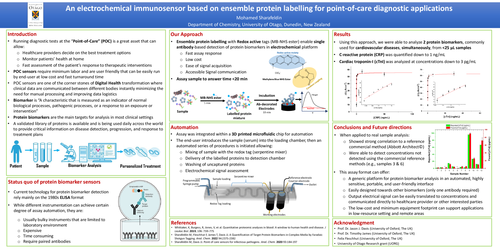
An electrochemical immunosensor based on ensemble protein labelling for point-of-care diagnostic applications
•Running diagnostic tests at the “Point-of-Care” (POC) is a great asset that can allow:
oHealthcare providers decide on the best treatment options
oMonitor patients’ health at home
oFast assessment of the patient’s response to therapeutic interventions
•POC sensors require minimum labor and are user friendly that can be easily run by end-user at low cost and fast turnaround time
•POC sensors are one of the corner stones of Digital Health transformation where clinical data are communicated between different bodies instantly minimizing the need for manual processing and improving data logistics
•Biomarker is “A characteristic that is measured as an indicator of normal biological processes, pathogenic processes, or a response to an exposure or intervention”
•Protein biomarkers are the main targets for analysis in most clinical settings
•A validated library of proteins is available and is being used daily across the world to provide critical information on disease detection, progression, and response to treatment plans
•Current technology for protein biomarker detection rely mainly on the 1980s ELISA format
•While different instrumentation can achieve certain degree of assay automation, they are:
oUsually bulky instruments that are limited to laboratory environment
oExpensive
oTime consuming
oRequire paired antibodies
•Ensemble protein labelling with Redox active tags (MB-NHS ester) enable single antibody-based detection of protein biomarkers in electrochemical platform
oFast assay response
oLow cost
oEase of signal acquisition
oAccessible Signal communication
•Assay sample to answer time <20 min
•Assay was integrated within a 3D printed microfluidic chip for automation
•The end-user introduces the sample (serum) into the loading chamber, then an automated series of procedures is initiated allowing:
oMixing of sample with the redox tag (serpentine mixer)
oDelivery of the labelled proteins to detection chamber
oWashing of uncaptured proteins
Electrochemical signal assessment
•Using this approach, we were able to analyze 2 protein biomarkers, commonly used for cardiovascular diseases, simultaneously, from <25 µL samples
•C-reactive protein (CRP) was quantified down to 1 ng/mL
•Cardiac troponin-I (cTnI) was analyzed at concentrations down to 3 pg/mL
•When applied to real sample analysis:
oShowed strong correlation to a reference commercial method (Abbott Architect©)
oWere able to detect concentrations not detected using the commercial reference methods (e.g., samples 3 & 6)
•This assay format can offer:
oA generic platform for protein biomarker analysis in an automated, highly sensitive, portable, and user-friendly interface
oEasily designed towards other biomarkers (only one antibody required)
oOutput electrical signal can be easily translated to concentrations and communicated directly to healthcare provider or other interested parties
oThe low-cost and minimum equipment footprint can support applications in low-resource setting and remote areas