253 posters, 14 videos, 27 audios, 14 topics, 392 authors, 132 institutions
ePostersLive by SciGen Technologies S.A. All rights reserved.
4th Commonwealth Chemistry Posters
October 4 - 5, 2023 | Online, United Kingdom

P140
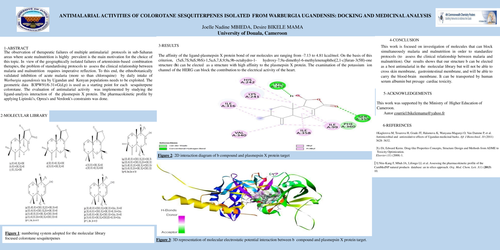
Antimalarial activities of colorotane sesquiterpenes isolated from Warburgia ugandensis: docking and medicinal analysis
Poster Presenter
Authors
Part of Topic
Good health and well-being
ABSTRACT
The observation of therapeutic failures of multiple antimalarial protocols in sub-Saharan areas where acute malnutrition is highly prevalent is the main motivation for the choice of this topic. In view of the geographically isolated failures of artemisinin-based combination therapies, the problem of standardising protocols to assess the clinical relationship between malaria and malnutrition requires imperative reflection. To this end, the ethnobotanically validated inhibition of acute malaria (more so than chloroquine) by daily intake of Warburgia ugandensis tea by Ugandan and Kenyan populations needs to be exploited. The geometric data B3PW91/6-31+G(d,p) is used as a starting point for each sesquiterpene colorotane. The evaluation of antimalarial activity was implemented by studying the ligand-analysis interaction of the plasmepsin X protein. The pharmacokinetic profile by applying Lipinski's, Oprea's and Verdonk's constraints was done.
RESULTS
The affinity of the ligand-plasmepsin X protein bond of our molecules are ranging from -7.13 to -4.81 kcal/mol. On the basis of this criterion, (5aS,7S,9aS,9bS)-1,5a,6,7,8,9,9a,9b-octahydro-1-hydroxy-7,9a-dimethyl-6-methylenenaphtho[2,1-c]furan-3(5H)-one structure (b) can be elected as a structure with high affinity to the plasmepsin X protein. The examination of the potassium ion channel of the HERG can block the contribution to the electrical activity of the heart.
CONCLUSION
This work is focused on investigation of molecules that can block simultaneously malaria and malnutrition in order to standardize protocols (to assess the clinical relationship between malaria and malnutrition). Our results shows that our structure b can be elected as a best antimalarial in the molecular library but will not be able to cross skin membrane, gastrointestinal membrane, and will be able to carry the blood-brain membrane. It can
ACKNOWLEDGEMENTS
This work was supported by the Ministry of Higher Education of Cameroon. Autor courriel:bikelemama@yahoo.fr
REFERENCES
1] Kuglerova M, Tesarova H, Grade JT, Halamova K, Wanyana-Maganyi O, Van Damme P, et al. Antimicrobial and antioxidative effects of Ugandan medicinal barks. Afr J Biotechnol. 10 (2011) 3628–3632.
[2] Li Di, Edward Kerns. Drug-like Properties Concepts, Structure Design and Methods from ADME to Toxicity Optimization. Elsevier (11) (2008) 1.
[3] Ntie-Kang F, Mbah JA, Lifongo LL et al. Assessing the pharmacokinetic profile of the CamMedNP natural products database: an in silico approach. Org. Med. Chem. Lett. 3(1) (2013) 10.